
How Modern Vehicles Are Becoming Safer Than Ever Before
The rising role of Anti-Lock Braking Systems in the future of transportation

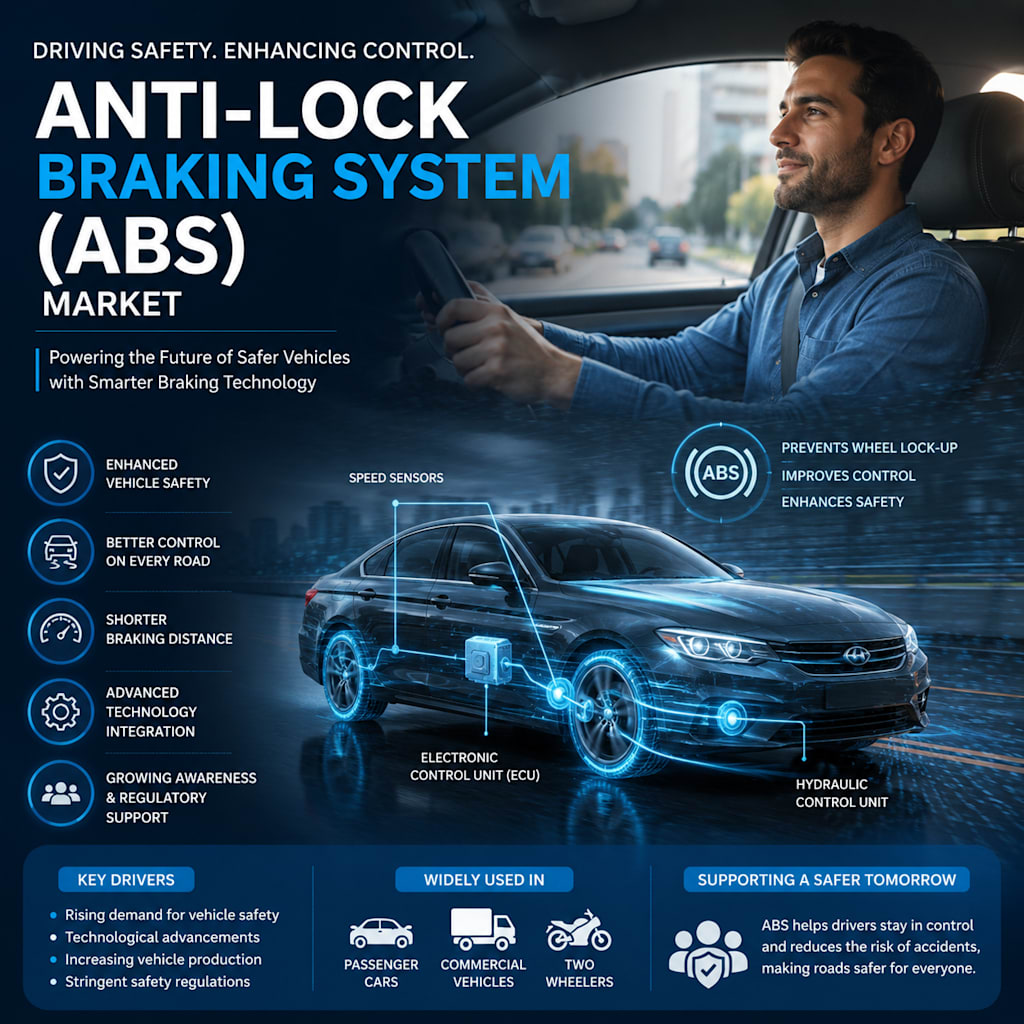
Road safety is no longer something limited to luxury cars and up-scale auto brands. It has now emerged as a critical factor throughout the entire automobile industry.
With traffic congestion increasing across many regions, vehicle ownership expanding and roads becoming more challenging for drivers worldwide, people are now looking for safer and smarter vehicles. Amongst the many technologies that enhances road safety, the anti-lock braking system (ABS) has continuously been one of the most significant in a vehicle’s background. Once known as the latest automotive safety innovation it is slowly turning out to be a must-have feature of modern vehicles.
A Market with Strong Global Growth
The global anti-lock braking system (ABS) market size was valued at approximately $54.1 billion in 2025 and industry experts predict it is expected to reach a staggering $99.9 billion by 2034.
This sustained growth has a compound annual growth rate (CAGR) of 6.85% in between 2026 to 2034. The growing demand is attributed to higher vehicle production, strengthening safety standards, innovations in technology and increased customer awareness in regards to automotive safety. With both regulators and manufacturers emphasizing on avoiding accidents more often, the role of ABS technology is expanding worldwide.
What exactly is an anti-lock braking system?
An anti-lock braking system (ABS) is a safety system designed to prevent a vehicle’s wheels from locking up while applying brakes. In sudden or heavy braking scenarios, locked wheels can cause loss of steering and thus lead to skidding or even a collision. ABS system aims to provide optimum stopping distances without sacrificing driver control in such emergencies. It does this by releasing and re-applying brakes rhythmically and very fast while controlling hydraulic pressure on each wheel. This system enables the driver to:
- Retain steering control of the vehicle.
- Avoid skidding the wheels and improve the risk of collision.
- Provide better braking on wet and slippery surfaces.
- Avoid obstacles effectively in case of emergencies.
In a nutshell, ABS gives the drivers control at times when it is most needed.
Why the demand for ABS technology is surging?
The foremost reason for the substantial growth of the ABS market is the burgeoning demand for automobiles across the world. The increasing rate of urbanization, growing populations and disposable incomes have greatly enhanced automobile ownership both in developed and developing countries. With more vehicles on the road, the number of road accidents are bound to rise. Hence, vehicle owners are becoming more cautious when it comes to safety features of the vehicle. They are actively looking for systems that ensure the driver’s and passengers’ safety. The ABS system is undoubtedly the most popular and reliable amongst all automotive safety features available today.
Safety regulations are reshaping the automotive industry
Regulatory policies are one of the key drivers that are rapidly enhancing ABS adoption. Stringent safety norms and legislations enacted in several nations across the world, mandate and promote ABS technology in passenger cars, motorcycles and commercial vehicles. Regulators are increasingly focusing on lowering the rate of accidents by making vehicles safer and more controllable especially during emergency situations.
Technological advancement are boosting ABS performance
Modern ABS systems are far more advanced than their previous versions. Contemporary ABS units utilize highly complex sensors, electronic control units and hydraulic parts to detect wheel speed and the state of braking instantly and accordingly regulate the hydraulic pressure on each wheel. This enhances the responsiveness and efficiency of the system, making it work much better than older ABS versions and improving braking in challenging road conditions and on wet surfaces. Features like Electronic Stability Control (ESC) and Traction Control System (TCS), combined with ABS in advanced systems are making cars more capable and safer to drive.
Electric vehicles creating new opportunities
With the accelerating rate of EV production worldwide, the ABS market has got a new arena for itself. With more weight than conventional gasoline cars due to the battery packs and use of regenerative braking technology which offers instantaneous braking force, EVs and more precisely their ABS systems are very advanced. This gives the market for advanced ABS systems in EVs an enormous growth opportunity.
Passenger cars are leading the market
Passenger cars currently have the largest share in the market. Sedans, hatchbacks, SUV's and Crossovers dominate the global car market hence pushing the demand for ABS systems higher. The strong focus on driver and passenger safety makes ABS a preferred technology among car consumers. Although, the demand for two-wheeler and commercial vehicle ABS is also rapidly increasing due to a broader focus on road safety across the entire automotive sector.
Why are ECUs so important?
Electronic Control Units (ECUs) have become one of the most significant parts of the ABS systems. The ECUs process the information obtained by the wheel speed sensors and control the hydraulic valves during hard braking events, making sure each wheel’s braking force is adjusted properly so that it does not lock. Advanced ECUs not only offer superior responsiveness but also increase the accuracy of the braking system and enable proper integration with other vehicle control modules such asESC and ABS to perform at their best. As ABS systems become more sophisticated the demand for highly developed ECUs also increases.
Asia-Pacific dominating the market in terms of growth
Asia Pacific region is leading the ABS market. Rapid growth in automotive industry and increasing number of vehicles along with stringent safety norms in countries like China, India, Japan, South Korea are creating more demand for automotive safety systems like ABS. The increasing popularity and the presence of a number of automotive manufacturing hubs in the region are also contributing to its leading position in terms of sales and market share of ABS systems. Europe and North America continue to be strong markets due to their established automotive industries, higher safety standards, continuous innovation and sophisticated consumer demand.
Competition is fostering innovation
The global ABS market is a competitive one and top automotive technology manufacturers like Bosch, Continental and ZF Friedrichshafen are constantly researching to enhance the system. Innovations such as more compact and lightweight ABS units with higher performance and better integration with vehicle's ADAS (Advanced Driver Assistance Systems) are becoming a focus for manufacturers. Partnerships between manufacturers and technology providers are also facilitating faster development of newer safety technologies.
Challenges faced by the market
Despite the robust growth of the ABS market, it faces certain challenges. With the increasing sophistication and technology, there is also an increase in cost and manufacturing process of ABS systems which in turn can affect the sales of such features in entry level cars in some of the under developing countries. Integration with future autonomous and electric vehicles is also going to be a technological hurdle which will eventually be overcome through constant research and development.
The future of ABS technology
With electric and autonomous driving on the rise, the ABS systems are expected to further evolve and adapt to modern automotive technology and functions. The future of ABS is seen in more advanced systems integrated with sophisticated ADAS technologies like predictive braking that anticipates accident before it occurs, intelligent ABS systems for both autonomous vehicles as well as EVs, and optimized regenerative braking systems in electric cars to maximize energy efficiency without compromising on safety.
Final remarks
Anti-lock Braking System (ABS) might not gain as much attention as other latest features like Electric Vehicles or Autonomous driving technologies but without doubt it is one of the most important inventions for the modern automotive world. From maintaining vehicle control in emergency situations to providing stability to sophisticated future vehicles with modern energy and autonomous drive technologies, ABS has proven its reliability as a critical component of vehicular safety.
About the Creator
Robert
Senior Market Researcher at IMARC Group, specializing in global market analysis, industry trends, and data-driven insights across diverse sectors.
Enjoyed the story? Support the Creator.
Subscribe for free to receive all their stories in your feed.
Comments
There are no comments for this story
Be the first to respond and start the conversation.