
How Mobile Virtual Network Operators Are Reshaping America's Wireless Future
Affordable Connectivity, 5G Expansion, and Consumer Choice Are Fueling a New Era in the U.S. Telecom Industry

The American wireless industry is undergoing a significant transformation. For decades, a handful of major network operators dominated the market, controlling infrastructure, pricing, and service offerings. Today, however, a new class of providers is reshaping the competitive landscape: Mobile Virtual Network Operators, commonly known as MVNOs.
These companies do not own wireless infrastructure. Instead, they lease network capacity from established carriers and provide mobile services under their own brands. By eliminating the enormous costs associated with building and maintaining cellular networks, MVNOs can offer consumers flexible, affordable, and highly customized mobile plans.
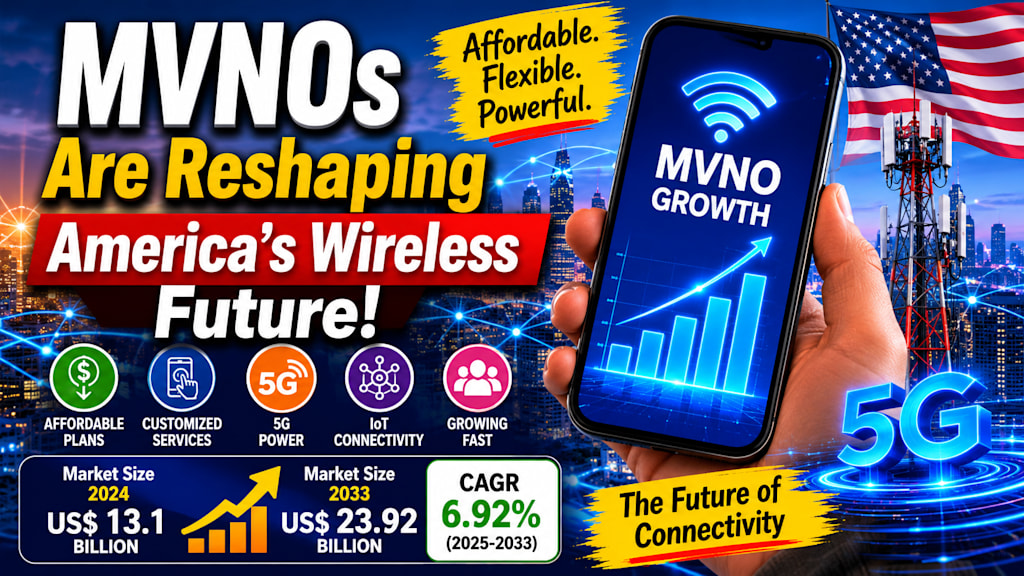
According to Renub Research, the United States Mobile Virtual Network Operator (MVNO) Market is projected to grow from US$ 13.1 billion in 2024 to US$ 23.92 billion by 2033, expanding at a CAGR of 6.92% between 2025 and 2033. This impressive growth reflects changing consumer preferences, technological advancements, and increasing demand for cost-effective mobile connectivity.
The Rise of MVNOs in America
Mobile Virtual Network Operators have existed for years, but their influence has accelerated dramatically in recent times. Several factors are contributing to this expansion.
Consumers today expect more than just voice and text services. They want affordable data plans, seamless streaming, reliable connectivity, and personalized options that align with their lifestyles. Traditional carriers often offer standardized plans that may not suit every customer. MVNOs fill this gap by targeting specific user groups with tailored services.
Whether it's students looking for budget-friendly plans, international travelers seeking affordable roaming, small businesses requiring specialized connectivity, or families searching for flexible packages, MVNOs provide alternatives that meet unique needs.
As a result, millions of Americans are embracing these providers as practical substitutes for traditional wireless operators.
Why Cost Matters More Than Ever
One of the strongest drivers behind MVNO growth is affordability.
Economic uncertainty and inflation have increased consumer focus on reducing recurring expenses. Mobile service is no exception. Many households actively compare wireless plans and seek options that deliver value without sacrificing quality.
Because MVNOs operate without owning network infrastructure, they enjoy lower operating costs. This enables them to offer competitive pricing while utilizing the same nationwide networks that major carriers maintain.
Many MVNOs provide:
No-contract plans
Flexible monthly subscriptions
Pay-as-you-go options
Family packages
International calling services
Data-only plans
This flexibility appeals particularly to younger consumers, students, seniors, and budget-conscious households.
As consumers continue prioritizing affordability, MVNOs are expected to attract an even larger share of the market.
Personalization Is Becoming a Competitive Advantage
Modern consumers increasingly expect products and services tailored to their individual preferences. The mobile industry is no exception.
Traditional operators often focus on broad customer segments. MVNOs, however, excel at serving niche audiences.
Some providers specialize in international communication, while others cater to business users, frequent travelers, gamers, or IoT device owners. This targeted approach allows MVNOs to build stronger relationships with customers who feel underserved by larger carriers.
Customized plans help improve customer satisfaction and retention. Instead of paying for features they rarely use, consumers can select services that match their actual requirements.
This shift toward personalization is becoming one of the most important competitive advantages in the wireless market.
The Impact of 5G Technology
The rollout of 5G networks represents another major growth catalyst for MVNOs.
Historically, smaller operators sometimes struggled to compete with major carriers in terms of network performance. Today, access agreements with large network operators allow many MVNOs to deliver high-speed 5G services without investing billions in infrastructure.
The benefits are substantial:
Faster internet speeds
Lower latency
Improved video streaming
Better gaming experiences
Enhanced remote work capabilities
Greater support for connected devices
Businesses also benefit from improved connectivity, creating opportunities for enterprise-focused MVNO services.
As 5G adoption continues expanding across the United States, MVNOs are well-positioned to capitalize on rising demand for next-generation wireless solutions.
IoT Creates New Growth Opportunities
The Internet of Things (IoT) is rapidly transforming industries ranging from healthcare and manufacturing to transportation and logistics.
Connected devices require reliable wireless communication, creating enormous opportunities for MVNOs specializing in machine-to-machine (M2M) connectivity.
Unlike traditional consumer-focused plans, IoT services often involve managing thousands of devices simultaneously. Smart sensors, industrial equipment, fleet management systems, and connected healthcare devices all require cost-efficient wireless solutions.
MVNOs can develop specialized offerings designed specifically for these applications, enabling businesses to manage connectivity more effectively.
As digital transformation accelerates across industries, IoT-related services are expected to become a significant growth segment within the MVNO market.
Challenges Facing the Industry
Despite promising growth prospects, MVNOs face several challenges.
Dependence on Host Networks
The most significant limitation is dependence on major network operators.
MVNOs rely on infrastructure owned by larger carriers such as Verizon, AT&T, and T-Mobile. While this arrangement reduces capital expenditure, it also limits control over network quality, coverage, and pricing.
Changes in wholesale agreements can directly affect profitability and competitiveness.
If network operators modify pricing structures or impose restrictions, MVNOs may have limited negotiating power.
Difficulty in Differentiation
Another challenge is market saturation.
Many MVNOs offer similar services using the same underlying networks. This creates difficulties in establishing a unique value proposition.
To stand out, operators often compete on:
Price
Customer service
Niche targeting
Specialized features
Brand identity
However, these advantages can be easily replicated by competitors, making long-term differentiation difficult.
California Leads the Way
California remains one of the strongest MVNO markets in the United States.
Several factors contribute to the state's leadership:
Large population
Technology-focused consumers
Diverse demographics
Strong smartphone adoption
Significant immigrant communities
Cities such as Los Angeles, San Francisco, and San Diego create favorable conditions for providers offering flexible and affordable wireless solutions.
Many California consumers value innovation and customization, making them ideal customers for MVNO offerings.
Texas Continues Expanding
Texas represents another major growth market.
The state's rapidly growing population and diverse demographic profile create opportunities for operators targeting specific customer groups.
Urban centers such as Houston, Dallas, Austin, and San Antonio drive strong demand for mobile connectivity. At the same time, rural regions benefit from affordable alternatives that extend access to wireless services.
The continued expansion of 5G infrastructure is expected to further strengthen MVNO adoption across Texas.
New York's Competitive Landscape
New York remains one of America's most competitive telecommunications markets.
High population density and extensive mobile usage create strong demand for flexible and affordable wireless solutions.
Consumers in New York often prioritize convenience, customization, and value, making MVNOs attractive alternatives to traditional carriers.
As mobile data consumption continues growing, providers that deliver innovative plans and excellent customer experiences are likely to thrive.
Key Market Segments
The U.S. MVNO market consists of several important segments.
By Type
Discount MVNOs
Telecom MVNOs
Retail MVNOs
Migrant-focused MVNOs
Business MVNOs
Roaming MVNOs
M2M MVNOs
By Operational Model
Reseller
Service Provider
Full MVNO
By End User
Consumer
Enterprise
Each segment serves distinct customer requirements and contributes to the industry's overall expansion.
Competitive Landscape
The market features numerous well-established players competing through pricing strategies, service innovation, and customer experience improvements.
Major participants include:
H2O Wireless
Mint Mobile
Red Pocket Mobile
TracFone Wireless
Visible
Cricket Wireless
Google Fi Wireless
Tello
UVNV
Xfinity Mobile
These companies continue investing in digital platforms, customer acquisition strategies, and advanced connectivity solutions to strengthen their market positions.
10 Recent Company Developments
Mint Mobile continued expanding its digital-first customer acquisition strategy following its integration into T-Mobile's broader ecosystem.
Google Fi Wireless enhanced international connectivity options and expanded multi-network support capabilities.
Visible introduced simplified unlimited plans focused on digital customer experiences.
Cricket Wireless expanded affordable 5G service availability across multiple U.S. regions.
Xfinity Mobile increased its bundled service offerings for broadband and wireless subscribers.
TracFone strengthened prepaid wireless solutions following its acquisition by Verizon.
Red Pocket Mobile expanded multi-carrier access options for customers seeking network flexibility.
Tello enhanced customizable plan structures targeting budget-conscious consumers.
H2O Wireless continued strengthening international calling solutions for immigrant communities.
Several MVNO providers accelerated investment in IoT and machine-to-machine connectivity services to address growing enterprise demand.
Looking Ahead
The future of the U.S. MVNO market appears exceptionally promising. Rising demand for affordable mobile services, expanding 5G coverage, growing IoT adoption, and increasing consumer preference for personalized plans are creating favorable conditions for sustained growth.
As competition intensifies, successful operators will be those that combine affordability, innovation, and customer-centric services. The ability to serve niche markets while leveraging advanced network technologies will become increasingly important.
With the market expected to approach US$ 24 billion by 2033, MVNOs are no longer simply alternative providers—they are becoming an essential component of America's evolving telecommunications ecosystem.
Final Thoughts
Mobile Virtual Network Operators have transformed from niche telecom players into influential forces within the wireless industry. By delivering affordable, flexible, and innovative solutions, they are challenging traditional business models and expanding consumer choice.
As technology continues advancing and digital connectivity becomes even more essential to everyday life, MVNOs are positioned to play a central role in shaping the future of mobile communications across the United States.
Their success demonstrates a simple truth: consumers increasingly value flexibility, personalization, and affordability—and MVNOs are uniquely equipped to deliver all three.
About the Creator
Enjoyed the story? Support the Creator.
Subscribe for free to receive all their stories in your feed.
Comments
There are no comments for this story
Be the first to respond and start the conversation.