
How Linear Motion Systems Are Driving the Next Industrial Revolution
The rise of smart factories, AI-powered production, and advanced robotics is creating unprecedented demand for precision motion control technologies.

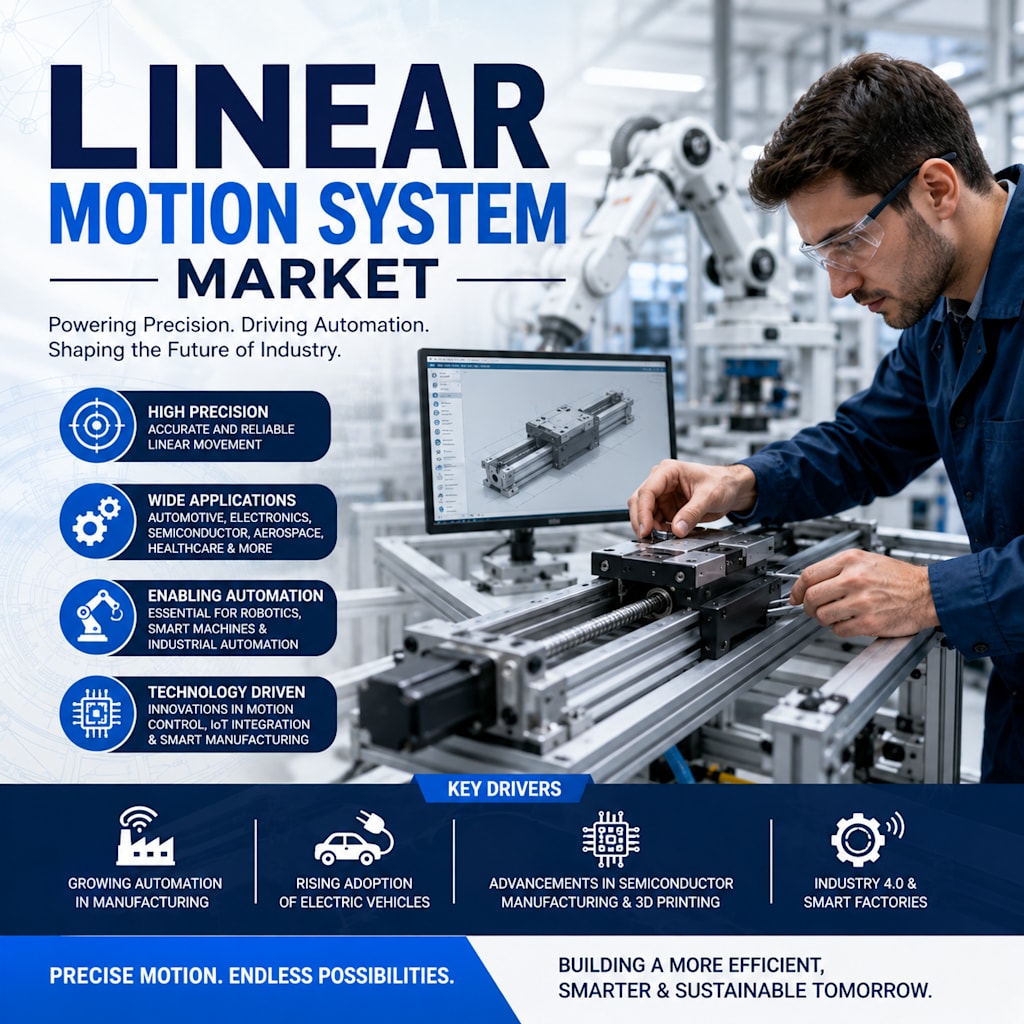
The Technology Driving Modern Automation: Why the Linear Motion System Market is on the Rise
How often do we actually think about what allows a robot arm to move, a semiconductor wafer to be precisely positioned or an automated assembly line to proceed? It’s easy to overlook, but underlying much of today's manufacturing advancement is a crucial component that enables precision motion: the linear motion system.
As manufacturing operations become increasingly reliant on automation, robotics and smart manufacturing, the demand for highly accurate motion control solutions is expanding rapidly. These systems, once solely the domain of specialized industrial applications, are now becoming indispensable in industries ranging from automotive manufacturing to healthcare, electronics to aerospace.
This increased dependence on precision automation is a major contributor to the booming growth of the global linear motion system market, which is forecast to grow from around $12.2 billion in 2025 to nearly $19.7 billion in 2034.
Understanding Linear Motion Systems
Fundamentally, a linear motion system is built to move objects along a linear path with extremely high precision. Unlike traditional rotational motion systems, which control movement in a circle, linear motion systems regulate motion in a straight line. Generally, they are a combination of linear guides, bearings, actuators, motors and controls.
Although the underlying principle is very simple, the possible applications for these systems are incredibly vast.
Linear motion systems are commonly utilized in the following areas:
* Industrial automation equipment
* Automated assembly lines of robots
* Semiconductor manufacturing facilities
* Medical imaging devices
* Surgical robots
* Automated packaging machinery
* Aerospace production systems
* 3D printing machines
Essentially, without the application of these advanced motion control systems, many technologies in the manufacturing and medical sectors would fail to achieve the necessary precision.
How Automation is Driving Market Growth
One of the most compelling drivers of the market's expansive growth is the global adoption of automation across the board. Manufacturers around the world face tremendous pressure to simultaneously increase their productivity and reduce operational costs. Automation solves these two key industrial challenges by both minimizing manual intervention and enhancing the consistency of their production.
Linear motion systems are at the heart of this transformation: they empower machines to perform repetitive tasks with remarkable accuracy, eliminating human errors while simultaneously increasing production efficiency. As companies increasingly invest in automated production lines and robotic systems, demand for advanced motion control components like linear motion systems will continue to surge. This is particularly true for manufacturing industries where product quality is directly impacted by precision, such as the electronics, automotive, and semiconductor sectors.
The Smart Factory Emergence
Smart factories are no longer a thing of the future; they are becoming a reality. These intelligent manufacturing facilities increasingly leverage technologies like AI, Big Data analysis, cloud computing and interconnected sensors to create sophisticated production environments. Smart factories rely heavily on linear motion systems because every automated function requires precision movement. Whether a robotic arm is assembled or assembled, a conveyor transports products or a machine examines quality, motion control is a prerequisite. As factories grow more intelligent and automated, the demand for faster, more accurate and highly reliable motion control systems like linear motion systems increases significantly.
Electric Vehicles and New Market Opportunities
Another key area driving growth in the linear motion system market is the surge in electric vehicle (EV) adoption. Governments are introducing increasingly stringent emissions standards and offering incentives to boost EV sales. Moreover, advancements in battery technology are making EVs more practical and affordable. EV manufacturing, by its nature, requires a high degree of precision. The assembly of batteries, motors and other EV components relies on precise movements in machines performing welding, automated inspection and other key functions, and linear motion systems are essential to achieve these required levels of precision. As EV production scales globally, the demand for linear motion systems capable of supporting this growth is expected to rise dramatically.
The Expanding Role of the Internet of Things
The Internet of Things (IoT) is revolutionizing the industrial landscape by making manufacturing operations more connected, and as such, these systems benefit from enhanced performance with IoT-enabled features like predictive maintenance. Instead of waiting for equipment to fail, manufacturers can now constantly monitor the systems in real time, identify any potential problems in their early stages and address them, ultimately preventing expensive equipment downtime. This capability makes the intelligent and connected motion systems more appealing to numerous industries.
Semiconductor Manufacturing and High Precision Engineered Devices
Few industries have a higher need for precision than the semiconductor industry. To create microchips, motion that measures just microns is necessary, thus making precise linear motion systems a prerequisite. With the increased global demand for advanced processors, AI and hardware for cloud computing, plus a strong and growing market for smart consumer electronics, semiconductor manufacturers are making significant investments in new, next-generation production facilities. Linear motion systems play an important role in the precise positioning of silicon wafers, moving materials and supporting equipment in inspection stations to enable the extraordinary levels of accuracy needed in this industry.
Multi-Axis Systems: Becoming the Dominant Technology
It’s rare that a modern manufacturing process relies on a single dimension of motion control. Most applications require simultaneous multi-axis motion control systems that allow movement in multiple directions to execute highly precise operations. This demand for flexibility is increasing the use of multi-axis systems in a variety of applications including robotics, CNC machining, automated inspection equipment, and automated assembly processes. These systems are not only valuable in many sectors, they also offer greater versatility and capability.
Asia-Pacific Continues to Lead the Charge
While demand for these systems is global, Asia-Pacific remains the market leader. With high industrial growth, robust manufacturing activity, and increased investment in automation technologies, this region continues to solidify its position as the biggest and fastest growing linear motion system market. The industrial development of China, Japan, South Korea and India, among others, with increasing investments in smart factories and robotic applications, alongside their large automotive and electronics manufacturing bases, continue to drive significant demand. North America and Europe, also growing with investments in automation, aerospace technologies and advanced manufacturing, contribute substantially to market expansion.
Innovation Driving the Future
The growing competition among the leading linear motion system manufacturers is paving the way for an era of accelerated innovation. Companies are pouring money into research and development for systems offering:
* Higher levels of accuracy
* Increased speed
* More efficient energy usage
* Higher payload capacities
* predictive maintenance functionalities
* Smart features like IoT connectivity
AI and machine learning could soon have an even bigger role to play, enabling motion systems to become adaptive, autonomous platforms that continuously optimize performance for the factory.
What the Future Holds
The future of the linear motion system market is tightly intertwined with that of industrial automation as a whole. As manufacturers seek greater efficiency, accuracy, and flexibility, demand for sophisticated motion control systems will only continue to grow. From EV production lines to semiconductor fabrication, and from robotics to smart factories, linear motion systems are the unsung heroes empowering the technologies that shape our world. While easily overlooked, these systems will remain a cornerstone of industrial automation, and their significance is only set to increase in the years ahead as factories become smarter and more connected, enabling them to run with even greater precision and efficiency.
About the Creator
Robert
Senior Market Researcher at IMARC Group, specializing in global market analysis, industry trends, and data-driven insights across diverse sectors.
Enjoyed the story? Support the Creator.
Subscribe for free to receive all their stories in your feed.
Comments
There are no comments for this story
Be the first to respond and start the conversation.