
How Customer Relationship Management Platforms Are Reshaping Business Success in the Digital Age
From AI-powered insights to cloud-based customer engagement, the global CRM market is entering a transformative era

In today's hyperconnected world, customer expectations have reached unprecedented levels. Consumers expect personalized interactions, instant support, seamless experiences across channels, and brands that understand their needs. As a result, businesses are investing heavily in technologies that help them build stronger customer relationships and maintain long-term loyalty.
Among these technologies, Customer Relationship Management (CRM) systems have become one of the most important business tools of the modern era. No longer limited to contact databases and sales tracking, CRM platforms now leverage artificial intelligence, predictive analytics, automation, and cloud computing to transform how organizations engage with customers.
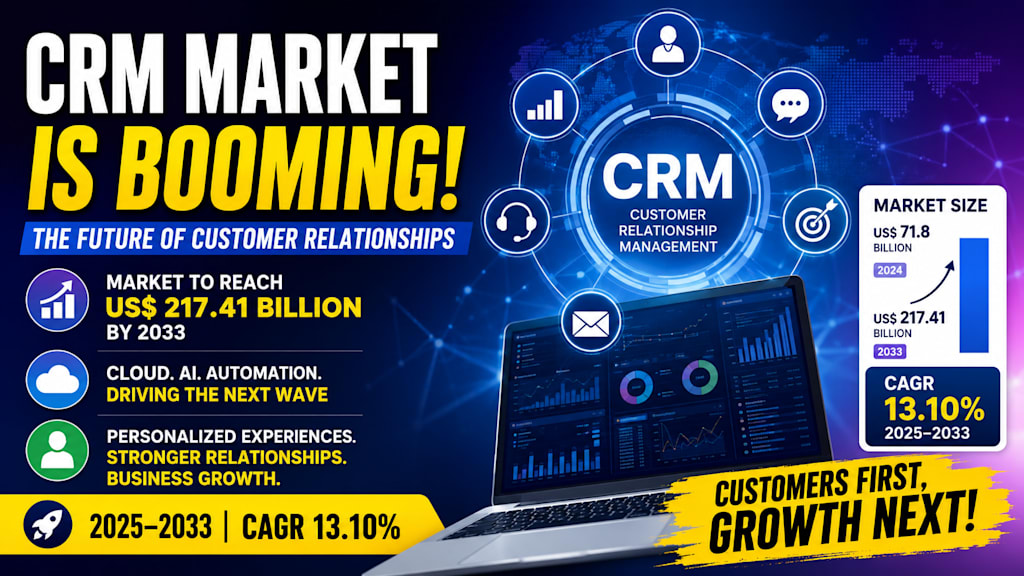
According to Renub Research, the global Customer Relationship Management Market is expected to grow from US$ 71.8 billion in 2024 to US$ 217.41 billion by 2033, expanding at a CAGR of 13.10% during 2025–2033. This remarkable growth highlights the increasing importance of customer-centric strategies across industries worldwide.
Download Free Sample Report:
Understanding the Evolution of CRM
Customer Relationship Management refers to a combination of technology, business processes, and strategic practices that enable organizations to manage interactions with current and potential customers. CRM platforms centralize customer information, track communication history, automate workflows, and provide valuable insights that help businesses improve customer experiences.
The earliest CRM systems focused primarily on maintaining customer records. Today's solutions, however, function as comprehensive business ecosystems capable of integrating sales, marketing, customer support, social media monitoring, analytics, and customer experience management.
Modern CRM platforms empower organizations to understand customer behavior, anticipate future needs, personalize interactions, and optimize business operations. This transformation has made CRM a mission-critical component for businesses seeking sustainable growth.
Why the CRM Market Is Growing So Rapidly
Several powerful factors are driving CRM adoption worldwide.
The Rise of Personalized Customer Experiences
Modern consumers expect brands to know who they are and understand their preferences. Generic marketing campaigns are becoming increasingly ineffective as customers seek relevant and personalized interactions.
CRM systems allow organizations to collect and analyze customer data from multiple touchpoints. This enables businesses to deliver personalized product recommendations, targeted marketing campaigns, and customized service experiences.
Organizations that successfully personalize customer interactions often experience higher engagement rates, stronger loyalty, and increased revenue generation.
Artificial Intelligence Is Revolutionizing CRM
Artificial intelligence has become one of the most significant innovations influencing CRM development.
AI-powered CRM platforms can analyze vast amounts of customer data in real time, identify patterns, predict future purchasing behavior, and automate routine processes. These capabilities allow sales teams to focus on high-value activities while improving overall efficiency.
Machine learning algorithms can recommend optimal sales strategies, identify potential customer churn, and suggest personalized marketing initiatives. AI-powered chatbots also provide instant customer support around the clock, improving response times and customer satisfaction.
The integration of AI into CRM platforms is helping organizations transform raw customer data into actionable business intelligence.
Cloud-Based CRM Solutions Continue to Expand
Cloud computing has dramatically changed how organizations deploy and manage CRM systems.
Traditional on-premises CRM solutions often required significant infrastructure investments and dedicated IT resources. Cloud-based alternatives provide a more flexible and cost-effective option.
Businesses can access cloud CRM platforms from virtually anywhere, enabling remote work, real-time collaboration, and improved operational agility. Subscription-based pricing models also make advanced CRM capabilities accessible to small and medium-sized enterprises.
As organizations continue embracing digital transformation, cloud CRM adoption is expected to remain a major growth driver.
The Role of Automation in Customer Engagement
Automation has become a cornerstone of modern CRM systems.
Businesses increasingly use CRM platforms to automate repetitive tasks such as lead management, follow-up communications, appointment scheduling, marketing campaigns, and customer service workflows.
Automation not only improves operational efficiency but also ensures consistency across customer interactions. Employees can focus on strategic initiatives while CRM systems handle routine activities in the background.
The result is improved productivity, reduced costs, and a better customer experience.
Industry-Wide Adoption Is Accelerating
CRM solutions are no longer limited to sales-focused organizations. Today, they are used across virtually every major industry.
Banking and Financial Services
Financial institutions use CRM platforms to enhance customer engagement, streamline communication, and deliver personalized financial solutions.
Healthcare
Healthcare providers leverage CRM systems to improve patient communication, appointment management, and care coordination.
Retail and E-commerce
Retailers use CRM technology to understand purchasing patterns, personalize promotions, and improve customer retention.
Telecommunications
Telecom providers rely on CRM systems to manage customer relationships, reduce churn, and improve service quality.
Government and Education
Public sector organizations are increasingly adopting CRM platforms to improve citizen engagement and service delivery.
This broad industry adoption is contributing significantly to market expansion.
Regional Growth Trends
United States
The United States remains one of the most influential CRM markets globally.
Organizations across sectors continue investing in cloud-based solutions, artificial intelligence, and advanced analytics to improve customer engagement. The growing importance of customer retention and data-driven decision-making is driving continued CRM adoption throughout the country.
As competition intensifies, businesses increasingly view CRM platforms as strategic investments rather than operational tools.
Germany
Germany's CRM market is growing despite economic challenges affecting various industries.
German organizations are adopting CRM solutions to improve efficiency, strengthen customer relationships, and enhance competitiveness. Data privacy and compliance remain important considerations, particularly given Europe's stringent regulatory environment.
Cloud adoption and AI integration continue to shape CRM innovation across the German market.
India
India is emerging as one of the fastest-growing CRM markets globally.
Rapid digital transformation, increased internet penetration, and growing SME adoption are creating significant opportunities. Indian technology companies are also playing an important role in CRM innovation.
The country's expanding startup ecosystem and increasing focus on customer-centric business models are expected to support long-term market growth.
Saudi Arabia
Saudi Arabia's CRM market is benefiting from the nation's Vision 2030 initiative and ongoing digital transformation efforts.
Organizations across public and private sectors are investing in customer engagement technologies to improve operational efficiency and service quality. Growing adoption of cloud technologies and artificial intelligence is creating a favorable environment for CRM expansion.
Challenges Facing the CRM Industry
Despite impressive growth prospects, the CRM market faces several important challenges.
Data Privacy and Security Risks
CRM platforms store vast amounts of sensitive customer information.
Cybersecurity threats, data breaches, and evolving privacy regulations require organizations to implement robust security measures. Compliance with regulations such as GDPR and other regional privacy frameworks has become increasingly complex.
Businesses must continually invest in cybersecurity infrastructure and employee training to maintain customer trust.
Customization Complexity
Every organization has unique workflows and operational requirements.
While CRM customization can deliver significant benefits, excessive modifications often increase implementation costs and create maintenance challenges. Poorly managed customization can also reduce system performance and complicate future upgrades.
Organizations must carefully balance flexibility and simplicity when implementing CRM solutions.
The Future of CRM: Intelligent, Connected, and Predictive
The future of CRM will be defined by intelligent technologies capable of predicting customer needs before they arise.
Emerging trends likely to shape the next generation of CRM platforms include:
Advanced generative AI assistants
Hyper-personalized customer experiences
Predictive customer analytics
Enhanced omnichannel engagement
Voice-enabled CRM interfaces
Automated customer journey management
Real-time sentiment analysis
Deeper integration with enterprise systems
As these innovations mature, CRM platforms will evolve from management tools into strategic decision-making engines that drive business growth.
10 Recent Developments Shaping the CRM Industry
1. Salesforce Expands AI Capabilities
Salesforce enhanced its AI offerings through advanced Einstein and Agentforce innovations designed to improve automation and customer engagement.
2. IBM and Salesforce Strengthen Collaboration
IBM expanded its partnership with Salesforce to integrate Watson AI capabilities into CRM workflows, enabling improved analytics and customer intelligence.
3. Microsoft Enhances Dynamics 365 Copilot
Microsoft introduced additional generative AI features within Dynamics 365 to improve productivity and customer engagement.
4. Oracle Expands Fusion Cloud CX
Oracle continued investing in AI-powered customer experience solutions across its Fusion Cloud CX platform.
5. Adobe Advances Experience Cloud
Adobe introduced new generative AI capabilities designed to support personalization and customer journey optimization.
6. Genesys and Salesforce Launch Integrated CX Solution
Both companies collaborated to create a unified AI-powered customer experience platform.
7. Zoho Introduces Enhanced CRM Automation
Zoho expanded automation and AI features designed specifically for small and medium-sized businesses.
8. Tech Mahindra and Sprinklr Partnership
The companies launched an omnichannel customer experience platform focused on improving engagement and operational efficiency.
9. Belsons Technologies Launches Belsio HRMS
Belsons Technologies introduced a cloud-based CRM and HR management platform that streamlines workforce operations.
10. Salesforce Opens Regional Headquarters in Riyadh
The company expanded its Middle East presence by establishing a regional headquarters to support Saudi Arabia's digital transformation goals.
Final Thoughts
Customer Relationship Management has evolved far beyond traditional customer databases. Today, CRM platforms serve as the foundation for customer engagement, sales optimization, marketing automation, and business intelligence.
With organizations increasingly prioritizing customer experience, CRM solutions are becoming indispensable tools for achieving competitive advantage. The integration of artificial intelligence, cloud computing, predictive analytics, and automation is creating unprecedented opportunities for businesses to strengthen customer relationships and drive sustainable growth.
As the market progresses toward an expected value of US$ 217.41 billion by 2033, CRM technology will continue shaping how organizations connect with customers, deliver value, and compete in an increasingly digital world.
For businesses seeking long-term success, investing in intelligent CRM solutions may no longer be optional—it may be essential.
About the Creator
Enjoyed the story? Support the Creator.
Subscribe for free to receive all their stories in your feed.
Comments
There are no comments for this story
Be the first to respond and start the conversation.