
How Construction Equipment Is Powering the Next Wave of Global Growth
Urbanization, infrastructure spending, and technological innovation are reshaping one of the world's most essential industries.

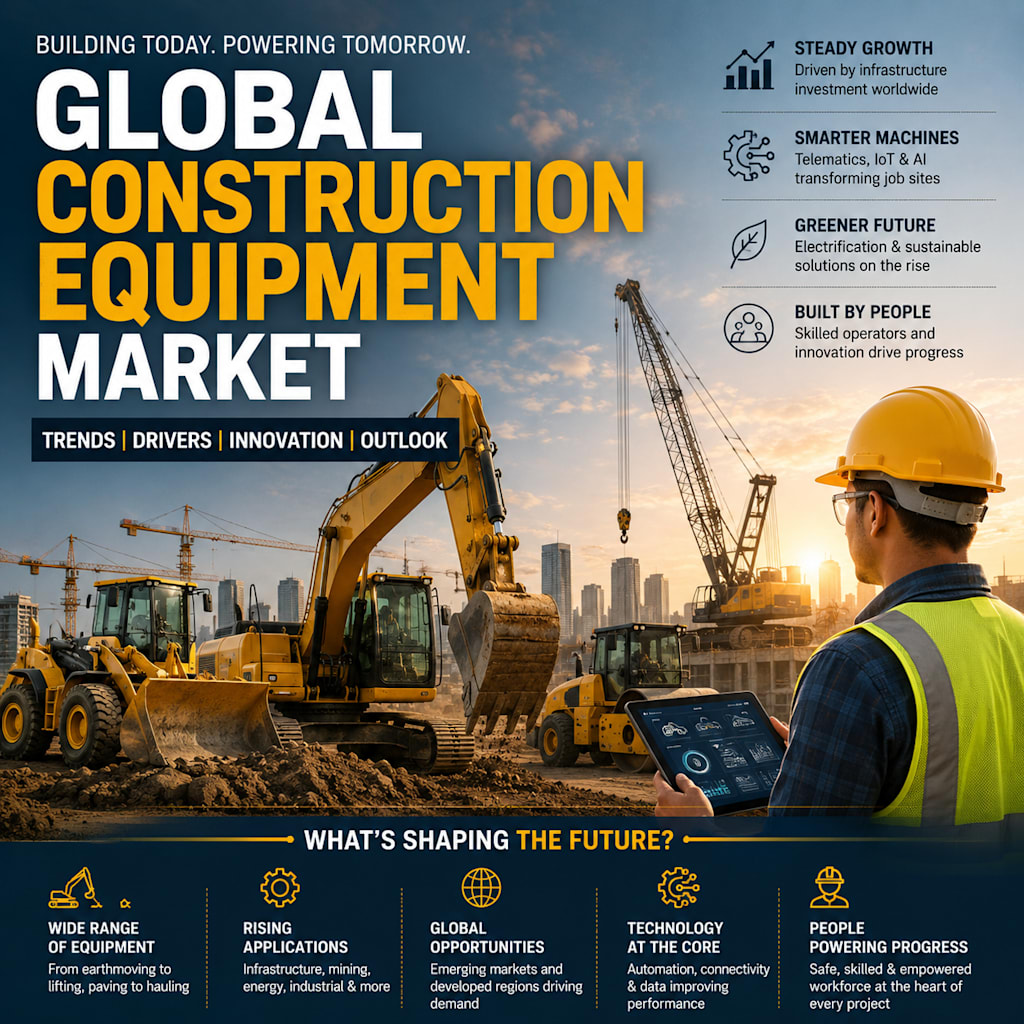
The Machines Building the Future: Why the Global Construction Equipment Industry Is Entering a New Era
From towering skyscrapers and high-speed rail networks to renewable energy projects and smart cities, nearly every major development project relies on one thing: construction equipment.
While most people notice the finished buildings, roads, and bridges, few pay attention to the machines that make these projects possible. Excavators, loaders, bulldozers, cranes, and dump trucks work behind the scenes, shaping the modern world one project at a time.
Today, the global construction equipment industry is undergoing a major transformation. Driven by infrastructure investment, urbanization, sustainability goals, and technological innovation, the sector is evolving far beyond traditional heavy machinery.
What was once a business focused primarily on horsepower and durability is becoming increasingly connected, intelligent, and environmentally conscious.
A Market Fueled by Global Development
The global construction equipment market size was valued at approximately USD 258.5 billion in 2025 and is expected to reach nearly USD 352 billion by 2034.
This steady growth reflects a larger global trend: governments and private organizations are investing heavily in infrastructure, transportation networks, industrial facilities, renewable energy projects, and urban development.
As populations continue to grow and cities expand, demand for construction equipment remains essential.
Unlike many industries that experience rapid shifts in demand, construction equipment benefits from long-term structural drivers. Roads need maintenance, cities require expansion, and energy infrastructure must continuously evolve.
These realities create consistent demand for machinery across both developed and emerging economies.
Urbanization Continues to Reshape the World
One of the strongest forces driving equipment demand is urbanization.
Millions of people move into urban areas every year, creating pressure on governments to build housing, transportation systems, utilities, and public infrastructure.
Emerging economies are particularly active in this transformation.
Countries across Asia, the Middle East, Africa, and Latin America are investing heavily in roads, airports, ports, railways, industrial parks, and residential developments. These projects require large fleets of construction equipment capable of operating efficiently under demanding conditions.
As urban populations continue to rise, construction activity is expected to remain a key economic driver for decades.
Why Earthmoving Equipment Dominates the Industry
Before any structure can be built, land must first be prepared.
This is why earthmoving equipment remains the largest segment within the construction equipment market.
Excavators, bulldozers, motor graders, and loaders are used for tasks such as:
* Site preparation
* Land clearing
* Foundation excavation
* Road construction
* Mining operations
* Utility installation
Virtually every construction project begins with earthmoving activities, making these machines indispensable across the industry.
As infrastructure spending increases globally, demand for earthmoving equipment continues to rise alongside it.
The Rise of Compact Equipment
While large machinery dominates major projects, compact equipment is becoming one of the fastest-growing categories in the market.
Mini excavators, skid steer loaders, and compact track loaders are increasingly popular because they can operate in confined urban spaces where larger machines struggle.
The growth of urban redevelopment projects, residential construction, and equipment rental services has accelerated demand for smaller, more versatile machines.
Contractors appreciate their flexibility, lower operating costs, and ability to complete tasks efficiently in crowded environments.
As cities become denser and construction sites become more space-constrained, compact equipment is expected to play an increasingly important role.
Technology Is Changing the Construction Site
Construction equipment is no longer just mechanical machinery.
Modern machines are becoming highly connected through digital technologies.
Telematics systems now allow operators and fleet managers to monitor equipment performance in real time. Sensors collect data on fuel consumption, maintenance needs, machine utilization, and operational efficiency.
This information helps companies:
* Reduce downtime
* Improve productivity
* Lower maintenance costs
* Extend equipment lifespan
* Increase project efficiency
Connected equipment is rapidly becoming the industry standard rather than a premium feature.
The construction site of the future will be increasingly data-driven.
The Push Toward Electrification
Environmental regulations and sustainability initiatives are also reshaping the industry.
For decades, diesel-powered equipment dominated construction sites worldwide. Today, manufacturers are investing heavily in electric and hybrid alternatives.
Electric excavators, loaders, and compact equipment are becoming more common, particularly in urban areas where noise and emissions restrictions are stricter.
These machines offer several advantages:
* Lower emissions
* Reduced operating costs
* Quieter operation
* Improved compliance with environmental regulations
Although diesel equipment still represents the majority of the market, the transition toward cleaner technologies is gaining momentum.
Many industry experts believe electrification will become one of the defining trends of the next decade.
Autonomous Equipment Is Closer Than Many Realize
Automation is another area generating significant interest.
The idea of self-operating construction equipment once sounded futuristic. Today, it is becoming a practical reality.
Several manufacturers are developing autonomous and semi-autonomous systems capable of performing tasks such as grading, excavation, hauling, and site mapping with minimal human intervention.
These technologies can improve precision, reduce labor requirements, and enhance safety on construction sites.
As artificial intelligence and machine learning continue to advance, autonomous construction equipment is expected to become increasingly common.
Asia-Pacific Leads Global Growth
Among all regions, Asia-Pacific remains the largest market for construction equipment.
Countries such as China and India continue to invest heavily in transportation networks, industrial infrastructure, housing projects, and urban development programs.
Large-scale initiatives involving highways, rail systems, ports, renewable energy facilities, and industrial corridors are creating enormous demand for machinery.
Meanwhile, Southeast Asian nations are experiencing rapid industrialization and infrastructure modernization, further supporting regional growth.
As a result, Asia-Pacific continues to represent the center of gravity for the global construction equipment industry.
Competition Is Becoming More Intense
The competitive landscape is evolving rapidly.
Global manufacturers continue to invest in innovation, digital technologies, electrification, and autonomous systems. At the same time, Chinese equipment manufacturers are expanding aggressively into international markets.
Their ability to offer competitive pricing has increased pressure on established players.
This competition is driving faster innovation across the industry and encouraging manufacturers to differentiate through technology, service quality, financing options, and connected solutions.
For customers, this means greater choice and access to more advanced equipment than ever before.
Looking Ahead
The construction equipment industry is entering a period of significant transformation.
Infrastructure investment remains strong, urbanization continues worldwide, and technology is redefining how projects are planned and executed.
Over the coming years, three trends are likely to shape the industry's future:
* Greater adoption of electric equipment
* Expansion of autonomous and AI-powered machinery
* Increased use of connected fleet management systems
Together, these developments will make construction projects more efficient, sustainable, and productive.
The machines building our roads, bridges, factories, and cities are becoming smarter than ever before. As governments and businesses continue investing in infrastructure, construction equipment will remain one of the most important industries powering global economic development.
And while these machines often operate in the background, their impact on the modern world is impossible to ignore.
About the Creator
Robert
Senior Market Researcher at IMARC Group, specializing in global market analysis, industry trends, and data-driven insights across diverse sectors.
Enjoyed the story? Support the Creator.
Subscribe for free to receive all their stories in your feed.
Comments
There are no comments for this story
Be the first to respond and start the conversation.