
How Autonomous AI Agents Actually Work Under the Hood
Why AI agents aren't magic - and how structured event-driven pipelines make them actually work at scale.

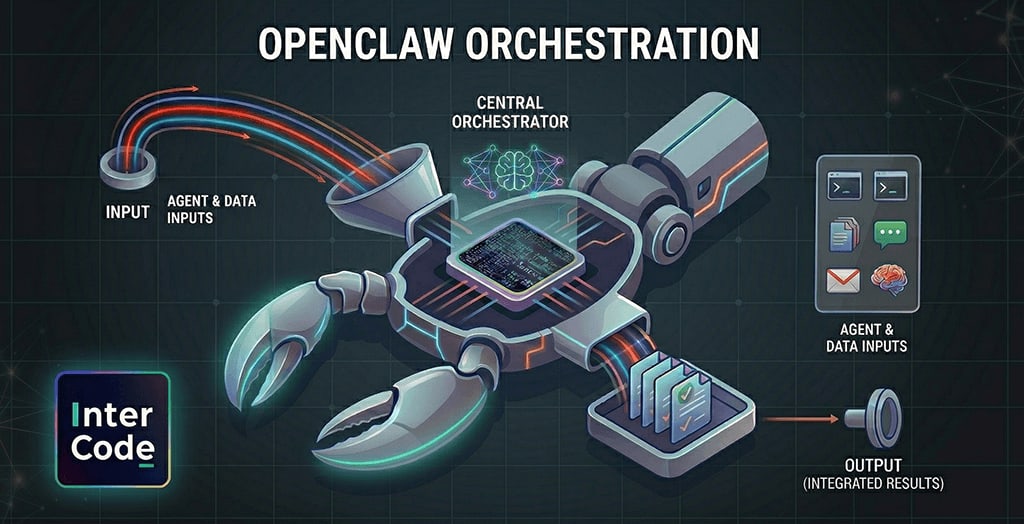
The rise of autonomous AI agents has sparked intense debate. When an agent places a call at 3:00 AM, monitors social media feeds, or books a meeting without human oversight, it can feel like magic or even sentient decision-making.
At InterCode, we regularly engineer agentic workflows and AI-driven platforms, and we see firsthand how these systems operate behind the scenes. In reality, autonomous AI systems do not "think" or make spontaneous choices. They rely on clean engineering, clever event loops, and structured queues.
Whether analyzing open-source frameworks like OpenClaw or building enterprise platforms, the underlying architecture follows predictable, logical mechanics.
The Four Pillars of Agent Autonomy
An AI agent appears proactive because it continuously reacts to inputs from its environment. Strip away the hype, and almost every agentic system relies on four basic triggers:
Heartbeats & Timers: Recurring background timers allow an agent to periodically "wake up," scan an inbox, check a database, or evaluate pending tasks without waiting for a user prompt.
Cron Jobs: Scheduled events fire specific instructions at predetermined times (e.g., pulling daily reports every morning at 9:00 AM).
Webhooks & Events: External software triggers the agent instantly when an action occurs - like a new lead filling out a website form.
Inter-Agent Communication: Specialized agents pass data to each other in message queues. One agent researches, passes its output to a writing agent, which then queues a task for a voice agent.
State Management and Execution Queues
To understand why agents stay consistent across interactions, you have to look at state persistence. Large Language Models (LLMs) themselves are completely stateless — they do not remember your last call or your preferences unless that context is provided in the prompt payload.
Production-ready agent systems solve this by maintaining external memory layers and structured orchestration. Incoming triggers do not execute immediately in isolation. Instead, they follow a strict pipeline:
Event Ingestion: The trigger enters a execution queue (such as Redis or AWS SQS).
Context Retrieval: The system fetches long-term user history, active rules, and preferences from a persistent database or vector storage.
Agent Turn Execution: The model evaluates the updated context, selects the appropriate tool or API call, and executes the payload.
State Persistence: The result of the action is saved back to the database, ensuring the agent remains context-aware for its next execution turn.
This deterministic cycle is what creates the illusion of a continuous, living assistant.
From Theory to Production: The Real-World Impact
Understanding this architecture is what separates a fragile prototype from a reliable product.
Take the real estate industry, where 78% of leads convert with the first responder. Traditional follow-ups rely on human callers who take hours to respond, miss calls after business hours, or leave leads cold.
By implementing structured agentic pipelines, platforms can completely automate this workflow:
A new lead enters through a webhook (from Zillow or a CRM).
The trigger immediately wakes up a conversational AI voice agent.
The agent dials the lead within 15 seconds, qualifies their budget, and handles common objections using natural dialogue.
Once qualified, the system checks calendar availability and books the appointment directly.
When engineered correctly, a single multi-agent system can scale to handle thousands of active agents simultaneously — an architecture pattern demonstrated in InterCode's AI voice agent platform rebuild for real estate professionals.
The Verdict
AI agents aren't magic; they are event-driven systems operating on time, inputs, and persistent memory. Moving from a messy beta to a production-ready product requires moving past bloated prompt engineering and focusing on clean architecture, reliable APIs, and robust state management.
Ultimately, scaling these workflows requires moving past quick fixes and applying the same software engineering rigor used in traditional distributed systems. When built with clean architecture, complex AI agent workflows shift from unpredictable experiments into stable, indispensable assets for modern platforms.
About the Creator
InterCode
InterCode is an AI-first B2B software development boutique for SMBs, focused on agentic engineering. We build AI agents, SaaS, cloud & DevOps solutions. Our team consists of CCAR-F Claude Certified Architects by Anthropic. intercode.com
Enjoyed the story? Support the Creator.
Subscribe for free to receive all their stories in your feed.
Comments
There are no comments for this story
Be the first to respond and start the conversation.