
How AI Is Turning Wearables Into Personal Healthcare Systems
The next revolution in healthcare may not happen inside hospitals. It may happen on your wrist.

For most of modern history, healthcare has been reactive. People visited doctors after symptoms appeared, underwent tests when something felt wrong, and received treatment once a problem had already developed. While advances in medicine have dramatically improved outcomes, the overall model has remained largely unchanged for decades.
Technology is beginning to challenge that approach.
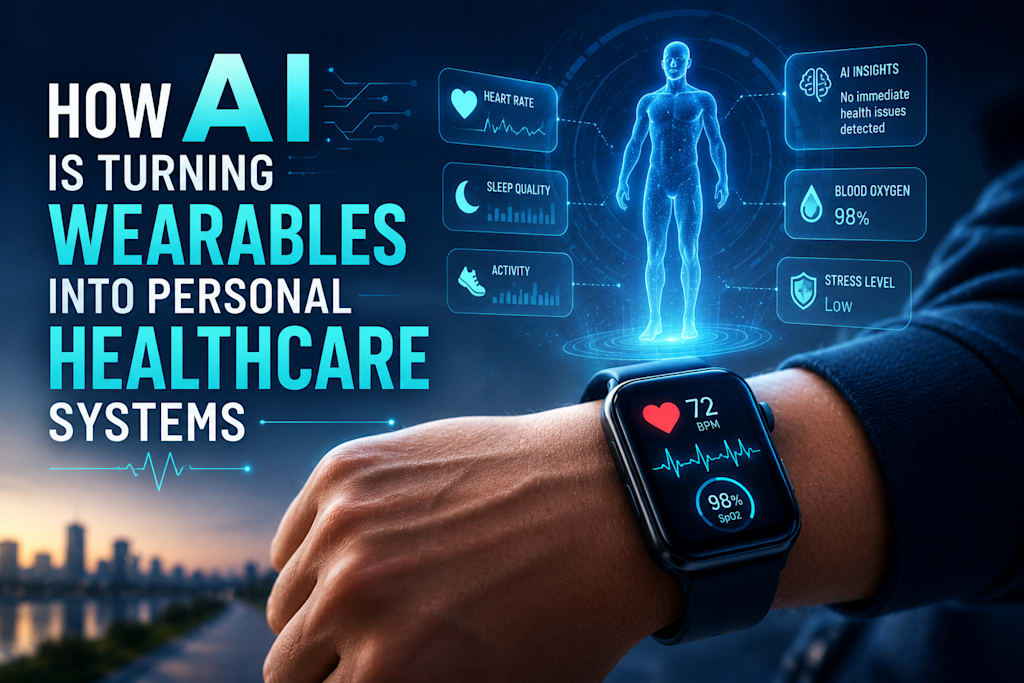
Millions of people now wear devices capable of tracking heart rate, sleep quality, physical activity, blood oxygen levels, and countless other health metrics throughout the day. What started as a way to count steps has evolved into something far more significant. Wearable devices are becoming constant companions that collect a continuous stream of information about the human body.
The real transformation, however, is not happening because of the devices themselves. It is happening because artificial intelligence is learning how to interpret the information they collect.
As AI becomes more sophisticated, wearable technology is moving beyond simple tracking and toward something much more powerful: continuous, personalized healthcare.
Moving Healthcare Beyond the Doctor's Office
Traditional healthcare offers snapshots of a person's health. A patient may spend fifteen minutes with a doctor during a routine appointment, undergo a few tests, and receive recommendations based on the information available at that moment.
The problem is that health does not exist in snapshots.
Our bodies change every hour of every day. Stress levels fluctuate. Sleep quality varies. Activity patterns shift. Small changes often occur gradually and can remain invisible during occasional medical visits.
Wearable technology creates a different picture. Instead of capturing isolated moments, these devices generate continuous records of how our bodies function over time. A single night's poor sleep may not mean much, but months of declining sleep quality could reveal meaningful trends. Slight changes in heart rate, recovery patterns, or activity levels may provide clues that traditional healthcare systems would never see.
This ability to observe health continuously opens the door to a completely different model of care.
Why Artificial Intelligence Matters
Collecting data is easy.
Understanding it is much harder.
A modern wearable device can generate thousands of data points every day. Multiply that by millions of users, and the amount of information becomes impossible for human healthcare professionals to analyze manually.
Artificial intelligence changes the equation. Machine learning systems can process enormous datasets, identify patterns, and detect anomalies that might otherwise go unnoticed. More importantly, they can learn how those patterns evolve over time.
Imagine a wearable device noticing subtle changes in sleep quality, activity levels, and resting heart rate over several weeks. Individually, each metric may seem insignificant. Together, they may suggest rising stress levels, worsening recovery, or the early signs of a developing health issue.
The goal is not to replace doctors. The goal is to provide earlier insights that help patients and healthcare professionals make more informed decisions.
In many ways, AI is transforming wearable devices from passive trackers into active health assistants.
The Rise of Continuous Care
Perhaps the most exciting aspect of AI-powered wearables is the shift from episodic care to continuous care.
Healthcare has traditionally been built around appointments. Patients seek help when symptoms appear, and healthcare providers respond to the information available during those interactions.
Wearables create the possibility of ongoing observation. Instead of checking health occasionally, systems can monitor trends continuously and identify changes as they happen.
This approach could be especially valuable for managing chronic conditions. Patients living with cardiovascular disease, diabetes, respiratory illnesses, or other long-term health concerns often require ongoing monitoring. AI-powered wearables could help identify warning signs earlier, potentially reducing complications and improving outcomes.
The broader implication is even more significant. Healthcare may gradually shift from treating illness to preventing it.
That is a fundamentally different vision of medicine.
The Privacy Challenge
As promising as wearable healthcare appears, it raises important questions.
Health information is among the most sensitive data people possess. Wearable devices collect details about sleep, movement, heart function, daily habits, and other deeply personal aspects of life. As these systems become more intelligent, the amount of information being generated will only increase.
This creates legitimate concerns around privacy, ownership, and security.
Who controls the data?
How is it stored?
Who can access it?
How is it protected?
The future of digital health will depend not only on technological innovation but also on public trust. People must feel confident that their information is being handled responsibly. Without that confidence, adoption may slow regardless of how advanced the technology becomes.
Building the Infrastructure for the Next Generation of Healthcare
Creating intelligent healthcare systems requires far more than connecting AI to wearable devices. Behind every health alert, recommendation, and prediction lies a complex infrastructure responsible for processing data securely and reliably.
Healthcare applications must balance privacy, compliance, security, scalability, and user experience simultaneously. The challenge becomes even greater when artificial intelligence is involved because decisions may directly influence patient care.
This is one reason companies such as GeekyAnts are exploring how AI, wearable technology, healthcare architecture, and regulatory requirements can work together. Building successful digital health platforms involves creating systems that are not only intelligent but also trustworthy and resilient.
As healthcare becomes increasingly connected, the technology behind the experience will become just as important as the experience itself.
A New Relationship With Health
The most profound impact of wearable healthcare may not be technological at all.
It may be psychological.
For generations, people have largely viewed healthcare as something they interact with when problems arise. AI-powered wearables encourage a different mindset, one focused on awareness, prevention, and continuous understanding.
Instead of waiting for symptoms, individuals may gain insights into their health every day. Instead of reacting to illness, they may have opportunities to identify risks earlier. Instead of relying entirely on periodic checkups, they may develop a deeper understanding of how lifestyle choices influence long-term wellbeing.
The healthcare systems of tomorrow may still rely on hospitals, clinics, and medical professionals. Those institutions will remain essential.
But increasingly, healthcare may begin long before someone walks through a hospital door.
It may start with the device on their wrist, quietly collecting information, analyzing patterns, and helping people understand their health in ways that were once impossible.
Further Reading
This article was inspired by insights discussed in a healthcare technology analysis published by GeekyAnts.
Source: https://geekyants.com/blog/integrating-ai-with-wearable-healthcare-apps-architecture-compliance-roi
About the Creator
Jane
Exploring the intersection of technology, AI, software engineering, and digital innovation. I write about emerging trends, product development, fintech, startup growth, and the real-world challenges of building scalable technology.
Enjoyed the story? Support the Creator.
Subscribe for free to receive all their stories in your feed.
Comments
There are no comments for this story
Be the first to respond and start the conversation.