
Horizons: Life Beyond Earth
How humanity tamed alien worlds and turned the impossible into everyday life – from underground cities to floating metropolises in gas giants.

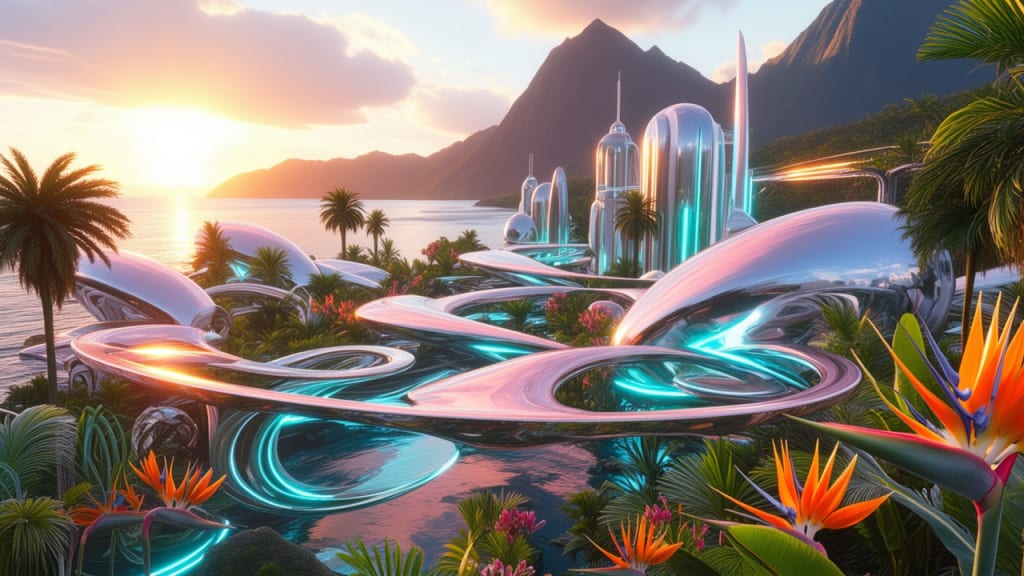
By the year 2171, Earth was no longer the center of civilization. What once was humanity’s cradle had become a distant memory – a milestone on the grand march toward the stars. Humanity had spread throughout the Solar System, and then beyond. The “Horizons” initiative — a multi-planet colonization program — changed everything.
There was no second Earth. There were twelve planets. Twelve entirely different worlds, each with its own challenges. Every colony demanded a new approach, new technology, a new philosophy of survival.
1. Arkanis Prime – Beneath the Red Dwarf
The first colony was established on Arkanis Prime — a planet orbiting a cold red dwarf. Surface temperatures rarely rose above -80°C, and cosmic radiation laced the sky like needles of light. The only solution was to build deep underground cities, powered by geothermal cores. People never saw the sky – instead, they lived in cave-like structures lit by pulsing artificial suns. Colonial psychologists introduced light rituals and simulated day cycles to preserve human mental stability.
2. Euronis – A World Without Land
Euronis was entirely covered in water – no continents, no solid ground. Colonization required the creation of floating cities, drifting like islands through perpetual storms. Built with nanofiber hulls engineered to withstand pressure and extreme temperature swings, these cities were feats of engineering. Power came from thermal-oceanic generators, harnessing the temperature difference between surface and deep waters. As for food? Grown in towering vertical greenhouses suspended alongside the floating structures.
3. Virellion – The Shifting Sky
Virellion was a trap. Its atmosphere shifted violently: from toxic gases to swirling plasma storms. Colonists survived by building mobile protective domes, drifting with the wind. Life here was all about anticipation — AI systems predicted environmental changes with second-level accuracy. Humanity became technological nomads, following the volatile rhythm of the skies, always moving to stay alive.
4. Thaleos – Floating Above a Gas Giant
The most ambitious colony was built on Thaleos — a gas giant with no surface. Cities here floated on levitating platforms, suspended in stable atmospheric layers. Massive anti-gravity turbines and magnetic repulsion systems kept the metropolises airborne. Life on Thaleos required a new mindset: there was no ground to walk on, only space and fog. People lived in constant motion — surrounded by clouds, refracted light, and the ever-present hum of atmospheric engines.
5. Calyx – The Silent Planet
Calyx was stunning — and deadly. No wind, no sound, no life. Its atmosphere was filled with microscopic crystals that interfered with electronics. Survival depended on biological technology — devices built from synthetic DNA and organic interfaces. Children born here developed the ability to interface with bio-systems directly. Calyx forced humanity to abandon traditional machines and merge with nature in ways never imagined — a bio-synthetic existence became the new standard.
New Technologies for New Life
The Horizons program sparked a renaissance of innovation: adaptive suits that changed structure based on environmental data, AI governing entire communities like ecosystems, and quantum comms linking distant worlds. Each colony was an experiment — every failure, a humbling lesson.
Nostalgia had no place here. Colonists didn’t try to recreate Earth. Instead, they learned to become something new — a version of humanity capable of thriving in the most alien conditions.
The Future of Horizons
By 2239, the Council of Colonies was formed — an independent body coordinating diplomacy, knowledge sharing, and joint research. A new culture began to emerge across worlds: shared symbols, education, language. The idea of the “Earth-born human” faded away.
New questions arose: Is this still humanity, or the beginning of something else? What is "home" when the sky changes color and a day lasts 70 hours?
Conclusion
Horizons was more than a colonization initiative. It was a declaration of courage, adaptation, and transformation. Each world was a lesson — each city, a mirror showing what we could become when we stop clinging to the familiar.
And when you gaze at the starlit sky from Thaleos, or listen to the absolute silence of Calyx, you realize: humanity didn’t just leave Earth.
It learned to live everywhere.
About the Creator
Enjoyed the story? Support the Creator.
Subscribe for free to receive all their stories in your feed.
Comments
There are no comments for this story
Be the first to respond and start the conversation.