
Honey Market Trends: Organic Demand, Natural Sweeteners & Forecast to 2034
How rising demand for natural sweeteners, increasing health awareness, and clean label preferences are transforming consumption patterns and product innovation in the honey market

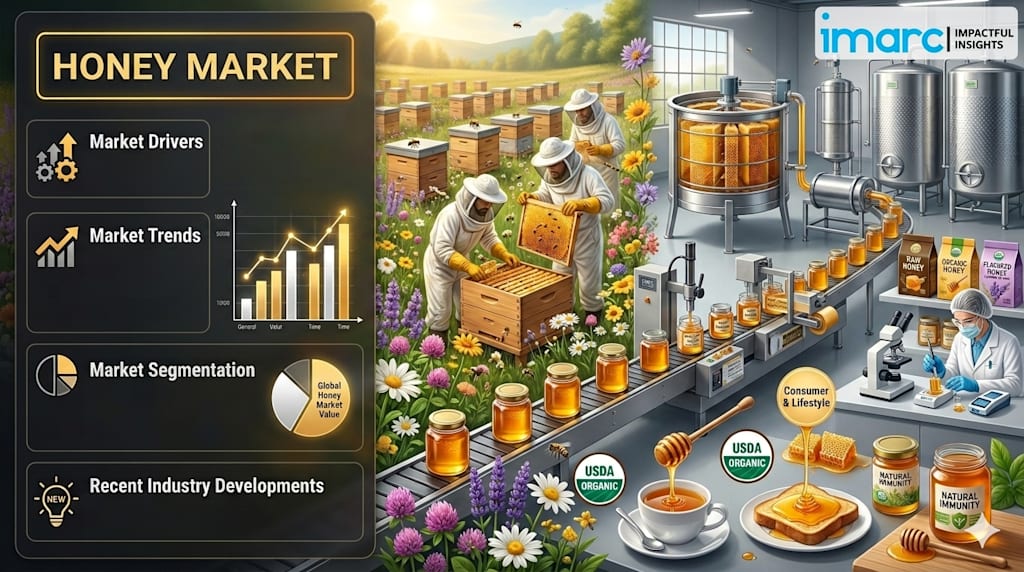
According to IMARC Group's latest research publication, The global honey market size was valued at USD 10.3 Billion in 2025. Looking forward, IMARC Group estimates the market to reach USD 16.9 Billion by 2034, exhibiting a CAGR of 5.49% from 2026-2034.
How Emerging Trends Are Reshaping the Future of the Honey Market
- Rising Consumer Preference for Natural and Organic Sweeteners: Growing health consciousness among consumers globally is fueling a measurable shift away from refined sugars and synthetic sweeteners toward natural alternatives. Honey, enriched with antioxidants, antimicrobial compounds, and essential enzymes, is increasingly positioned as a superfood rather than a simple condiment. A recent survey indicates that nearly 68% of American respondents consider maintaining healthy eating habits critical to longevity, reinforcing honey's role in daily nutrition routines. This behavioral shift is compelling food manufacturers to reformulate products with honey as a primary sweetening agent, particularly across bakery, confectionery, and beverage segments.
- Expansion of Honey Applications in Functional Food and Beverages: Honey's versatility as both a flavor enhancer and a functional ingredient is driving its penetration across high-growth food categories including energy bars, herbal teas, immunity beverages, and wellness shots. The food and beverages segment currently leads the honey market with approximately 65.8% of total market share, reflecting the ingredient's widespread adoption across culinary and industrial applications. As clean-label product demand intensifies, food processors across key markets are integrating honey as a natural binding, flavoring, and preservative alternative, reducing dependence on synthetic additives while meeting evolving regulatory and consumer standards.
- Growing Utilization in Natural Cosmetics and Personal Care Products: The global natural cosmetics industry is emerging as one of honey's most dynamic demand channels. Honey's humectant properties, moisture-retention capability, and antibacterial activity make it a preferred ingredient in skin masks, shampoos, lotions, and anti-aging formulations. With approximately 5,146 businesses operating in the cosmetic and beauty products manufacturing industry in the United States alone, the pipeline for honey-based personal care innovation is expanding rapidly. Manufacturers are leveraging honey's natural positioning to appeal to consumers who actively seek chemical-free, sustainably sourced skincare solutions.
- Pharmaceutical and Therapeutic Applications Accelerating Demand: Honey's well-documented antimicrobial, anti-inflammatory, and wound-healing properties are generating measurable traction within the pharmaceutical sector. Traditional and modern medicine systems alike incorporate honey in treatments for sore throat, cough, digestive disorders, and topical wound management. As chronic diseases including diabetes and obesity continue to rise globally, consumers and healthcare practitioners are turning to honey-based formulations as complementary therapeutic options. This convergence of folk medicine credibility with clinical validation is broadening honey's addressable market well beyond food and beverage applications.
- Digital Retail Expansion and E-Commerce Penetration: While supermarkets and hypermarkets continue to dominate distribution with approximately 43.7% of market share, online retail channels are reshaping how consumers discover and purchase honey products. E-commerce platforms enable specialty and artisanal honey producers to reach health-conscious consumers in secondary cities and niche demographic segments previously underserved by traditional retail formats. The growing availability of premium, raw, and monofloral honey varieties through digital storefronts is elevating average transaction values and enabling brands to communicate provenance, certifications, and health benefits directly to end consumers, building loyalty in an increasingly quality-discerning market.
Honey Industry Overview
Asia Pacific currently dominates the global honey market, holding a market share of over 37.6%, driven by large-scale beekeeping operations, strong domestic consumption traditions, and the region's established role as a primary supplier to global export markets. China, India, and other high-production economies across the region benefit from favorable agricultural conditions, government support for apiculture, and growing middle-class demand for natural food products. India alone recorded 41,481 food processing units as per the Annual Survey of Industries, a significant share of which are integrating honey into product formulations as natural ingredient demand rises. North America represents another critical market, supported by rising health awareness, strong retail infrastructure, and consumer willingness to pay premium prices for raw, organic, and locally sourced honey varieties. Europe, meanwhile, maintains robust demand anchored by stringent clean-label regulations that inherently favor natural sweeteners over synthetic alternatives. Across all regions, the intersection of wellness trends, regulatory frameworks promoting natural ingredients, and expanding organized retail access is creating a broadly favorable environment for honey market growth.
Honey Market Trends and Drivers
Consumer awareness of honey's multifaceted health benefits is the foundational driver sustaining global market expansion. Beyond its widely recognized role as a natural sweetener, honey is increasingly valued for its immune-supportive, antibacterial, and antioxidant properties, attributes that align directly with the preventive health priorities of modern consumers. The rise of chronic lifestyle diseases has amplified demand for dietary alternatives that offer functional value without the metabolic drawbacks associated with refined sugar consumption.
The proliferation of specialty and premium honey variants is creating differentiated demand segments and enabling producers to command higher price points. Buckwheat honey currently holds approximately 30.0% of the type segment, leading all varieties due to its distinctive robust flavor, superior antioxidant content, and strong appeal within health food and gourmet culinary communities. Monofloral varieties, including acacia, clover, and linden honey, are gaining traction among consumers seeking specific flavor profiles and traceability in their food purchases.
Government-led apiculture development programs are also reinforcing supply-side capacity while supporting rural agricultural communities. Multiple national governments across Asia, Europe, and the Middle East have introduced subsidy schemes, training programs, and quality certification frameworks aimed at strengthening domestic honey production and improving product standardization for both local consumption and export. These policy tailwinds are reducing production costs, improving product consistency, and increasing the volume of certified organic and traceable honey entering global supply chains.
The pharmaceutical segment represents a high-value growth frontier, with honey-based formulations gaining acceptance in wound care management, cough and cold treatment, and digestive health products. Regulatory approvals for medical-grade honey products across key markets are widening the therapeutic application base, attracting investment from pharmaceutical and nutraceutical manufacturers seeking to capitalize on consumer trust in natural health solutions.
Leading Companies Operating in the Global Honey Industry
- Barkman Honey LLC
- Beeyond the Hive
- Billy Bee Honey Products
- Capilano Honey Ltd
- Comvita Limited
- Dabur India Ltd.
- Dutch Gold Honey
- Forana S.A.
- Rowse Honey Ltd (Valeo Foods Group)
- Savannah Bee Company
- Sioux Honey Association Co-op
- Wedderspoon Organic
- Honey Market Report Segmentation
By Type:
- Alfalfa Honey
- Date Honey
- Buckwheat Honey
- Acacia Honey
- Clover Honey
- Linden Honey
- Others
Buckwheat honey stands as the largest type, holding approximately 30.0% of the market, driven by its rich nutritional profile, immune-enhancing properties, and strong appeal across health food and gourmet applications.
By Application:
- Food and Beverages
- Personal Care and Cosmetics
- Pharmaceuticals
- Others
Food and beverages leads with approximately 65.8% of total market share, reflecting honey's dominant role as a natural sweetening and flavoring ingredient across a wide spectrum of consumer and industrial food products.
By Distribution Channel:
- Supermarkets and Hypermarkets
- Convenience Stores
- Online Stores
- Others
Supermarkets and hypermarkets lead distribution with approximately 43.7% of market share, benefiting from high foot traffic, extensive product assortments, and promotional activity that drives consistent consumer purchase volumes.
Regional Insights:
- North America (United States, Canada)
- Asia Pacific (China, Japan, India, South Korea, Australia, Indonesia, Others)
- Europe (Germany, France, United Kingdom, Italy, Spain, Russia, Others)
- Latin America (Brazil, Mexico, Others)
- Middle East and Africa
Asia Pacific exhibits clear dominance in the honey market, holding over 37.6% of global market share, supported by large-scale apiculture infrastructure, strong export capacity, and rising domestic health-food consumption trends.
Recent News and Developments in the Honey Market
- August 2024: Nestlé's Nespresso launched honey and honey syrup under its new Nespresso Bloom product line, marking the brand's first expansion beyond coffee in its 40-year history. The honey is sourced from bees pollinating Colombian coffee plants, combining sustainability credentials with premium positioning to address growing consumer demand for natural sweetener alternatives in the beverage segment.
- October 2024: Local Hive introduced three new Hot Honey flavors, including Original, Chipotle, and Sriracha variants, now available at Walmart and through online retail channels. Each product features U.S. raw and unfiltered honey infused with spicy peppers, targeting consumers seeking bold, functional flavor profiles and reinforcing the trend of honey-based innovation within the specialty condiment category.
- March 2025: Comvita Limited announced an expansion of its Manuka honey production operations in New Zealand, investing in additional processing capacity to meet growing export demand from North American and European markets. The expansion reflects rising global consumer appetite for certified therapeutic honey products and the company's strategic commitment to scaling premium, traceable supply chains.
- June 2025: Dabur India launched a new range of certified organic honey products under its Nature's Best sub-brand, targeting health-conscious urban consumers across Tier 1 and Tier 2 Indian cities. The launch is supported by a nationwide digital marketing campaign emphasizing purity certifications, farm traceability, and honey's nutritional superiority over refined sugar, aligning with India's broader clean-label food consumption shift.
- January 2026: Capilano Honey Ltd entered into a strategic supply agreement with a leading Australian supermarket chain to expand shelf presence for its premium raw honey range across 600 additional store locations nationwide. The agreement highlights the continued prioritization of natural and functional food products within organized retail, with honey emerging as a key category driver in health-oriented grocery assortments.
Note: If you require specific details, data, or insights that are not currently included in the scope of this report, we are happy to accommodate your request. As part of our customization service, we will gather and provide the additional information you need, tailored to your specific requirements. Please let us know your exact needs, and we will ensure the report is updated accordingly to meet your expectations.
About the Creator
Abhay Rajput
I am working in market research company that provides market and business research intelligence across the globe.
Enjoyed the story? Support the Creator.
Subscribe for free to receive all their stories in your feed.
Comments
There are no comments for this story
Be the first to respond and start the conversation.