
Home Improvement Services Market Trends: Smart Renovation, DIY Influence & Industry Forecast to 2034
How rising renovation demand, smart home adoption, and digital service platforms are transforming consumer preferences and driving growth in the home improvement services market

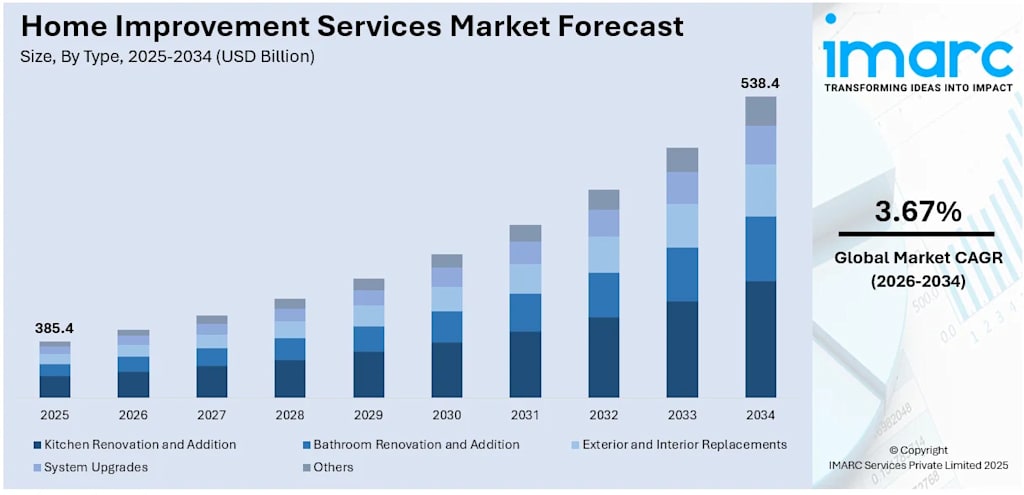
Rising demand for property value enhancement, the surge in aging housing infrastructure, and a growing interest in energy-efficient living spaces are propelling the home improvement services market. These factors are further supported by the rise of smart home integrations and favorable government tax credits for sustainable renovations. According to IMARC Group’s latest data, the global home improvement services market size was valued at USD 385.4 Billion in 2025. Looking forward, IMARC Group estimates the market to reach USD 538.4 Billion by 2034, exhibiting a CAGR of 3.67% from 2026-2034.
The home improvement services sector has transformed into a resilient multi-billion-dollar industry, now exceeding the USD 380 billion mark globally. Homeowners are increasingly shifting away from "buying new" to "improving current," driven by the "lock-in effect" where high interest rates encourage residents to stay in their existing homes and upgrade them. This trend is fueled by the need for kitchen and bathroom remodels, which remain the top spend categories, and the integration of functional upgrades like HVAC system replacements and smart security. Additionally, the market is seeing a rise in "aging-in-place" modifications as the global population grows older, necessitating accessibility features like walk-in tubs and ramp installations.
Download Exclusive Insights on the "Home Improvement Services Market" Today
Home Improvement Services Market Growth Drivers:
- Growing Aging Housing Stock and Maintenance Needs
The global residential landscape is aging, with the median age of homes in major markets like the United States now reaching over 40 years. This structural shift creates a constant demand for essential repair and maintenance services to ensure structural integrity. As property owners face deteriorating roofing, plumbing, and electrical systems, the necessity for professional intervention grows. Recent data indicates that maintenance-based projects now account for a substantial portion of contractor activity, as homeowners prioritize preserving their primary asset’s value over purely aesthetic changes.
- The "Lock-In Effect" and Rising Property Values
With mortgage rates remaining relatively high compared to previous decades, many homeowners are choosing to stay put rather than move. This "lock-in effect" has led to a surge in remodeling activities as families adapt their current spaces to meet evolving needs. By investing in extensions or interior reconfigurations, owners can increase their home equity without the high cost of a new purchase. Market figures show that home improvement spending share increased to 44% of total residential construction spending in early 2025, highlighting this shift toward renovation.
- Integration of Smart Home and Energy-Efficient Systems
Modern consumers are increasingly investing in home improvement services that lower long-term utility costs and improve convenience. The adoption of smart thermostats, high-efficiency HVAC systems, and solar panel installations is no longer a niche luxury but a standard upgrade. In many regions, government schemes such as the Inflation Reduction Act in the U.S. provide significant tax credits for weatherization and energy-saving windows. This financial incentive, combined with the desire for a "connected" home, drives consistent demand for specialized contractors capable of handling advanced technical installations.
Home Improvement Services Market Trends:
- Rise of the "Aging-in-Place" Modification Segment
A significant trend involves retrofitting homes to accommodate senior citizens who wish to remain independent. Contractors are seeing a notable increase in requests for universal design features, such as non-slip flooring, widened doorways, and lever-style handles. Surveys from the National Association of Home Builders (NAHB) show that over 55% of remodelers are now involved in aging-in-place projects. This demographic shift is turning "senior-friendly" renovations into a primary market vertical, as nearly three-quarters of respondents report rising consumer interest in these specific accessibility features for long-term residency.
- Eco-Friendly and Sustainable Material Selection
Sustainability has moved to the forefront of the home improvement industry, with a growing preference for "green" materials. Homeowners are actively seeking out low-VOC paints, reclaimed wood, and recycled insulation to reduce their environmental footprint. This shift is driven by both personal ethics and stricter building codes focused on carbon reduction. Leading service providers are now offering "green certifications" for renovations, satisfying a consumer base where a third of purchase decisions are influenced by sustainability. This trend is particularly dominant in urban centers where eco-conscious lifestyles are the norm.
- Digitalization of Project Management and AR Visualization
The way homeowners interact with service providers is being revolutionized by digital tools. The use of Augmented Reality (AR) to visualize kitchen remodels or paint colors before the first hammer is swung has become a major selling point. AI-driven project estimators and mobile apps for contractor selection are streamlining the planning process and reducing consumer anxiety over budget overruns. By providing transparent, real-time tracking of project milestones, service firms are improving customer satisfaction and efficiency, allowing for a more "hands-on" digital experience for the modern, tech-savvy homeowner.
Recent News and Developments in Home Improvement Services Market
- February 2026: The National Association of Home Builders (NAHB) reported that the Remodeling Market Index (RMI) remains consistently above the 50-point threshold, signaling sustained optimism among professional remodelers as they tackle a backlog of projects related to aging infrastructure.
- December 2025: Leading restoration and home service firms, including FirstService and Belfor, announced expanded service lines focusing on "resilient remodeling" to help homeowners in climate-affected regions prepare for extreme weather events through reinforced roofing and flood-proofing.
- September 2025: A major initiative was launched by a consortium of North American contractors to address the skilled labor shortage by partnering with vocational schools, aiming to train 50,000 new carpenters and electricians to meet the growing demand for high-end renovations.
Note: If you require specific details, data, or insights that are not currently included in the scope of this report, we are happy to accommodate your request. As part of our customization service, we will gather and provide the additional information you need, tailored to your specific requirements. Please let us know your exact needs, and we will ensure the report is updated accordingly to meet your expectations.
About the Creator
Andrew Sullivan
Hello, I’m Andrew Sullivan. I have over 9+ years of experience as a market research specialist.
Enjoyed the story? Support the Creator.
Subscribe for free to receive all their stories in your feed.
Comments
There are no comments for this story
Be the first to respond and start the conversation.