
High Purity Alumina Market Trends: LED Demand, Lithium-Ion Batteries & Industry Forecast to 2034
How LED manufacturing expansion, display technologies, and semiconductor innovation are boosting consumption patterns and production capabilities across the high purity alumina market

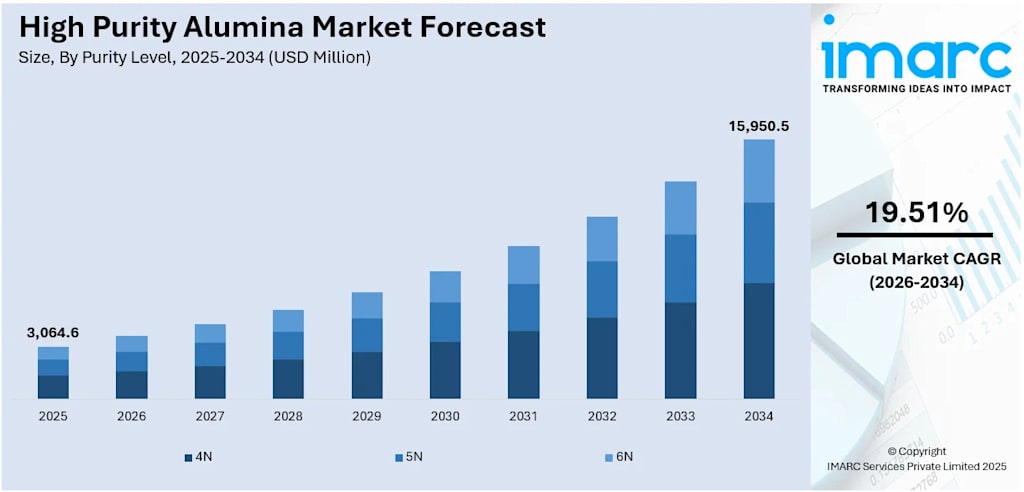
Rapid industrialization and the escalating demand for high-performance electronics and electric vehicles are steering the global high purity alumina (HPA) market toward a period of remarkable expansion. As a critical material for lithium-ion battery separators and semiconductor substrates, HPA is becoming a cornerstone of the green energy transition. According to IMARC Group’s latest data, the global high purity alumina market size was valued at USD 3,064.6 Million in 2025. Looking forward, IMARC Group estimates the market to reach USD 15,950.5 Million by 2034, exhibiting a CAGR of 19.51% from 2026-2034.
High purity alumina has evolved from a niche industrial chemical into a multi-billion-dollar strategic resource, with the global market now exceeding USD 3 billion and showing no signs of slowing down. This trajectory is fueled by the aggressive global rollout of 5G infrastructure, the miniaturization of consumer electronics, and the automotive industry’s shift toward high-capacity battery systems. Key industry segments include 4N, 5N, and 6N purity levels, with 4N alumina currently leading the market due to its extensive use in LED lighting and synthetic sapphire production.
Discover Key Trends in the "High Purity Alumina Market" – Download Now!
High Purity Alumina Market Growth Drivers:
- Explosive Growth in the Electric Vehicle (EV) Sector
The global push for sustainable mobility is a primary engine for HPA demand. High purity alumina is used as a coating on lithium-ion battery separators to prevent thermal runaway, significantly improving safety and performance. With global electric car sales reaching nearly 14 million units recently a 35% jump from previous years battery manufacturers are racing to secure high-quality materials. This surge is reflected in a market valuation of over USD 3,064 million, as HPA enables higher energy density and faster charging cycles, which are non-negotiable for the next generation of long-range electric vehicles.
- Dominance of LED Lighting and Display Technologies
Energy efficiency mandates worldwide are forcing a transition from traditional incandescent bulbs to LED variants, where HPA is essential for creating high-quality sapphire substrates. This application alone accounts for nearly 49.6% of the market share. As cities implement smart lighting projects and consumers demand high-definition displays for smartphones and tablets, the need for defect-free synthetic sapphire has skyrocketed. The sector’s stability is anchored by its role in ensuring superior thermal management, preventing overheating in compact devices, and maintaining the longevity of lighting systems in both industrial and residential settings.
- Rising Demand in Semiconductor Manufacturing
The semiconductor industry is undergoing a massive expansion driven by AI data centers and the global 5G rollout. HPA’s exceptional insulation properties and resistance to corrosion make it an ideal material for semiconductor substrates and plasma-screen cleaners. With the global consumer electronics market crossing the USD 1.2 trillion mark, the demand for precision-engineered HPA has intensified. Recent developments show that high-purity variants like 5N and 6N are increasingly sought after for specialized applications in quantum computing and high-performance sensors, where material purity directly impacts processing speeds and reliability.
High Purity Alumina Market Trends:
- Shift Toward Eco-Friendly and Low-Carbon Production
A significant trend is the industry’s move away from traditional, energy-intensive aluminum alkoxide hydrolysis toward cleaner methods like hydrochloric acid leaching from kaolin clay. Companies are now announcing breakthroughs in low-emission production; for instance, new facilities in Quebec are leveraging 100% renewable energy to bring carbon footprints to near-zero levels. This aligns with global corporate ESG goals and government pressures to decarbonize the supply chain.
- Strategic Government Support for Critical Minerals
Governments are increasingly viewing HPA as a "critical mineral" essential for national security and technological sovereignty. In 2025 and early 2026, several nations launched multi-million-dollar funding schemes to boost domestic production. Australia, for example, backed major HPA projects with over USD 400 million in debt and equity to ensure a resilient supply chain for semiconductors and batteries. These initiatives are designed to reduce dependence on a single regional source and promote local manufacturing hubs. Such policy-driven investments are creating a more stable investment landscape and accelerating the construction of large-scale refining facilities globally.
- Advancements in Medical Bio-ceramics and Aerospace
Beyond electronics, HPA is finding new frontiers in high-tech medical and aerospace applications. Its biocompatibility and extreme hardness make it a preferred material for orthopedic implants and dental prosthetics, which require materials that can withstand long-term wear within the human body. Simultaneously, in the aerospace sector, HPA-based ceramics are being used for engine components and heat shields due to their ability to maintain structural integrity at extreme temperatures.
Recent News and Developments in High Purity Alumina Market
- June 2025: Alpha HPA finalized a USD 20 Million contracting deal to begin Stage 2 of its high-purity alumina plant in Queensland. This USD 550 Million facility is heavily supported by government debt and aims to produce over 10,000 tonnes annually to meet the surging global demand for green energy materials.
- May 2025: Andromeda Metals achieved a technological milestone by producing 99.9985% purity (4N) HPA using a low-carbon process powered by renewable energy. This development targets the semiconductor and LED sectors, offering a more sustainable alternative to traditional refining methods.
- April 2025: Impact Minerals secured a 50% joint venture stake in Hipura Proprietary Limited, acquiring advanced solvent extraction technology. This move is designed to accelerate HPA production and position the company as a leading regional producer in the Asia-Pacific market.
Note: If you require specific details, data, or insights that are not currently included in the scope of this report, we are happy to accommodate your request. As part of our customization service, we will gather and provide the additional information you need, tailored to your specific requirements. Please let us know your exact needs, and we will ensure the report is updated accordingly to meet your expectations.
About the Creator
Andrew Sullivan
Hello, I’m Andrew Sullivan. I have over 9+ years of experience as a market research specialist.
Enjoyed the story? Support the Creator.
Subscribe for free to receive all their stories in your feed.
Comments
There are no comments for this story
Be the first to respond and start the conversation.