
High Performance Materials and Chemicals Market: Powering the Next Industrial Revolution
How advanced materials are quietly reshaping technology, infrastructure, and sustainability

Introduction: The Materials Behind Modern Progress
Every major technological leap—whether in artificial intelligence, electric vehicles, or renewable energy—depends on something less visible but equally critical: advanced materials. These are not ordinary substances. They are engineered to perform under extreme conditions, from intense heat inside semiconductor fabrication plants to the structural stress of aerospace systems.
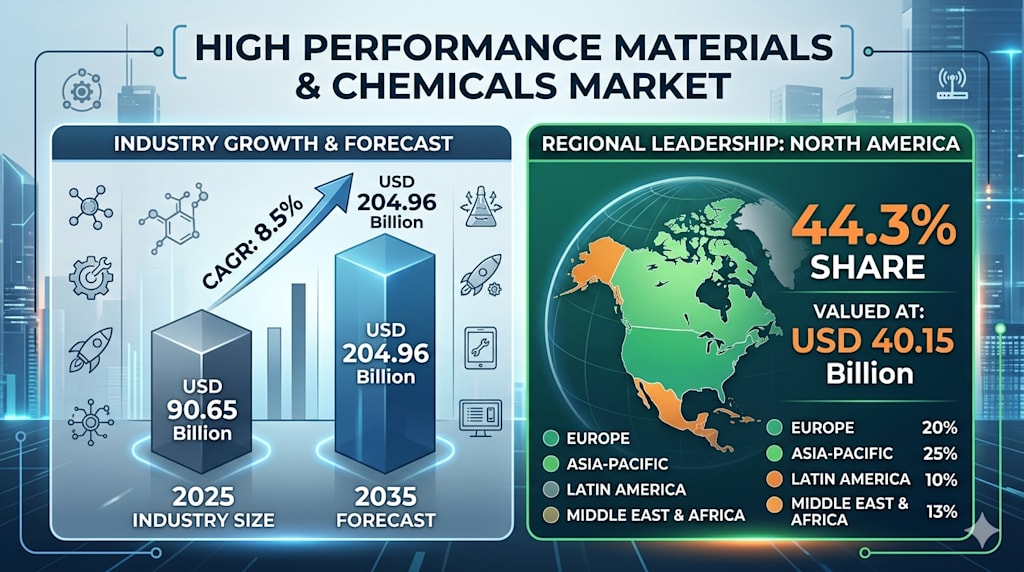
The global High Performance Materials and Chemicals Market is projected to grow from USD 90.65 billion in 2025 to approximately USD 204.96 billion by 2035, expanding at a steady 8.5% annual rate. This growth reflects a deeper shift in how industries operate. Companies are no longer choosing materials based solely on cost; they are prioritizing durability, efficiency, and environmental impact.
This transformation is not just technical—it’s strategic. Materials now sit at the center of innovation, influencing everything from supply chains to geopolitical decisions.
Market Highlights
- North America leads all regions with a 44.3% share, valued at USD 40.15 billion.
- Films dominates the Product Type segment with a 67.2% share.
- Composites leads the Material Type segment with a 43.5% share.
- Construction holds the largest Application Type segment share at 42.7%.
A Market Driven by Performance and Sustainability
At its core, this market revolves around substances designed for demanding applications. These include composites used in aircraft, specialty coatings that resist corrosion, and electronic chemicals essential for chip manufacturing. What sets them apart is their ability to deliver consistent performance in environments where failure is not an option.
But performance alone is no longer enough. Sustainability has become a parallel requirement. Industries such as automotive, electronics, and healthcare are under increasing pressure to reduce emissions and meet environmental regulations. Manufacturers are redesigning products with materials that lower environmental impact without compromising functionality.
This dual demand—high performance and sustainability—is reshaping the competitive landscape. Suppliers that can meet both criteria are gaining long-term contracts and stronger market positioning.
The Role of Technology: AI, Electronics, and Beyond
One of the strongest growth drivers is the rapid expansion of artificial intelligence and advanced computing. Data centers, which power AI systems, require materials that can handle high الحرارة and electrical loads. Specialized films and coatings are now essential for thermal management and chip packaging.
As processors become more powerful, they also generate more heat. This creates a need for materials with precise thermal conductivity and structural stability. Even minor improvements in these properties can significantly enhance performance and energy efficiency.
Beyond AI, the electronics sector as a whole is pushing material innovation forward. From smartphones to industrial automation systems, the demand for smaller, faster, and more reliable components continues to grow. This trend ensures that advanced materials remain a critical part of future technological development.
Key Segments Shaping the Industry
The market is diverse, but a few segments stand out for their dominance and influence.
Films lead the product category, accounting for over two-thirds of demand. Their importance lies in electronics manufacturing, where they are used for insulation, protection, and heat management. As devices become more compact and powerful, the need for high-quality films continues to rise.
In terms of material types, composites hold a leading position. These materials combine strength with lightweight properties, making them ideal for transportation industries. In electric vehicles, for example, reducing weight directly improves battery efficiency and driving range.
On the application side, construction remains the largest segment. Infrastructure projects increasingly rely on durable coatings, sealants, and structural materials that extend the lifespan of buildings and reduce maintenance costs. Governments worldwide are investing heavily in infrastructure, further boosting demand.
Other applications, such as healthcare and food packaging, also play important roles. In these sectors, materials must meet strict safety and regulatory standards, creating opportunities for specialized solutions.
Regional Dynamics: A Shifting Global Landscape
Geography plays a significant role in how this market evolves. North America currently leads, driven by strong policy support and investment in semiconductor and clean energy industries. Government initiatives have encouraged local production, reducing reliance on imports and strengthening domestic supply chains.
Europe, on the other hand, faces structural challenges. High energy costs and strict regulations have made large-scale chemical production less competitive. However, the region continues to excel in high-value specialty materials, where quality and innovation outweigh cost considerations.
Asia-Pacific is emerging as a powerhouse of production. Countries like China are rapidly expanding capacity, particularly in metals and advanced manufacturing materials. At the same time, efforts to adopt greener production methods are gaining momentum, aligning with global sustainability goals.
Meanwhile, regions such as Latin America and the Middle East are gradually entering the market. Investments in infrastructure and industrial diversification are creating new demand, especially for construction-related materials and coatings.
Challenges That Could Slow Growth
Despite strong momentum, the market is not without obstacles. One of the most pressing issues is the high cost of capital. Developing new materials or building production facilities requires significant investment, and rising interest rates have made financing more difficult.
This challenge is particularly evident in Europe, where companies are delaying or scaling back expansion plans. Instead of building new capacity, many are focusing on optimizing existing operations. While this approach maintains stability, it can limit long-term growth.
Another concern is supply chain complexity. As materials become more specialized, sourcing raw inputs and ensuring consistent quality becomes increasingly difficult. Geopolitical tensions and trade restrictions add another layer of uncertainty, forcing companies to rethink their sourcing strategies.
Emerging Trends: Specialization and Strategic Focus
One of the most notable trends is the shift toward specialized, standalone companies focused entirely on advanced materials. Large industrial firms are spinning off these divisions to create more agile and targeted businesses. This allows them to invest more effectively in high-growth areas such as electronics and sustainable materials.
Innovation is also moving toward circular solutions. Companies are developing materials that can be recycled or derived from renewable sources, addressing both environmental concerns and regulatory requirements. This trend is especially strong in industries like automotive and packaging.
Another emerging pattern is the increasing importance of certification and traceability. Buyers now demand proof that materials meet environmental and performance standards. This has turned compliance into a competitive advantage, rather than just a regulatory requirement.
Conclusion: Materials as the Foundation of Future Innovation
The evolution of advanced materials is shaping industries in ways that are both visible and subtle. From enabling faster computing to supporting cleaner energy systems, these materials form the backbone of modern innovation.
The growth of the High Performance Materials and Chemicals Market reflects more than just rising demand—it signals a shift in priorities. Performance, sustainability, and reliability are now interconnected, influencing decisions across industries and regions.
The companies that succeed will be those that adapt quickly to changing requirements. They will invest in innovation, build resilient supply chains, and align their offerings with both technological and environmental goals.
In many ways, the future of industry depends not just on what we build, but on what we build it with.
About the Creator
Yash Mule
SEO Specialist with 10+ years of experience at Evolvance Market Research. Expert in technical SEO, content strategy, and data-driven optimization, with a proven track record of significantly increasing organic traffic and search rankings.
Enjoyed the story? Support the Creator.
Subscribe for free to receive all their stories in your feed.
Comments
There are no comments for this story
Be the first to respond and start the conversation.