
Hempcrete Market Set to Reach US$ 38.69 Billion by 2033 as Sustainable Construction Reshapes Global Building Industry
Eco-Friendly Building Materials Gain Momentum as Governments, Builders, and Consumers Prioritize Carbon-Negative Construction Solutions

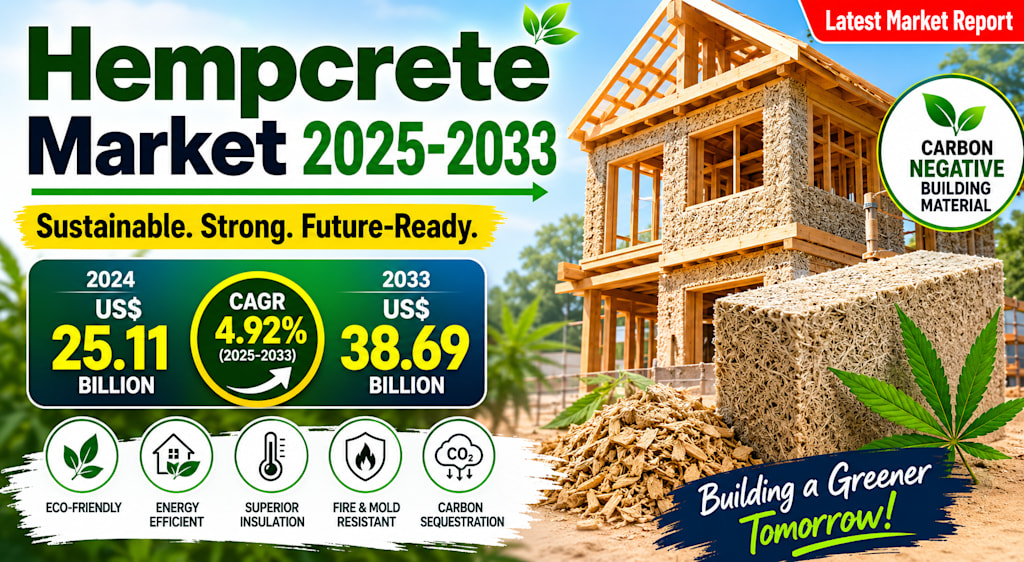
Hempcrete Market Growth Accelerates Amid Global Push for Sustainable Construction
The construction industry is undergoing one of the most significant transformations in its history. As climate concerns intensify and governments worldwide tighten environmental regulations, builders and developers are actively searching for sustainable alternatives to traditional construction materials.
Among the most promising innovations is hempcrete, a bio-composite building material derived from industrial hemp. Once considered a niche solution for eco-conscious builders, hempcrete is rapidly gaining recognition as a mainstream construction material capable of helping the world reduce carbon emissions while improving energy efficiency.
According to Renub Research, the Global Hempcrete Market is projected to grow from US$ 25.11 billion in 2024 to US$ 38.69 billion by 2033, expanding at a CAGR of 4.92% between 2025 and 2033.
This growth reflects a broader shift toward environmentally responsible construction practices and the increasing adoption of sustainable building materials across residential and commercial projects.
What Is Hempcrete and Why Is It Important?
Hempcrete is a mixture of hemp hurd (the woody core of the hemp plant), water, and a lime-based binder. Unlike traditional concrete, hempcrete is lightweight and non-structural, meaning it is typically used as an insulating material rather than a load-bearing component.
Its unique properties have made it increasingly attractive to architects, builders, and environmental advocates.
Key benefits include:
Excellent thermal insulation
Natural moisture regulation
Mold and pest resistance
Fire-resistant characteristics
Reduced environmental impact
Carbon sequestration capabilities
Improved indoor air quality
One of hempcrete's most remarkable advantages is its ability to absorb more carbon dioxide throughout its lifecycle than is emitted during production, making it a carbon-negative building material.
As countries pursue net-zero carbon goals, materials like hempcrete are becoming central to sustainable construction strategies.
Sustainability Trends Driving Market Expansion
The demand for environmentally responsible construction materials continues to rise globally.
Traditional building materials such as concrete and steel are major contributors to greenhouse gas emissions. As governments and industries seek ways to reduce their environmental footprint, hempcrete offers an attractive alternative.
Green building certifications such as LEED and BREEAM increasingly encourage the use of sustainable materials, creating additional incentives for builders to adopt hempcrete.
Consumers are also becoming more environmentally conscious. Homebuyers now place greater value on energy efficiency, sustainability, and healthy indoor environments, all of which align with hempcrete's benefits.
This growing environmental awareness is expected to remain one of the strongest growth drivers for the hempcrete market over the next decade.
Energy Efficiency Creates Strong Demand
Energy costs continue to rise worldwide, placing greater emphasis on efficient building design.
Hempcrete's superior insulation performance allows buildings to maintain more stable indoor temperatures throughout the year. This reduces reliance on heating and cooling systems and lowers energy consumption.
The material's natural thermal mass helps regulate temperature fluctuations, making it particularly valuable in regions experiencing extreme weather conditions.
As governments implement stricter building efficiency standards and consumers seek lower utility bills, hempcrete's energy-saving capabilities become increasingly attractive.
Passive house projects and net-zero energy buildings are especially driving demand for hempcrete-based insulation systems.
Government Policies Supporting Industry Growth
Supportive government regulations are playing a crucial role in market expansion.
Many countries have begun relaxing restrictions surrounding industrial hemp cultivation, increasing the availability of raw materials needed for hempcrete production.
Public investments and sustainability-focused incentives are also helping accelerate adoption.
Governments recognize that sustainable construction materials can contribute significantly to national climate objectives.
In the United States, support for hemp-based construction materials has increased following industrial hemp legalization measures and sustainability-focused initiatives.
Similarly, European nations continue to provide favorable conditions for green construction projects, strengthening the market outlook for hempcrete manufacturers and suppliers.
Residential Construction Remains the Largest Opportunity
The residential sector represents one of the most important growth segments within the hempcrete market.
Homeowners increasingly seek healthier living environments, lower energy bills, and sustainable building materials.
Hempcrete is being incorporated into:
Single-family homes
Eco-villages
Off-grid housing projects
Luxury sustainable residences
Renovation and retrofit projects
Its breathable nature helps maintain indoor comfort while reducing moisture-related issues often associated with traditional construction materials.
As sustainability becomes a major purchasing factor for homebuyers, residential demand is expected to continue expanding throughout the forecast period.
Commercial Construction Adoption Continues to Rise
While residential applications dominate current demand, commercial and institutional projects are increasingly embracing hempcrete.
Office buildings, schools, hotels, resorts, and public infrastructure projects are exploring hempcrete as part of broader sustainability initiatives.
Organizations pursuing green building certifications are particularly attracted to hempcrete's environmental credentials and insulation performance.
Corporate sustainability commitments and environmental reporting requirements are further encouraging the adoption of innovative construction materials that help reduce carbon footprints.
As awareness grows, non-residential applications are expected to contribute significantly to future market growth.
Wall Applications Lead Market Demand
Among application categories, wall systems account for the largest share of hempcrete usage.
Hempcrete walls offer:
Excellent thermal insulation
Improved acoustic performance
Enhanced moisture control
Greater energy efficiency
Long-term durability
Builders frequently use hempcrete as infill material within timber-framed structures, creating energy-efficient buildings with superior environmental performance.
Growing interest in sustainable architecture has strengthened demand for hempcrete wall systems across Europe, North America, and emerging green construction markets.
Roofing and Flooring Applications Gain Momentum
Roofing applications are becoming increasingly important within the hempcrete market.
The material's lightweight characteristics and insulation properties make it well suited for roofing systems, particularly in environmentally focused construction projects.
Similarly, hempcrete flooring solutions are gaining attention due to their thermal performance and sustainable composition.
As architects seek holistic sustainable building solutions, hempcrete is finding applications throughout entire building envelopes rather than being limited to wall insulation alone.
Regional Markets Show Strong Growth Potential
France Maintains Global Leadership
France remains the global leader in hempcrete adoption.
The country's established industrial hemp industry, mature supply chains, and widespread awareness have created ideal conditions for hempcrete growth.
French builders have decades of experience working with hemp-based materials, making France one of the most advanced hempcrete markets worldwide.
United States Expands Rapidly
The United States is emerging as a major growth market.
The legalization of industrial hemp cultivation has improved raw material availability and encouraged innovation throughout the industry.
Growing consumer demand for sustainable housing and increasing investment in green building technologies are helping drive adoption.
Several American startups are actively developing advanced hempcrete solutions designed to meet modern construction requirements.
India Presents Significant Long-Term Opportunity
India is gradually embracing sustainable construction practices, creating opportunities for hempcrete adoption.
States such as Uttarakhand and Himachal Pradesh have shown growing interest in industrial hemp cultivation and eco-friendly construction.
With rapid urbanization, increasing environmental awareness, and rising demand for affordable sustainable housing, India could become an important future market for hempcrete manufacturers.
UAE Explores Sustainable Building Alternatives
The UAE's commitment to sustainability and carbon reduction initiatives has increased interest in innovative construction materials.
Luxury residential projects, eco-resorts, and green commercial developments are exploring hempcrete's potential.
Given the region's extreme temperatures, hempcrete's insulation capabilities provide substantial advantages for energy-efficient construction.
Challenges Facing the Hempcrete Industry
Despite strong growth prospects, several challenges remain.
The most significant limitation is that hempcrete is not a structural material. It cannot replace traditional concrete or steel in load-bearing applications and must be used alongside structural frameworks.
Other challenges include:
Limited public awareness
Supply chain constraints
Regulatory uncertainties in some regions
Higher upfront costs
Limited manufacturing infrastructure
Addressing these barriers will be essential for achieving large-scale adoption and maximizing market potential.
10 Recent Developments Shaping the Hempcrete Market
1. Hempitecture Inc.
Released ASTM E84-tested hemp lime insulation solutions demonstrating enhanced fire resistance and safety standards.
2. Americhanvre
Successfully validated Spray-On Hempcrete systems through advanced fire performance testing for commercial applications.
3. IsoHemp
Expanded manufacturing capabilities to meet growing European demand for sustainable building materials.
4. Lime Technology
Introduced advanced hemp-lime construction systems focused on energy-efficient residential buildings.
5. Just BioFiber Structural Solutions
Enhanced bio-based building technologies aimed at reducing construction carbon emissions.
6. HempEco Systems
Strengthened sustainable construction partnerships across North American markets.
7. Australian Hemp Masonry Company
Expanded awareness programs promoting hemp-based construction throughout Australia.
8. Hemp Block USA
Increased production capacity to support growing demand for hemp building products.
9. Dun Agro Hemp Group
Invested in industrial hemp processing infrastructure to improve supply chain efficiency.
10. Hempcrete Natural Building Ltd.
Continued advancing eco-friendly building solutions through innovative hempcrete applications and construction techniques.
Final Thoughts
The global hempcrete market is entering a pivotal growth phase. As governments, developers, and consumers increasingly prioritize sustainability, hempcrete offers a compelling solution that combines environmental responsibility with practical construction benefits.
Its carbon-negative profile, superior insulation capabilities, and alignment with green building initiatives position hempcrete as one of the most promising materials in the future of sustainable construction.
While challenges related to awareness, infrastructure, and structural limitations remain, continued technological advancements and supportive policies are expected to drive broader adoption worldwide.
With the market forecast to reach US$ 38.69 billion by 2033, hempcrete is no longer simply an alternative building material—it is becoming a cornerstone of the global movement toward greener, healthier, and more energy-efficient buildings.
About the Creator
Enjoyed the story? Support the Creator.
Subscribe for free to receive all their stories in your feed.
Comments
There are no comments for this story
Be the first to respond and start the conversation.