
Hair Oil Market Growth: The $54 Billion Category the West Underestimated
A practice rooted in millennia of tradition is now one of beauty's fastest-growing global markets.

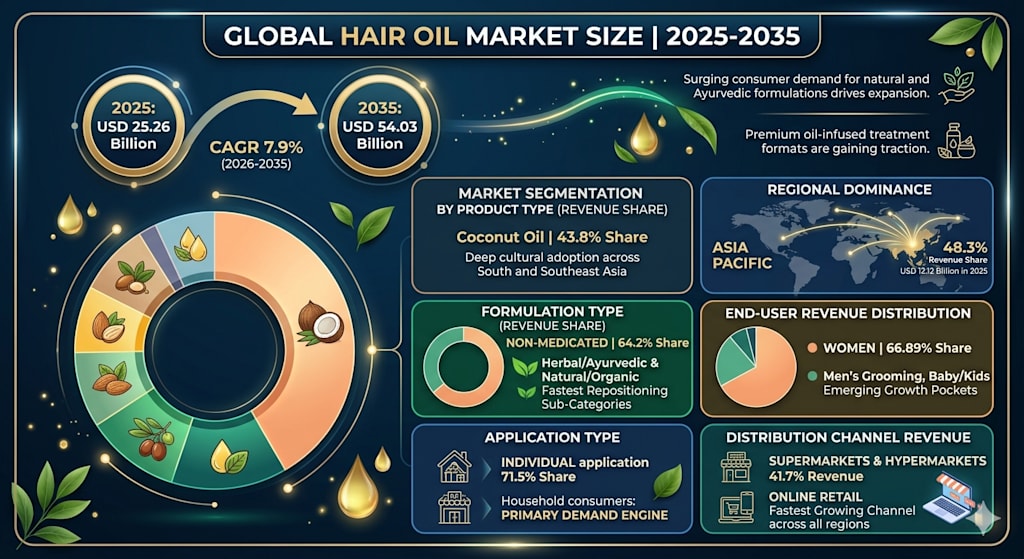
Hair Oil Is a $25 Billion Industry. Western Beauty Media Has Barely Noticed.
Coconut oil has been applied to scalps in South Asia for roughly three thousand years. Ayurvedic texts from the first century AD documented amla oil as a treatment for hair fall. None of that history stopped the Western beauty industry from treating hair oiling as a "trend" when it started appearing on TikTok around 2022 — as though the practice had been invented by an influencer rather than predating most of the countries those influencers live in.
The global hair oil market is currently valued at $25.26 billion in 2025 and is projected to reach $54.03 billion by 2035, growing at a CAGR of 7.9%. Full segment and regional figures are covered in this global hair oil industry research overview. The market's growth trajectory reflects genuine demand — not a passing aesthetic moment.
Asia Pacific Is Not Just a Market. It Is the Foundation.
Forty-eight percent of global hair oil revenue originates in Asia Pacific, valued at $12.12 billion in 2025 alone. That concentration makes sense when you understand the cultural architecture of the category. In India, oiling is not a wellness ritual adopted from a YouTube tutorial. It is a routine passed between generations, practiced before school on weekday mornings, embedded in the social fabric of family life. Marico, the Indian FMCG company behind Parachute coconut oil, reported in its 2024 investor disclosures that 64.7% of surveyed consumers use hair oil overnight — treating it as therapeutic rather than purely cosmetic.
Coconut oil commands 43.8% of the global market by product type, and that dominance is built on exactly this kind of deep-rooted usage. Argan oil and amla oil are growing faster in percentage terms, largely driven by premiumization, but coconut oil's sheer installed base across South and Southeast Asia makes it structurally resistant to displacement.
The Premiumization Push Is Real, But It Has Limits
The story Western beauty brands are telling themselves goes roughly like this: hair oiling is now mainstream in high-income markets, therefore premium-priced serums and oil hybrids will convert existing consumers to higher ticket products. That logic is not entirely wrong. Serum-oil hybrids are among the fastest-repositioning sub-categories in the segment, and prestige channels are growing. L'Oréal and Unilever have both extended into oil-adjacent hair treatment formats in recent years, clearly sensing category momentum.
But non-medicated formulations still hold 64.2% of global revenue, and herbal and Ayurvedic formats are growing fastest not because they are premium but because they are trusted. The consumer in Tamil Nadu buying Kesh King or Dabur Amla is not buying an aspirational product. She is buying a functional one she has used since childhood. Premiumization works at the margins of this market. The core of it runs on efficacy perception, not price signaling.
The Channel Shift That Actually Matters
Supermarkets and hypermarkets still account for 41.7% of hair oil revenue globally. For a category this mature, that number is not surprising. What is more interesting is how quickly online retail is taking share across every region simultaneously. The category's replenishment nature — people buy the same oil repeatedly, in predictable volumes — makes it well-suited to subscription and auto-replenishment models on platforms like Amazon and Nykaa.
India's Nykaa has been particularly effective here, building a digital channel where premium hair oil brands can reach urban consumers who might not encounter them in a local kirana store. This dynamic is replicated in different forms across Southeast Asian markets through platforms like Shopee and Lazada. The hair oil market growth being driven by online retail is not a story about disruption — it is a story about access, reaching consumers in geographies and income brackets that traditional retail missed.
Men's Grooming and the Baby Segment Are the Quiet Upside
Women account for 66.89% of hair oil end-user revenue globally. That figure is expected, given the category's historical marketing orientation. What is worth watching is what sits in the remaining third. Men's grooming has grown as a deliberate expansion target for brands like Bajaj Consumer Care, which markets Bajaj Almond Drops explicitly to male consumers through sports sponsorships and mass media. The baby and kids segment is growing separately, driven by parental demand for natural, chemical-free formulations that have clear ingredient provenance.
Neither segment is about to overturn the category's demographic fundamentals. But both represent addressable pockets of growth that do not require convincing anyone that hair oiling is a good idea — just that a particular product works for a consumer who was previously underserved by existing options.
Where the Category Goes by 2035
The next decade in hair oil will be shaped by two forces pulling in opposite directions. The first is ingredient science. Scalp health has emerged as a clinical positioning claim, with brands investing in microbiome research and dermatologist-backed formulations that blur the line between cosmetic and medicated products. The second is heritage. Consumers in high-growth markets are not moving away from traditional Ayurvedic and herbal formulations — they are demanding that those formulations be verified, traceable, and free of adulteration. The brands that can hold both of those ideas simultaneously, modern efficacy standards applied to ancient ingredient knowledge, are the ones positioned to define what $54 billion looks like in 2035.
About the Creator
Suge kun
Research Analyst passionate about data & market insights. I turn complex information into clear, actionable strategies. Detail-driven & results-focused — helping businesses make smarter decisions. — Suge Kun
Enjoyed the story? Support the Creator.
Subscribe for free to receive all their stories in your feed.
Comments
There are no comments for this story
Be the first to respond and start the conversation.