
Hair Loss Treatment Market: The Female Majority Nobody Is Serving Yet
With women driving 71% of revenue and biotech pouring in capital, the real market story is not about shampoo.

Women Are the Hair Loss Market's Biggest Customers. Nobody Is Marketing to Them That Way.
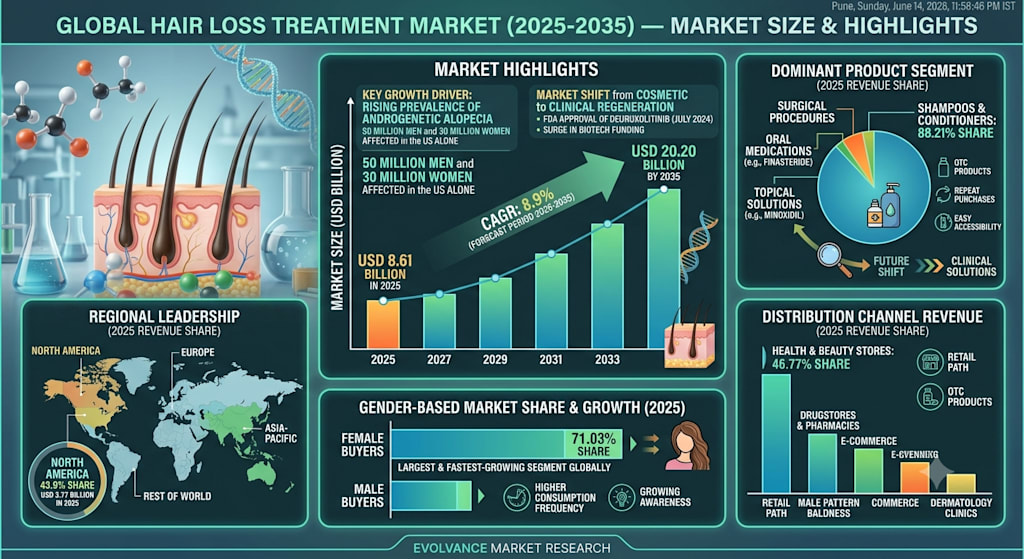
Shampoos account for 88.21% of all hair loss treatment revenue globally. That number sounds like a market dominated by drugstore basics, but it obscures something more interesting: the global hair loss treatment market reached USD 8.61 billion in 2025 and is on track for USD 20.20 billion by 2035 at an 8.9% CAGR, with women representing 71.03% of revenue by gender, North America holding 43.9% at USD 3.77 billion, and a biotech pipeline now receiving the kind of capital (Pelage Pharmaceuticals closed a USD 120 million Series B in October 2025, co-led by ARCH Venture Partners and GV) that signals the category is shifting from cosmetic management toward clinical regeneration.
The full breakdown across product type, disease indication, route of administration, and distribution channel is covered in this hair loss treatment industry segment and forecast reference. What sits beneath those numbers is a market structured almost entirely around male androgenetic alopecia that is being quietly taken over by female buyers who have different needs, different treatment responses, and almost no dedicated premium products designed specifically for them.
The Female Majority Nobody Built Products For
Forty percent of women experience pattern hair loss by age 50. Postpartum shedding affects a significant portion of new mothers within months of delivery, and postmenopausal diffuse thinning is pervasive enough to have its own clinical literature. Yet the treatment aisle at any major pharmacy looks roughly the same as it did fifteen years ago: minoxidil formulations calibrated for male pattern baldness, branded with packaging that barely acknowledges female physiology exists. The result is a USD 6-billion female-majority market being served by products designed for the other 29%.
This is not a minor oversight. Female hair loss responds poorly to male-formulated topical concentrations, partly due to application zone differences and partly because the hormonal mechanisms diverge significantly across androgenetic alopecia, telogen effluvium, and postmenopausal diffuse loss. Brands that have recognized this, including Nutrafol with its clinical-grade supplement positioning, have captured loyal repeat-purchase audiences without meaningful competition from the consumer health majors. Procter and Gamble, Unilever, and L'Oreal have the distribution relationships and retail authority to dominate this space. So far, none of them has committed to a differentiated female-focused clinical OTC line with the same conviction they bring to skincare.
The Telehealth Effect on Prescription Access
Hims and Hers Health reported 2.2 million subscribers in 2024, up 45% year-over-year. That growth tells you something specific about where the market is moving beyond retail: online prescription access removed the main friction point keeping female patients away from finasteride and oral minoxidil. Dermatologist visits require appointments, referrals in some markets, and the willingness to discuss an emotionally loaded condition in person. Telehealth platforms replace all of that with a ten-minute intake form and a pharmacy delivery.
The pharmacy channel itself benefits from every OTC reclassification and new approval, functioning as a structurally durable revenue floor regardless of which brand is winning at any given moment. What telehealth platforms add is speed of adoption: a new oral minoxidil formulation clears FDA review, and within weeks, Hims and Hers and Roman Health have it in their prescribing catalog, reaching patients who would not have seen a dermatologist for another year. Health and beauty stores still anchor 46.77% of distribution revenue because physical retail allows label inspection and product comparison that online purchase cannot fully replicate, but the prescription tier is now genuinely contested by DTC operators in a way it was not five years ago.
The JAK Inhibitor Opening and What Comes After
FDA approval of deuruxolitinib (Leqselvi) from Incyte Corporation in July 2024 validated JAK inhibitors as a commercial prescription class for alopecia areata. This matters beyond the specific condition. Regulatory validation of a new mechanism class signals to investors and development teams that approval pathways are navigable, which pulls forward pipeline funding for adjacent indications. Alopecia areata affects a smaller patient population than androgenetic alopecia, but the clinical willingness to pay is substantially higher, and the prescriber base (dermatologists already familiar with JAK inhibitor safety profiles from rheumatology and dermatitis) is already in place.
The more consequential near-term development is Cosmo Pharmaceuticals advancing clascoterone 5% topical solution, which showed 53.9% improvement in target area hair count versus placebo in male pattern hair loss Phase 3 trials, toward FDA and EMA submissions. Clascoterone is an androgen receptor antagonist that acts locally without systemic hormonal effects, which makes it directly applicable to female pattern hair loss in a way that finasteride is not. If that NDA clears, it fills a gap that has existed in the prescription market for decades.
Where Stem Cell Science Stands Right Now
Pelage Pharmaceuticals' Phase 2a results from June 2025 are the most specific clinical data available on follicle stem cell reactivation: 31% of men with higher-degree hair loss achieved more than 20% increase in hair density at week eight, against 0% in the placebo group. Those numbers represent a clean signal in a development category that has generated more press than clinical evidence for years. Phase 3 initiation is planned for 2026 following the Series B close.
Veradermics (NYSE: MANE) raised USD 256 million in a February 2026 IPO priced at the higher end of range, with VDPHL01 targeting an NDA filing that would mark the first new oral non-hormonal treatment for pattern hair loss in nearly thirty years. A successful approval in 2027 or 2028 would open prescribing conversations with the substantial patient population that avoids finasteride due to systemic hormonal concerns, including most female patients of childbearing age. That is not a niche.
Absci's Phase 1/2a initiation for ABS-201, an anti-PRLR antibody targeting a biologic pathway entirely separate from androgen signaling, extends the pipeline further into immunological mechanisms that carry different side-effect profiles and potentially different patient populations.
Exosome-based treatments are already in over 500 US dermatology clinics despite operating in a formal regulatory gray zone: neither classified as drugs nor approved as cosmetics by the FDA or EMA as of 2025. Seoul-based clinical applications have shown hair density increases of 14 to 29% within months, outperforming traditional topical minoxidil benchmarks in comparative assessments. Premium patients in GCC countries and major urban markets in the US and South Korea are already paying out-of-pocket for clinic-administered exosome protocols based on these results, without waiting for regulatory resolution.
Why Asia Pacific Is the Region to Watch Through 2035
South Korea operates the densest dermatology clinic network relative to population among major markets, and its domestic patent filings in follicle-stimulating compounds make it the region's active clinical development hub. Japan's aging demographic base generates persistent structural demand that is insensitive to economic cycles. China and India contribute volume growth tied to rising middle-class health spending on premium treatments that were simply not accessible or affordable to most urban consumers a decade ago.
The hair loss treatment market growth trajectory in Asia Pacific differs from North America's maturation pattern in one specific way: the OTC channel is less saturated, which means category entry is still being shaped by first-mover positioning rather than brand switching. Consumer brands with distribution relationships in Southeast Asian pharmacy chains and with Korean or Japanese clinical credibility are entering markets where the reference product for many buyers is still a basic shampoo. The distance between that entry point and a mid-tier prescription oral treatment is exactly the commercial opportunity that telehealth-adjacent platforms are building toward in the US, and that the dermatology clinic networks in Seoul and Tokyo have already partially captured.
Pipeline timelines of 2028 to 2029 for the most advanced regenerative candidates mean the next four years belong to whoever executes best on the female segment with currently approved mechanisms, on oral minoxidil adoption through digital prescription channels, and on building the clinical-grade OTC positioning that no consumer health major has yet fully committed to. The brands that own that positioning when the stem cell and androgen receptor inhibitor approvals arrive will be the ones with the installed patient relationships to convert new clinical options into durable revenue rather than starting acquisition from scratch.
About the Creator
Suge kun
Research Analyst passionate about data & market insights. I turn complex information into clear, actionable strategies. Detail-driven & results-focused — helping businesses make smarter decisions. — Suge Kun
Enjoyed the story? Support the Creator.
Subscribe for free to receive all their stories in your feed.
Comments
There are no comments for this story
Be the first to respond and start the conversation.