
Gypsum Board Market Strengthens with Investments in Modern Infrastructure
Increasing infrastructure investments and renovation projects are strengthening demand for advanced gypsum board solutions across residential and commercial sectors

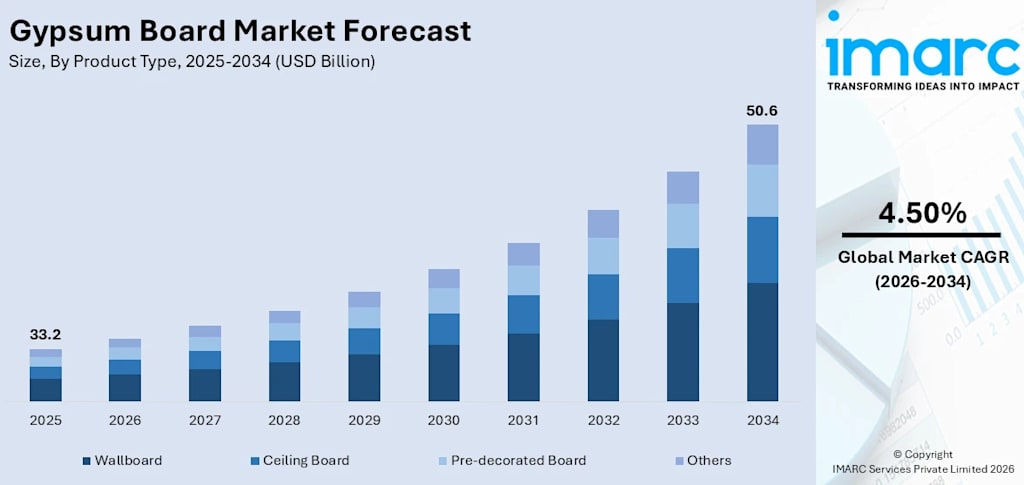
Rapid urbanization, expanding real estate development, and a strong preference for modern, lightweight construction materials are driving global gypsum board demand, supported by green building initiatives, dry construction trends, and high-performance product innovations. According to IMARC Group’s latest data, The global gypsum board market size was valued at USD 33.2 Billion in 2025. Looking forward, IMARC Group estimates the market to reach USD 50.6 Billion by 2034, exhibiting a CAGR of 4.50% from 2026-2034.
Gypsum boards now represent a multi-billion-dollar global building material market exceeding USD 30 billion and exhibiting steady year-on-year expansion. Demand is driven by accelerating commercial and residential real estate starts, busy project timelines that favor rapid dry construction over traditional wet plastering, and an increased interest in lightweight, fire-resistant, and high-purity architectural designs. Manufacturing innovation and structural engineering trends, such as factory-fabricated panel systems and custom sound-insulating formats, are further accelerating uptake.
Gypsum Board Market Growth Drivers:
- Accelerating Residential and Commercial Real Estate Development
Surging global populations and accelerating urban migration demand rapid, high-volume property development, challenging developers to adopt materials that compress project timelines. The global housing sector faces massive structural pressures, with international bodies highlighting the ongoing need for thousands of daily housing completions to support rising urban dense populations. Gypsum boards provide a scalable, fast-to-install alternative to slow brick-and-mortar setups, serving as the essential substrate for modern interior design. Commercial spaces, including expansive corporate towers, shopping malls, and institutional health complexes, depend heavily on these lightweight panel systems to create adaptable workspaces.
- Rising Demand for Fire-Resistant and High-Performance Building Materials
Modern building safety codes enforce strict performance standards, making non-combustible building materials a fundamental requirement rather than an optional choice for real estate developers. Gypsum boards feature a unique chemically combined water core that actively resists extreme heat transmission, providing vital passive fire protection during structural crises. This performance-driven safety profile increases its specification across multi-family residential complexes and high-density corporate structures. Additionally, advanced manufacturing allows for the engineering of high-density acoustic barriers and mold-resistant surfaces, ensuring deep application across critical infrastructure like healthcare corridors, recording studios, and modern educational classrooms.
Get Expert Analysis and Forecasts for the Gypsum Board Market!
- Widespread Shift Toward Modular and Prefabricated Construction Methods
Global construction industries are shifting away from traditional, labor-intensive on-site wet plastering to focus heavily on fast, standardized off-site prefabrication and modular dry construction. Gypsum boards are perfectly suited for factory-automated production lines, allowing manufacturers to seamlessly pre-integrate complete wall panel assemblies and ceiling systems before transport. This structural compatibility significantly cuts down on-site manual labor costs, limits structural building waste, and minimizes expensive weather-related project delays. The ongoing optimization of standardized board dimensions ensures rapid deployment across large-scale student housing facilities, emergency relief structures, and high-volume commercial developments worldwide.
Gypsum Board Market Trends:
- Sustainability and Eco-Friendly Green Building Initiatives
Architects and construction organizations are prioritizing green building certifications like LEED, driving massive manufacturing shifts toward low-carbon and highly recyclable building materials. Industry leaders are redesigning raw material sourcing, heavily substituting traditional mined rocks with advanced synthetic flue gas desulfurization options and high-ratio recycled material streams. Real-world applications are expanding due to direct government interventions, such as circular economy initiatives and corporate sustainability incentives that reward low-impact building techniques. Large commercial developments and infrastructure projects utilize these eco-certified panels to actively lower their embedded carbon footprint while maintaining high structural performance.
- Advanced Product Formulations and Multifunctional Material Innovations
The global industry is experiencing a massive wave of high-tech material innovations aimed at boosting everyday interior air quality and structural durability. Leading manufacturers are introducing specialty multi-attribute product lines engineered with active air-purifying properties that absorb indoor chemical pollutants like volatile organic compounds and formaldehyde. Furthermore, specialized options like high-strength boards designed for heavy structural loading and heavy-duty outdoor weather layers are successfully expanding into non-traditional exterior wall systems. These material innovations allow builders to tackle severe climatic challenges and complex spatial demands while eliminating complex multi-stage installation procedures.
- Strategic Portfolio Expansion and Localized Manufacturing Facilities
Major market participants are heavily investing in localized, state-of-the-art production plants situated close to major logistics hubs to mitigate high transportation costs and supply chain disruptions. Establishing high-capacity localized manufacturing units enables companies to deliver consistent material supplies directly to rapid urban construction projects while shielding developers from global tariff swings. Recent industrial investments underscore this regionalized focus, with companies setting up multi-million-dollar production spaces across emerging zones to target specific infrastructure requirements. This trend ensures robust, high-volume local availability while allowing brands to customize thickness levels and core compositions for regional architectures.
Recent News and Developments in Gypsum Board Market
- May 2025: Coromandel Chemicals Limited entered into a strategic joint venture with Sakarni Plaster to establish a manufacturing plant in Visakhapatnam focused on producing eco-friendly, low-carbon phosphogypsum green building materials, supporting local circular economy goals.
- February 2025: CGC announced the commercial launch of its Sheetrock Brand UltraLight PRO Panels, featuring an advanced core structure that reduces overall weight by nearly nine percent while boosting edge strength to protect against installation damage.
- February 2025: Industrial House for Building Materials announced a strategic partnership with the Suez Canal Economic Zone to construct a new twelve-million-dollar gypsum wallboard facility in Egypt's Technology Valley to supply global modular construction sectors.
Note: If you require specific details, data, or insights that are not currently included in the scope of this report, we are happy to accommodate your request. As part of our customization service, we will gather and provide the additional information you need, tailored to your specific requirements. Please let us know your exact needs, and we will ensure the report is updated accordingly to meet your expectations.
About the Creator
Andrew Sullivan
Hello, I’m Andrew Sullivan. I have over 9+ years of experience as a market research specialist.
Enjoyed the story? Support the Creator.
Subscribe for free to receive all their stories in your feed.
Comments
There are no comments for this story
Be the first to respond and start the conversation.