
Green Chemistry Goes Mainstream: The Rise of Sustainable Industrial Chemicals
How cleaner, bio-based alternatives are reshaping one of the world’s most essential industries.

Introduction
The chemicals industry sits at the core of modern life. From agriculture and packaging to textiles and construction, it powers countless products we rely on every day. But it also carries a heavy environmental footprint, making it a key focus of global sustainability efforts.
This is where the shift toward greener alternatives begins to matter. The Sustainable Industrial Chemicals Market is gaining momentum as companies rethink how chemicals are produced, sourced, and used. Driven by stricter regulations and growing corporate accountability, this transition is no longer optional—it’s becoming the new standard.
A Market Expanding with Purpose
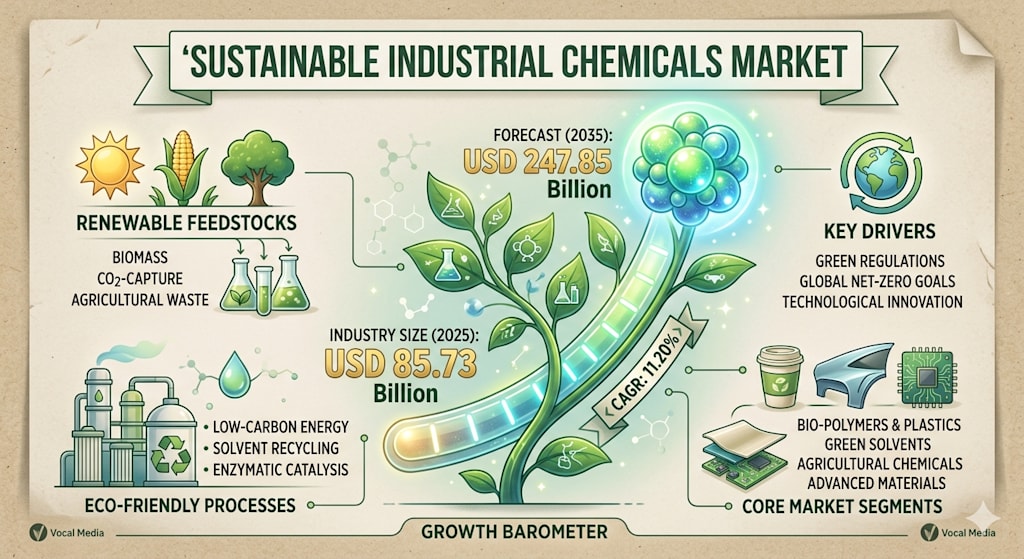
The scale of growth in this Sustainable Industrial Chemicals Market is significant. It is expected to rise from USD 85.73 billion in 2025 to approximately USD 247.85 billion by 2035, reflecting a compound annual growth rate of 11.20%. This steady expansion shows that sustainability is not a passing trend but a long-term transformation.
Europe currently leads the market, holding nearly half of global demand. This dominance is tied to strong policy frameworks like the EU Green Deal, which sets clear targets for reducing emissions and promoting clean production. These policies are shaping not just regional markets but also global supply chains.
North America follows with strong investment incentives, particularly through government-backed programs that encourage low-carbon technologies. Meanwhile, Asia Pacific remains a major production hub, though its transition toward sustainable practices is progressing at a slower pace due to reliance on traditional feedstocks.
Market Highlights
- Europe leads regional demand with a 47.6% share, valued at USD 40.8 Billion.
- Bio-based Chemicals dominate the Product Type segment with a 62.4% share.
- Solvents lead the Functionality segment with a 53.6% share.
- Bio-based leads Sustainability Attribute with a 44.3% share.
- Agriculture leads the Application segment with a 42.8% share.
- Large enterprises dominate the End-User segment with a 43.2% share.
What Makes Chemicals ‘Sustainable’?
Sustainable industrial chemicals are designed to reduce environmental impact without compromising performance. They often use renewable resources, such as plant-based materials, instead of fossil fuels. Others focus on cleaner production methods that lower emissions or reduce waste.
Some are biodegradable, meaning they break down naturally after use. Others are low in volatile organic compounds (VOCs), which helps improve air quality. There are also circular solutions, where materials are reused or recycled within a closed loop.
The key idea is efficiency—getting the same or better results while using fewer resources and creating less pollution. For businesses, this often translates into long-term savings, even if initial costs are higher.
Bio-Based Products Lead the Way
Among all product types, bio-based chemicals dominate the market. These are derived from renewable sources like crops, biomass, or agricultural waste. Their popularity is driven by both regulatory support and growing demand from industries that want to reduce their carbon footprint.
Large companies, particularly in consumer goods and pharmaceuticals, are setting internal targets for using renewable materials. This is pushing suppliers to offer products with verified bio-content. Certification systems are also making it easier for buyers to trust these claims, removing a key barrier to adoption.
Green solvents are another important segment. These are used in cleaning, extraction, and manufacturing processes, replacing traditional solvents that may be harmful to health or the environment. As regulations tighten, especially in Europe, switching to safer alternatives is becoming a necessity rather than a choice.
Key Applications Driving Demand
Agriculture is the largest application area for sustainable chemicals. Farmers are under pressure to reduce the use of synthetic pesticides and fertilizers, leading to increased demand for bio-based inputs. These alternatives can improve soil health while maintaining crop productivity.
Packaging is another major driver. With stricter rules on single-use plastics and waste management, companies are turning to biodegradable polymers and recyclable materials. This shift is being accelerated by consumer expectations as well as government policies.
The textile industry is also evolving. Brands are facing increased scrutiny over their environmental impact, pushing them to adopt cleaner dyes, finishes, and processing methods. Sustainable chemicals play a key role in meeting these new standards.
Water treatment and construction are additional growth areas. In both sectors, there is a clear need for solutions that improve efficiency while reducing environmental harm.
Challenges Behind the Transition
Despite strong growth, the shift to sustainable chemicals is not without challenges. One of the biggest hurdles is cost. Bio-based and low-emission products often come at a premium compared to traditional alternatives. This can slow adoption, particularly among smaller companies with limited budgets.
Supply chain complexity is another issue. Many sustainable products rely on agricultural feedstocks, which can be affected by weather, land use, and market fluctuations. This creates uncertainty around availability and pricing.
In some regions, reliance on fossil-based inputs remains deeply embedded in industrial systems. Transitioning away from these systems requires significant investment in new infrastructure and technology. This is not something that can happen overnight.
There is also the challenge of standardization. While certification systems are improving, there is still a need for consistent global frameworks to verify sustainability claims and ensure transparency.
Innovation Is Unlocking New Opportunities
Even with these challenges, innovation is driving the market forward. Advances in biotechnology are enabling the production of chemicals through fermentation and other biological processes. These methods can reduce energy use and emissions while maintaining high performance.
Another area of progress is carbon capture and utilization. This involves converting industrial emissions into usable chemical feedstocks, effectively turning waste into a resource. It’s a promising approach that aligns with the principles of a circular economy.
Digital tools are also playing a role. Companies are using data and analytics to track emissions, optimize processes, and improve supply chain efficiency. This level of visibility helps businesses make more informed decisions about material sourcing and production methods.
As these technologies mature, they are expected to lower costs and increase accessibility, making sustainable chemicals a viable option for a wider range of industries.
The Role of Large Enterprises
Large corporations are leading the transition, largely because they face the greatest regulatory pressure and have the resources to invest in change. They are also more likely to have public sustainability commitments, which influence procurement decisions.
These companies are entering long-term agreements with suppliers to secure sustainable materials. This not only ensures supply but also helps stabilize prices over time. Their actions are setting industry standards and encouraging smaller players to follow.
However, small and medium-sized enterprises still face barriers. Limited access to capital and technical expertise can make it difficult to adopt new materials or processes. Policy support and incentives will be important in closing this gap.
Conclusion
The shift toward sustainable chemistry represents a fundamental change in how the industry operates. The Sustainable Industrial Chemicals Market is growing steadily as businesses adapt to new regulations, environmental goals, and consumer expectations.
While challenges remain, the direction is clear. Cleaner, more efficient chemical solutions are becoming essential rather than optional. As innovation continues and costs gradually decrease, adoption will likely expand across industries of all sizes.
In the long run, this transition is not just about compliance—it’s about building a more resilient and responsible industrial system. And that is a goal that benefits everyone.
About the Creator
Yash Mule
SEO Specialist with 10+ years of experience at Evolvance Market Research. Expert in technical SEO, content strategy, and data-driven optimization, with a proven track record of significantly increasing organic traffic and search rankings.
Enjoyed the story? Support the Creator.
Subscribe for free to receive all their stories in your feed.
Comments
There are no comments for this story
Be the first to respond and start the conversation.