
Green Building Materials Market Set for Rapid Expansion as Low-Carbon Construction Becomes Mainstream
Government mandates, investor pressure, and new low-carbon technologies are transforming how the world builds homes, offices, and infrastructure.

The global construction industry is undergoing a profound shift. As governments tighten carbon regulations and developers face growing pressure to meet sustainability goals, environmentally responsible construction products are moving from niche alternatives to essential building components.
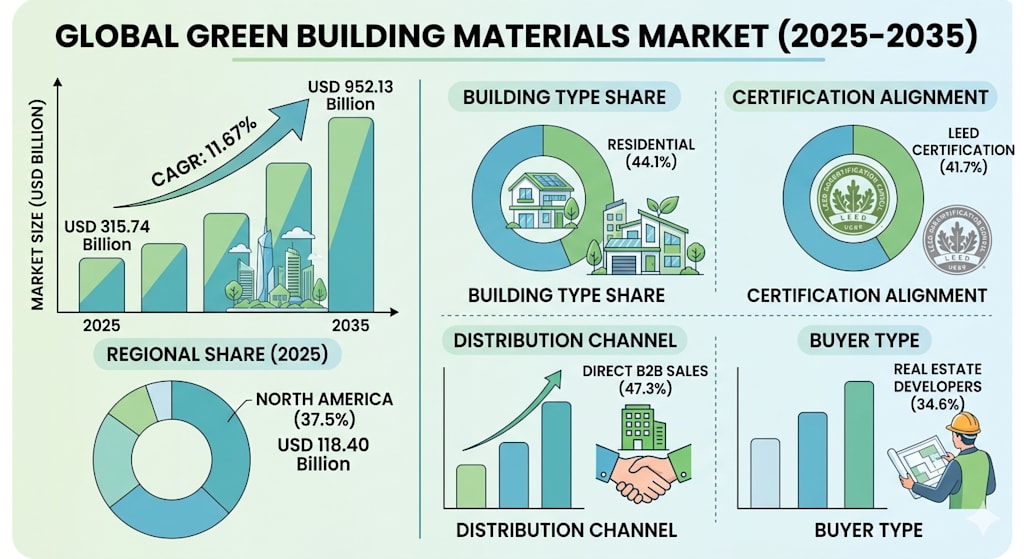
The Green Building Materials Market, valued at USD 315.74 billion in 2025, is projected to reach approximately USD 952.13 billion by 2035, growing at a compound annual growth rate (CAGR) of 11.67%.
This growth reflects more than changing consumer preferences. It signals a structural transformation in the construction economy, where carbon reporting, energy efficiency, and certified low-emission materials are becoming central to procurement decisions. From low-carbon cement and recycled steel to advanced insulation and mass timber, green materials are increasingly shaping the future of residential, commercial, and industrial development worldwide.
Market Highlights
- North America leads all regions with a 37.5% share, valued at USD 118.40 Billion.
- Residential building type holds the largest segment share at 44.1%.
- LEED certification alignment dominates with 41.7% share among certification segments.
- Direct B2B sales leads distribution channels with 47.3% share.
- Real estate developers are the top buyer type at 34.6% of demand.
Why Sustainable Construction Materials Are Gaining Momentum
One of the biggest drivers behind market expansion is the growing push for decarbonization across the construction sector. Buildings account for a significant share of global carbon emissions, not only through energy use but also through the materials used during construction. This has placed new attention on “embodied carbon,” which measures emissions generated during manufacturing, transportation, and installation of building products.
Governments are responding with stricter procurement policies and funding programs. In the United States, federal agencies have introduced carbon thresholds for products such as cement, asphalt, concrete, and flat glass. Suppliers that fail to meet these standards risk losing access to major public-sector contracts.
Private-sector demand is accelerating just as quickly. Real estate developers, institutional investors, and commercial property owners are increasingly prioritizing certified low-carbon materials to satisfy environmental, social, and governance (ESG) commitments. In many cases, sustainability certifications have become directly tied to financing opportunities, tenant demand, and long-term property value.
Research showing that low-embodied-carbon building solutions can reduce emissions by up to 46% with minimal cost increases has also helped remove a major barrier to adoption. For many procurement teams, green materials are no longer viewed as expensive alternatives but as practical investments with measurable returns.
Residential Construction Leads the Market
Residential construction currently represents the largest share of demand, accounting for 44.1% of the market. This dominance is largely driven by large-scale housing developments, energy-efficiency retrofits, and government-backed renovation programs across North America and Europe.
Homeowners are increasingly seeking products that improve energy performance while lowering long-term utility costs. Materials such as advanced insulation systems, energy-efficient windows, low-VOC paints, and sustainably sourced timber have become common features in modern residential projects.
Retrofit activity is playing a particularly important role. Older housing stock in developed economies often requires upgrades to meet stricter energy-efficiency standards. Governments are supporting these efforts through subsidies and tax incentives, encouraging homeowners and builders to adopt certified environmentally friendly materials.
Certification Systems Are Reshaping Procurement Decisions
Certification programs have become a powerful force in the modern construction industry. LEED currently dominates the certification segment with a 41.7% market share, particularly in North America and parts of Asia.
For developers and contractors, certification is no longer simply a branding exercise. Many financial institutions now link favorable lending conditions to sustainability performance. This means project teams must carefully select materials that comply with approved environmental standards from the earliest design stages.
Architects are playing an increasingly influential role in this process. By specifying low-carbon materials during planning and design phases, they effectively shape purchasing decisions before contractors begin procurement. The growing use of digital carbon-calculation tools and environmental product declarations (EPDs) is making it easier to compare products based on verified emissions data.
Regional certification systems are also expanding rapidly. India’s IGBC and GRIHA programs are encouraging adoption across fast-growing urban construction markets, while Europe continues to rely heavily on BREEAM and DGNB frameworks for commercial and institutional developments.
As carbon disclosure requirements become more common, suppliers that can provide transparent emissions data and third-party verification are gaining a competitive advantage.
Technology and Innovation Are Transforming the Supply Chain
Innovation is reshaping the industry at an extraordinary pace. Manufacturers are investing heavily in next-generation cement technologies, carbon-capture systems, and recycled construction materials to meet growing demand for low-carbon products.
Traditional cement production remains one of the largest industrial sources of carbon emissions globally. In response, companies are developing alternative production methods that significantly reduce clinker content or eliminate fossil-fuel-intensive processes altogether.
Carbon-capture projects are also moving from pilot stages into commercial-scale deployment. Major producers across Europe and North America are building facilities designed to capture hundreds of thousands of tonnes of CO₂ annually. While these projects require substantial government support, they represent a major step toward decarbonizing one of the construction sector’s most emissions-intensive industries.
Regional Markets Show Different Growth Dynamics
North America currently leads the market with a 37.5% share, valued at approximately USD 118.40 billion. The region’s leadership is closely tied to strong federal procurement rules, mature certification infrastructure, and extensive public funding for low-carbon manufacturing projects.
The United States has emerged as a particularly influential market because of its Buy Clean initiatives and strict embodied-carbon standards for federally funded projects. These policies are creating a stable demand environment for compliant manufacturers while encouraging widespread investment in cleaner production capacity.
Europe remains another major hub for sustainable construction materials. EU climate policies, industrial decarbonization programs, and sustainable finance regulations continue to drive adoption across commercial and institutional projects.
Asia Pacific, however, is expected to experience the fastest long-term growth. Rapid urbanization, updated green building codes, and expanding certification programs in China, India, and Southeast Asia are generating enormous demand potential.
Challenges Still Stand in the Way
Despite strong momentum, the industry still faces important obstacles. Certification processes for new materials can be slow, delaying the commercial rollout of promising technologies. Some advanced low-carbon products remain stuck in approval pipelines for years before reaching mainstream procurement systems.
High capital requirements also remain a major concern. Building carbon-capture cement plants and next-generation manufacturing facilities often depends on public subsidies and long-term policy support. Without consistent government funding, many large-scale projects may struggle to reach commercial viability.
Another challenge is the industry’s skills gap. Many construction professionals still lack the technical expertise needed to measure embodied carbon or evaluate environmental product data effectively. This slows adoption, even when certified products are readily available and competitively priced.
Conclusion
The Green Building Materials Market is entering a period of sustained global expansion driven by regulation, technology, and changing investment priorities. What was once considered a premium niche is rapidly becoming the foundation of mainstream construction strategy.
Governments are creating powerful incentives through procurement mandates and subsidy programs, while developers and investors increasingly view low-carbon construction as essential for long-term competitiveness. At the same time, innovations in cement production, recycling, and carbon-capture technology are opening entirely new pathways for growth.
About the Creator
Yash Mule
SEO Specialist with 10+ years of experience at Evolvance Market Research. Expert in technical SEO, content strategy, and data-driven optimization, with a proven track record of significantly increasing organic traffic and search rankings.
Enjoyed the story? Support the Creator.
Subscribe for free to receive all their stories in your feed.
Comments
There are no comments for this story
Be the first to respond and start the conversation.