
GPT vs Gemini vs Claude
Three titans. One honest verdict. Which AI actually deserves a place in your daily life — and which ones are all hype?

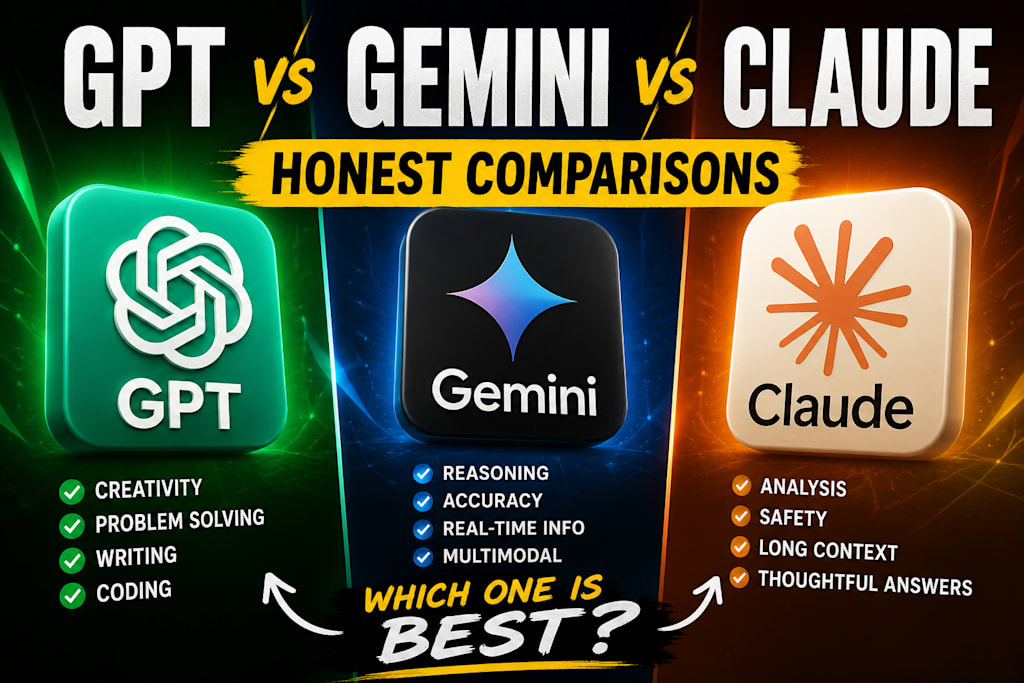
Every week, millions of people open ChatGPT, Gemini, or Claude and ask it something important — a career question, a creative idea, a medical concern. These tools have quietly become a part of how we think, work, and decide. But here is the question nobody answers honestly: which one is actually better?
The truth is — it depends. Each of these three AI systems was built with different priorities, different strengths, and different weaknesses. This article does not pick a winner for the sake of it. Instead, it breaks down what each one is genuinely good at, where it falls short, and who it is actually built for.
Meet the three contenders
ChatGPT (GPT-4o / OpenAI) is the household name. Launched in late 2022, it took the world by storm and introduced millions to conversational AI. Backed by OpenAI — now one of the most valuable AI companies on earth — GPT has the largest user base, the most integrations, and the longest list of features. It feels like the Swiss army knife of AI: voice mode, image generation via DALL·E, web search, code execution, and a sprawling plugin ecosystem.
Gemini (Google DeepMind) is Google's answer, and it arrives with a unique superpower: native integration with the entire Google ecosystem. Gmail, Docs, Drive, YouTube — Gemini lives inside the tools billions already use every day. Google also has access to real-time search data, which means Gemini is often better at answering questions about current events than its competitors.
Claude (Anthropic) is the quiet overachiever. Built by former OpenAI researchers with a strong focus on AI safety, Claude is widely regarded as the most thoughtful and nuanced conversationalist of the three. It tends to be more careful with sensitive topics, better at long documents, and — many users report — simply more pleasant to have a real conversation with.
Where each one shines
GPT is best for doing things. Need to generate an image, run a piece of code, browse the web, and summarise a PDF — all in the same conversation? GPT handles this workflow better than anyone. Its plugin ecosystem and tool-use capabilities make it the most powerful all-in-one assistant. For developers and power users who want a single tool that does everything, GPT is hard to beat.
Gemini is best for staying informed. Because it is deeply wired into Google Search and the Google Workspace suite, Gemini excels at answering questions that require up-to-date knowledge. Ask it about something that happened last week — a product launch, a political event, a sports result — and it will usually give you a more accurate answer than the others. If you live inside Google's ecosystem, Gemini feels almost invisible in how naturally it fits into your workflow.
Claude is best for thinking together. When the task requires reading a long document, reasoning through a complex ethical dilemma, drafting something that actually sounds human, or working through a hard decision — Claude is the one most users reach for. Its responses are longer, more considered, and more likely to push back gently when something does not quite add up. For writers, researchers, and anyone who wants a genuine intellectual collaborator, Claude is the clear choice.
Where each one struggles
GPT can sometimes feel like it is trying too hard — eager to please, occasionally overconfident, and prone to "hallucinating" facts with total conviction. Gemini, despite Google's resources, still feels like a work in progress in terms of conversation depth; it can be surface-level where depth is needed. Claude, for its part, can occasionally be overly cautious — declining to help with things that are perfectly reasonable because they brush up against sensitive territory.
The honest verdict: There is no single winner here. GPT is the most capable tool. Gemini is the most connected. Claude is the most thoughtful. The real question is not which AI is "best" — it is which one fits the way you actually think and work.
So which should you use?
Use ChatGPT if you need maximum functionality and the broadest range of built-in tools — especially for technical or creative production work.
Use Gemini if you are heavily embedded in Google's world and need an AI that stays current with real-world information.
Use Claude if you value conversation quality, nuanced reasoning, and a model that genuinely engages with complex ideas rather than just outputting text.
The good news? You do not have to choose just one. All three offer free tiers, and the wisest approach is to develop a feel for which tool handles which kind of task best — and switch between them accordingly. The era of one AI to rule them all is probably not coming. What is coming is a world where knowing how to use these tools together becomes one of the most valuable skills you can have.
Mind Meets Machine will keep watching this space. The race is far from over.
About the Creator
Mind Meets Machine
Mind Meets Machine explores the evolving relationship between human intelligence and artificial intelligence. I write thoughtful, accessible articles on AI, technology, ethics, and the future of work—breaking down complex ideas into Reality
Enjoyed the story? Support the Creator.
Subscribe for free to receive all their stories in your feed.
Comments
There are no comments for this story
Be the first to respond and start the conversation.