
Gold Nanoparticles Market: Therapeutic Innovations, Research Funding & Industry Prospects
How growing investments in advanced therapeutic research and laboratory innovation are driving technological evolution within the global gold nanoparticles industry landscape

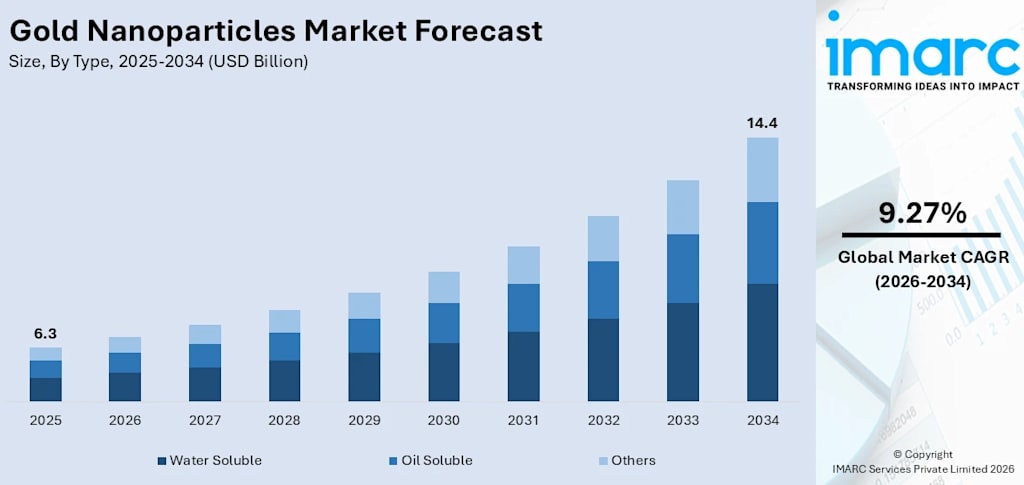
Rising demand for targeted drug delivery systems, continuous miniaturization in electronics, and expanding use in diagnostics are driving gold nanoparticles demand, supported by green synthesis breakthroughs, government research funding, and increasing adoption in high-end medical treatments. According to IMARC Group’s latest data, The global gold nanoparticles market size was valued at USD 6.3 Billion in 2025. Looking forward, IMARC Group estimates the market to reach USD 14.4 Billion by 2034, exhibiting a CAGR of 9.27% from 2026-2034.
Gold nanoparticles now represent a multi-billion-dollar global industry exceeding USD 6 billion and exhibiting steady year-on-year expansion. Demand is driven by rising investments in nanomedicine, precision electronics that require ultra-thin conductive materials, and an increasing need for sensitive point-of-care diagnostic kits. Advanced manufacturing methods and eco-friendly scaling are helping producers lower regulatory risks and stabilize output quality. Major segments include nanospheres, nanorods, nanoshells, and nanocages, with the healthcare, medical imaging, and semiconductor sectors prioritizing highly stable, biocompatible, and high-purity colloidal solutions to achieve reliable real-world performance.
Gold Nanoparticles Market Growth Drivers:
- Accelerating Demand in Nanomedicine and Targeted Therapeutics
Oncology researchers and pharmaceutical companies utilize biocompatible gold nanoparticles to transport therapeutic payloads directly to diseased cells, minimizing the harsh systemic side effects of conventional treatments. The high surface area-to-volume ratio allows hundreds of targeting molecules to coat a single nanoparticle. Global healthcare systems heavily back these clinical trials to address rising chronic disease rates. This sustained investment keeps medical and dentistry applications as the primary revenue generator for the sector, where high-purity particles are critical for precision dosing and advanced hyperthermia therapies.
- Continuous Miniaturization and Integration in High-End Electronics
The electronics industry relies on gold nanowires and nanoparticles to connect microscopic elements within advanced semiconductors, printable inks, and optoelectronic chips. Consumer electronics companies design thinner, flexible components for wearable monitors and 5G infrastructure, making highly conductive, oxidation-resistant nanoscale gold essential. As processing demands rise and device footprints shrink, manufacturers integrate these materials to maintain structural integrity and low-power performance. This steady shift toward advanced hardware keeps electronics production among the fastest-growing commercial segments utilizing specialized metal colloids.
Receive Your "Gold Nanoparticles Market" Research Sample PDF
- Surge in High-Sensitivity In-Vitro Diagnostics and Rapid Testing
Diagnostic laboratories and point-of-care medical device manufacturers leverage the strong optical readouts of gold nanospheres in lateral flow assays and colorimetric sensors. Widespread adoption in everyday diagnostic kits, including rapid infectious disease tests, stems from the material's stable bioconjugation properties. Healthcare networks prioritize these fast, visible readouts to streamline patient screening and field-based clinical assessments. This ongoing reliance on rapid testing frameworks ensures a consistent commercial market for high-purity gold solutions capable of identifying complex proteins and environmental pollutants.
Gold Nanoparticles Market Trends:
- Widespread Shift Toward Sustainable Green Synthesis Methods
Colloidal gold manufacturers adopt biological and continuous-flow synthesis techniques using plant extracts and non-toxic reducing agents to replace hazardous chemicals. This biological approach significantly lowers the environmental footprint and toxicity risks associated with standard chemical reduction methods. Regulatory bodies closely monitor nanoscale materials, making clean-label, eco-friendly synthesis essential for clearing compliance hurdles in the life sciences. Industrial operations utilize these continuous lines to produce uniform particle sizes while lowering hazardous solvent waste across major production facilities.
- Expansion of Material Standardization and Traceability Frameworks
Downstream buyers in healthcare and IVD development increasingly mandate rigorous quality control documentation, including comprehensive Certificates of Analysis and ISO-aligned tracking. This structural shift moves the market away from variable raw colloids toward application-ready, standardized particles with predictable particle-size distributions. Leading material providers invest in automated, high-throughput verification lines to fulfill strict documentation criteria. This emphasis on supply chain transparency helps pharmaceutical developers mitigate manufacturing risks and accelerate their transition from experimental laboratory validation to scaled commercial batches.
- Rising Integration in Renewable Energy and Photovoltaic Systems
Industrial engineers utilize the plasmonic properties of gold nanoparticles to enhance light absorption and energy conversion rates in next-generation solar cells and storage devices. The integration of nanorods and nanoshells into organic photovoltaics allows clean energy equipment to capture broader spectrum wavelengths. This technological application gains significant traction as global infrastructure initiatives seek performance-driven materials to meet carbon-reduction targets. Energy firms back these pilot-scale validations, turning specialized surface chemistries into crucial components for optimizing efficiency in heavy industrial power applications.
Recent News and Developments in Gold Nanoparticles Market
- January 2026: American Elements expanded its high-purity nanomaterials manufacturing portfolio to scale the delivery of specialized gold nanoparticles tailored for advanced semiconductor fabrication and biomedical applications.
- January 2026: American Elements expanded its high-purity nanomaterials manufacturing portfolio to scale the delivery of specialized gold nanoparticles tailored for advanced semiconductor fabrication and biomedical applications.
- January 2026: American Elements expanded its high-purity nanomaterials manufacturing portfolio to scale the delivery of specialized gold nanoparticles tailored for advanced semiconductor fabrication and biomedical applications.
Note: If you require specific details, data, or insights that are not currently included in the scope of this report, we are happy to accommodate your request. As part of our customization service, we will gather and provide the additional information you need, tailored to your specific requirements. Please let us know your exact needs, and we will ensure the report is updated accordingly to meet your expectations.
About the Creator
Andrew Sullivan
Hello, I’m Andrew Sullivan. I have over 9+ years of experience as a market research specialist.
Enjoyed the story? Support the Creator.
Subscribe for free to receive all their stories in your feed.
Comments
There are no comments for this story
Be the first to respond and start the conversation.