
Gold Nanoparticles Market Outlook: Biomedical Innovation, Imaging Growth & Forecast to 2034
How point-of-care testing demand, fast diagnostics needs, and imaging technology progress are boosting opportunities in the global gold nanoparticles market.

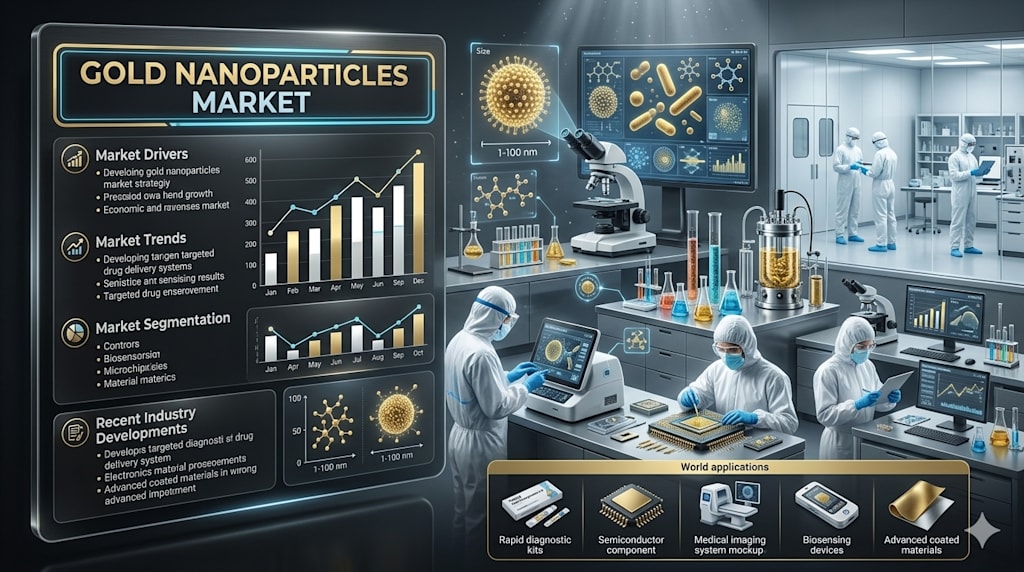
Rising investments in nanotechnology, expanding biomedical applications, and growing adoption in electronics and diagnostics are driving gold nanoparticles demand, supported by precision medicine advances, green synthesis innovations, and increasing government funding across research and development initiatives. According to IMARC Group's latest data, The global gold nanoparticles market size was valued at USD 6.3 Billion in 2025. Looking forward, IMARC Group estimates the market to reach USD 14.4 Billion by 2034, exhibiting a CAGR of 9.27% during 2026-2034.
Gold nanoparticles represent one of the most versatile and rapidly advancing segments within the broader nanotechnology landscape. Demand is driven by their exceptional optical and chemical properties, expanding role in targeted cancer therapy and molecular diagnostics, and growing integration into electronics for conductive inks and nanoscale circuit fabrication. Government funding initiatives, academic-industrial collaborations, and regulatory advancements are further accelerating commercialization. Major segments include water-soluble and oil-soluble variants, with healthcare commanding the largest end-use share and imaging leading among application categories. Consumers and institutions alike are prioritizing biocompatibility, surface functionalization precision, and application-specific customization across sectors.
Evaluate Market Potential Before You Invest – Get the Report Sample
Gold Nanoparticles Market Growth Drivers:
Expanding Role in Precision Medicine and Cancer Theranostics
Gold nanoparticles are increasingly integrated into cancer theranostics, photothermal therapy, and targeted drug delivery due to their superior surface functionalization and biocompatibility. Healthcare accounts for approximately 49.1% of total gold nanoparticles end-use market share. The U.S. federal authorities have committed more than USD 1.4 Billion in funding for the National Nanotechnology Initiative, confirming the strategic importance of nanotech in next-generation medicine. Brands and research institutions are innovating with precision-targeted formulations to minimize side effects and improve therapeutic outcomes across oncological and cardiovascular applications.
Growing Demand in Electronics and Semiconductor Manufacturing
Miniaturization of electronic devices is elevating adoption of gold nanoparticles for their excellent conductivity and stability in conductive inks, photo-sensors, thin-film transistors, and nanoscale circuit fabrication. The Semiconductor Industry Association notes over USD 540 Billion in U.S. semiconductor supply-chain investments are currently in motion, intensifying R&D into nanoparticle-enabled interconnects and metamaterials. Asia Pacific's semiconductor sector, particularly India's, is valued at USD 23.2 Billion and projected to reach USD 80.3 Billion, further stimulating demand for nanoscale materials including gold nanoparticles across flexible electronics and chip-level sensor manufacturing.
Green Synthesis Innovation and Sustainable Production
Consumer and institutional preference for clean, eco-friendly synthesis methods is reshaping how gold nanoparticles are produced globally. In February 2024, researchers at Goa University developed a pioneering eco-friendly synthesis method using indigenous Termitomyces mushrooms to replace toxic chemicals, creating a clean green production route that offers India the potential to reduce import reliance in a local gold nanoparticle supply chain valued at approximately USD 450 Million globally. Europe's growing emphasis on sustainable nanomaterials is also reinforced by data from the European Union Observatory for Nanomaterials, which notes that approximately 1.5% of all new cosmetic products notified in Europe now contain nanomaterials, reflecting rising clean-formulation integration across consumer product categories.
Gold Nanoparticles Market Trends:
Precision Drug Delivery and Targeted Therapeutic Systems
Researchers and pharmaceutical companies are advancing aptamer-conjugated and DNA-tagged gold nanoparticle platforms to enable highly selective, shape-optimized drug delivery to diseased cells. In January 2025, National University of Singapore researchers used DNA barcoding to identify triangular gold nanoparticles as the most effective shape for cellular uptake and photothermal cancer therapy, enabling high-throughput in vivo tracking for personalized nanomedicine. In the same month, a separate research team demonstrated that aptamer-conjugated gold nanoparticles could selectively deliver therapeutic oligonucleotides into muscle stem cells in a Duchenne Muscular Dystrophy mouse model, showing enhanced muscle regeneration with strong biocompatibility, validating gold nanoparticles as a scalable platform for precision therapeutics.
Space-Based and Next-Generation Synthesis Experiments
Market fundamentals remain highly favorable as research institutions explore frontier synthesis environments to produce higher-quality gold nanoparticles with greater symmetry and structural consistency. In April 2025, Redwire launched the Golden Balls experiment aboard the International Space Station, marking the first attempt to produce high-quality symmetrical gold nanospheres in microgravity conditions, with potential implications for improving cancer diagnostics and drug delivery efficacy on Earth. In March 2025, researchers from Waseda, Osaka, and Kyoto Universities activated gold nanoparticles through neutron irradiation, converting standard gold to a radioactive isotope that enabled five-day tracer-free visualization of drug distribution in tumor-bearing mice, opening a scalable method to monitor AuNP-based therapeutics in vivo.
Regulatory Advancement and Standardization Globally
Government bodies are implementing structured regulatory frameworks to govern the safe production, labeling, and clinical deployment of gold nanoparticles across healthcare and consumer markets. The National Institute of Standards and Technology issues reference standards specifically for nanoscale particles in the biomedical research community, while the FDA and European Medicines Agency are actively developing guidelines for gold nanoparticle-based diagnostics and therapeutics. In January 2024, a new European directive mandated traceability and labeling of nanomaterials in consumer products, boosting transparency and safety compliance. The Environmental Protection Agency has also issued rules under the Toxic Substances Control Act requiring one-time reporting and recordkeeping for nanoscale chemical substances, expanding environmental accountability standards industry-wide.
Recent News and Developments in the Gold Nanoparticles Market
April 2025: Redwire launched its Golden Balls experiment on the International Space Station, marking the first attempt to produce high-quality symmetrical gold nanospheres in microgravity, with potential applications in enhancing cancer diagnostics, drug delivery, and therapeutic solutions on Earth.
March 2025: Researchers from Waseda, Osaka, and Kyoto Universities activated gold nanoparticles through neutron irradiation, enabling five-day tracer-free visualization of drug distribution in tumor-bearing mice, demonstrating a scalable method to monitor AuNP-based therapeutics and advance gold nanoparticle drug research.
January 2025: NUS researchers developed DNA-tagged gold nanoparticles to optimize targeted cancer drug delivery, identifying triangular shapes as most effective for cellular uptake and photothermal therapy, advancing personalized, safer, and more effective nanotherapeutics for cancer and broader medical applications.
January 2025: Researchers developed aptamer-conjugated gold nanoparticles to deliver therapeutic oligonucleotides into muscle stem cells in a Duchenne Muscular Dystrophy mouse model, enhancing muscle regeneration and function while proving biocompatible, selective, and adaptable for broader precision drug delivery applications using gold nanoparticle technology.
Note: If you require specific details, data, or insights that are not currently included in the scope of this report, we are happy to accommodate your request. As part of our customization service, we will gather and provide the additional information you need, tailored to your specific requirements. Please let us know your exact needs, and we will ensure the report is updated accordingly to meet your expectations.
About the Creator
Suhaira Yusuf
I specialize in Consumer Insights, focusing on transforming detailed market data into strategic business solutions that accelerate growth and improve customer engagement.
Enjoyed the story? Support the Creator.
Subscribe for free to receive all their stories in your feed.
Comments
There are no comments for this story
Be the first to respond and start the conversation.