
Global Tuna Market: Demand-Supply Gap, Price Volatility & Industry Outlook
How sustainability initiatives, responsible fishing practices, and eco-label certifications are transforming supply chains and consumer trust across the global tuna market landscape

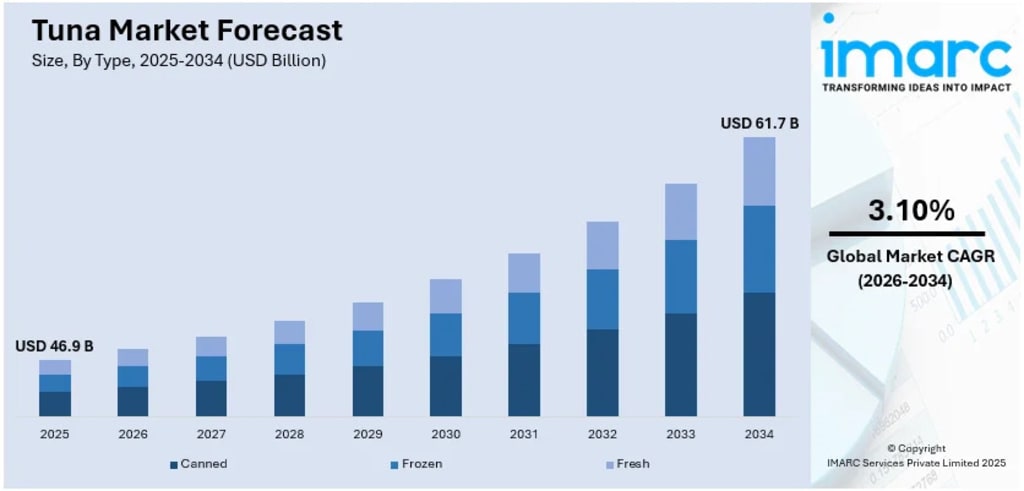
Rising health consciousness, a surge in the popularity of international cuisines like sushi and sashimi, and a growing need for convenient, shelf-stable protein are fueling the global tuna market. This demand is further supported by the expansion of the organized food services sector and significant innovations in sustainable fishing and high-tech processing. According to IMARC Group’s latest data, the global tuna market size was valued at USD 46.9 Billion in 2025. Looking forward, IMARC Group estimates the market to reach USD 61.7 Billion by 2034, exhibiting a CAGR of 3.10% during 2026-2034.
Tuna has moved far beyond a simple pantry staple, evolving into a cornerstone of the global seafood industry valued well over USD 45 billion. The narrative is no longer just about affordability; it's about the intersection of high-grade nutrition and culinary versatility. We are seeing a massive pull from both the retail sector where canned and frozen formats dominate and the high-end HORECA (Hotel, Restaurant, and Cafe) segment, where fresh species like Bluefin and Bigeye are prized. With skipjack leading the volume due to its abundance, the market is characterized by a mix of mass-market accessibility and premium, source-traceable offerings that cater to an increasingly ethically-minded consumer base.
Global Tuna Market Growth Drivers:
- Growing Health and Nutritional Consciousness
People are paying closer attention to what’s on their plates, and tuna is winning because it’s a nutritional powerhouse. It’s packed with lean protein, omega-3 fatty acids, and essential minerals like selenium, which are vital for heart health and brain function. Global health organizations often highlight these benefits, pushing consumers toward "brain foods." In 2025, the market reached a valuation of USD 46.9 Billion, largely because tuna is an easy win for those managing weight or looking for nutrient-dense meal options without the heavy fats of red meat.
- Urbanization and the Need for "Right Now" Food
Life isn't slowing down, and the demand for portable, ready-to-eat (RTE) meals is proving it. Canned and pouch-packaged tuna are the ultimate convenience play no cooking required and a shelf life that outlasts almost any other protein. This "grab-and-go" culture is particularly strong in urban hubs where professionals need quick, healthy lunch solutions. With the market already crossing the USD 46 billion mark, the sheer accessibility of tuna in supermarkets and convenience stores ensures it remains a top choice for busy households globally.
Download Now: Free "Global Tuna Market" Comprehensive Report!
- Expansion of Global Culinary Trends
The "sushi effect" is real. As Japanese and Mediterranean cuisines go mainstream, the demand for high-quality fresh and frozen tuna has spiked in non-traditional markets. It’s not just about sandwiches anymore; it’s about sashimi, poke bowls, and gourmet grilled steaks. This culinary shift is supported by massive investments in cold chain logistics, allowing premium tuna to reach landlocked regions in peak condition. With species like skipjack holding a 57.8% share, there’s enough volume to feed both the mass market and the specialized culinary segments effectively.
Global Tuna Market Trends:
- Heavy Lean Toward Sustainability and Traceability
The industry is facing a "green" reckoning. Consumers today aren't just buying a can of fish; they’re buying a story of responsible sourcing. We are seeing a major shift toward MSC-certified products and "pole-and-line" caught labels that promise minimal bycatch. For instance, Spanish retailer EROSKI recently launched own-brand MSC-certified tuna to meet this exact demand. This isn't just a niche preference nearly a third of purchase decisions are now influenced by sustainability. Brands that can’t prove where their fish came from are quickly losing ground to transparent competitors.
- Technological Integration in Quality Assessment
Wait-and-see quality checks are being replaced by real-time AI. In early 2025, a partnership involving Fujitsu and Tokai University launched an AI-powered device capable of measuring fat content in frozen tuna without even cutting the fish. This kind of tech reduces labor by up to 80% and ensures consistent grading for premium markets. It’s a game-changer for the supply chain, allowing for faster processing and less waste. As the market moves toward a USD 61.7 Billion valuation, these efficiencies are what will separate the industry leaders from the laggards.
- Premiumization and "Gourmet" Packaging Innovations
Canned tuna is getting a makeover. We’re seeing a move away from "basic" brine and toward premium infusions like extra virgin olive oil, chili lime, and smoked variants. The launch of Old Bay and McCormick flavored tuna packets by Chicken of the Sea is a perfect example of this. Packaging is also evolving—Eco-friendly "ECOTWIST" designs and BPA-free linings are becoming the new standard. This premiumization allows brands to command higher margins by positioning tuna as a sophisticated, gourmet ingredient rather than just a budget-friendly backup.
Recent News and Developments in Global Tuna Market:
- October 2025: Schouten Europe introduced an upgraded plant-based tuna at the Anuga trade fair. This "alternative" tuna mimics the texture and taste of the real thing, targeting the growing segment of consumers worried about overfishing of species like Bluefin.
- May 2025: India took a massive step in infrastructure with the inauguration of its first exclusive tuna fishing harbor in Chennai. The USD 32 million (Rs 272.70 crore) facility can handle 70,000 tons annually, drastically improving the speed-to-market for local fishermen.
- February 2025: EROSKI made headlines in Spain by launching the country’s first own-brand MSC-certified canned light tuna. The product uses eco-friendly line-and-hook methods, signaling a major win for sustainable retail practices in Europe.
Note: If you require specific details, data, or insights that are not currently included in the scope of this report, we are happy to accommodate your request. As part of our customization service, we will gather and provide the additional information you need, tailored to your specific requirements. Please let us know your exact needs, and we will ensure the report is updated accordingly to meet your expectations.
About the Creator
Andrew Sullivan
Hello, I’m Andrew Sullivan. I have over 9+ years of experience as a market research specialist.
Enjoyed the story? Support the Creator.
Subscribe for free to receive all their stories in your feed.
Comments
There are no comments for this story
Be the first to respond and start the conversation.