
Global Thermoplastic Elastomers Market Size to Hit USD 103.66 Billion by 2035, Growing at 8.3% CAGR
Global Thermoplastic Elastomers Market Report 2025–2035: Size, Trends, and Forecast

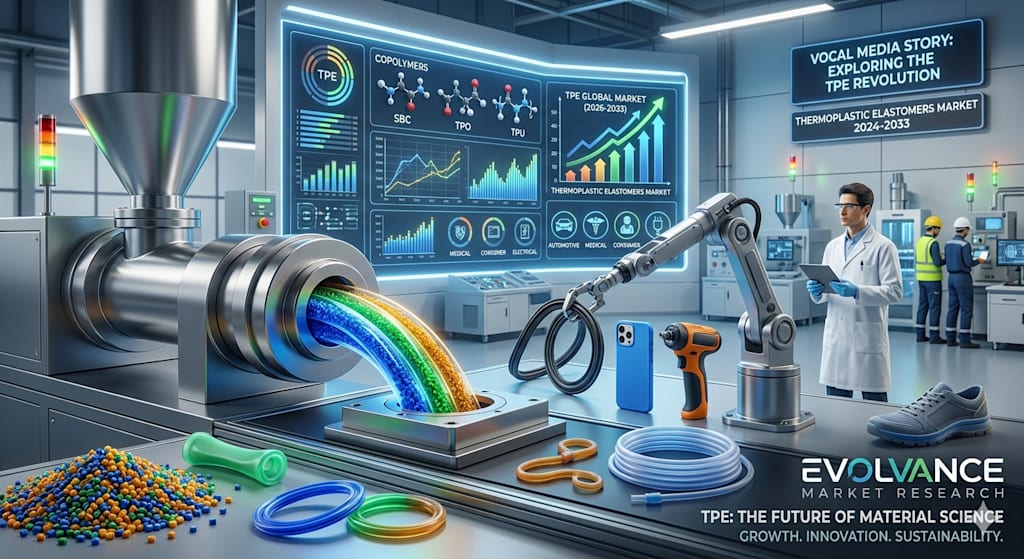
Thermoplastic Elastomers Market Size
The Global Thermoplastic Elastomers Market size is calculated at USD 46.70 billion in 2025 and is predicted to increase from USD 50.57 billion in 2026 to approximately USD 103.66 billion by 2035, expanding at a CAGR of 8.3% from 2026 to 2035.
Thermoplastic Elastomers have become essential materials across modern manufacturing. They combine the soft, flexible feel of rubber with the easy processing and recyclability of plastic. You find them in car seals, medical tubing, shoe soles, phone cases, and countless everyday products.
Market Highlights
- North America dominated the market, holding the largest share of 36.4% in 2025, valued at USD 16.9 billion.
- The TPE-S (Styrenic Block Copolymers) segment contributed the biggest market share of 30.4% in 2025.
- Pellets and Granules captured the major market share of 38.9% in 2025.
- Automotive and Transportation application held the largest market share of 42.6% in 2025.
- Automotive end-use dominated with 34.6% share, driven by fuel efficiency rules and lightweighting programs.
Industry Growth Overview
The Thermoplastic Elastomers market is moving through a steady expansion phase, driven by the global shift toward lightweight vehicles, safer medical devices, and recyclable materials.
As manufacturers face pressure to cut costs and meet environmental rules, TPEs offer a clear advantage over traditional rubber and rigid plastics.
Automotive Industry
The automotive sector remains the largest consumer of TPEs, accounting for over 42% of all applications. Car makers are replacing heavy metal parts and stiff plastics with flexible TPE components.
Every kilogram saved improves fuel economy in gas cars and extends range in electric vehicles. EV production, in particular, creates new demand for battery pack seals and high-voltage cable insulation.
Medical Devices
Healthcare is the fastest-growing end-use sector for TPEs. Aging populations in North America, Europe, and Japan need more surgical tools, catheters, tubing, and drug delivery systems.
TPEs meet strict FDA and ISO 10993 biocompatibility standards. They survive repeated sterilization without breaking down. And they contain no harmful plasticizers found in older medical plastics like PVC.
Sustainability Push
Brands across footwear, consumer electronics, and packaging want recyclable materials. Traditional thermoset rubber cannot be melted and reused. TPEs can.
This circular economy advantage is pushing more companies to switch. Major shoe brands now specify TPE soles that can be ground up and remade into new products.
Why are TPE-S (Styrenic Block Copolymers) dominating the Thermoplastic Elastomers market?
TPE-S holds a 30.4% share because it offers the best balance of low cost, easy processing, and good performance. These materials work well in injection molding and extrusion, two of the most common manufacturing methods.
Why are Pellets and Granules dominating the Thermoplastic Elastomers market?
Pellets and granules account for 38.9% of the market because they are the easiest form for factories to handle. They pour smoothly into automated feeding systems. They create minimal dust.
They measure precisely. Film, sheet, and powder forms serve niche applications, but pellets win for high-volume manufacturing of auto parts, medical devices, and consumer goods.
Why is Automotive and Transportation dominating the Thermoplastic Elastomers market?
Automotive and Transportation applications hold 42.6% share because modern vehicles use TPEs everywhere — door seals, window trims, interior soft-touch surfaces, bumpers, and under-hood components. Electric vehicles add new uses: battery pack seals, cooling system hoses, and cable management parts.
Why is Automotive dominating the Thermoplastic Elastomers end-use segment?
Automotive end-use accounts for 34.6% of the market because car makers face strict government fuel economy rules. US CAFE standards and EU CO2 limits force automakers to cut vehicle weight.
TPE parts replace heavier metal, glass, and rigid plastic components. A typical modern car contains several kilograms of TPE materials, and that number keeps growing.
Regional Insights
Why Is North America Leading the Thermoplastic Elastomers Market?
North America dominates with a 36.4% share (USD 16.9 billion) because it combines three advantages: massive auto production (Detroit Three plus foreign brands), world-leading medical device manufacturing (Minnesota, California, Massachusetts), and strict environmental rules that favor recyclable TPEs over traditional rubber.
Why Is Asia Pacific the Fastest-Growing Region in the Thermoplastic Elastomers Market?
Asia Pacific is the fastest-growing region, with an expected CAGR of 10.2%, because China, India, and Southeast Asian nations are rapidly expanding auto production, electronics manufacturing, and healthcare infrastructure.
China now makes more cars than any other country. India is building new medical device factories to serve its large population. Rising middle-class incomes mean more consumer goods — all made with TPEs.
Investment Landscape
Significant capital is flowing into bio-based TPE development and recycling capacity. Chemical companies like BASF, DuPont, and Covestro are investing in pilot plants for plant-based TPEs.
Startups are creating chemical recycling technologies that break TPEs back into base chemicals for virgin-quality remaking.
Role of Sustainability
Environmental pressure is reshaping the TPE market. California Proposition 65 and EU REACH rules restrict harmful chemicals in consumer products.
Auto industry standards like ISO 16949 demand consistent quality. Brands are setting 2030 targets for recycled and renewable content. TPEs that meet these requirements will capture premium pricing.
Top Key Players in the Market
BASF SE offers a wide range of TPE products for automotive, construction, and consumer applications. The company is heavily invested in bio-based TPEs and recycling programs.
DuPont provides high-performance TPE brands like Hytrel and Zytel for demanding automotive and industrial sealing applications requiring heat and chemical resistance.
Kraton Polymers specializes in styrenic block copolymer (TPE-S) technology using renewable pine-based feedstocks for sustainable product lines.
ExxonMobil Chemical produces Santoprene and Vistamaxx TPE families for automotive, consumer goods, and wire-cable applications, with expanding capacity in Asia.
Covestro focuses on polyurethane-based TPEs (TPE-U) for industrial belts, footwear, and medical devices requiring high abrasion resistance.
Conclusion
The Thermoplastic Elastomers market is steadily expanding into a mature, essential materials sector driven by automotive lightweighting, medical device growth, and the global push for recyclable alternatives to rubber. TPEs are not flashy, but they are everywhere — and their future looks strong.
About the Creator
Yash Mule
SEO Specialist with 10+ years of experience at Evolvance Market Research. Expert in technical SEO, content strategy, and data-driven optimization, with a proven track record of significantly increasing organic traffic and search rankings.
Enjoyed the story? Support the Creator.
Subscribe for free to receive all their stories in your feed.
Comments
There are no comments for this story
Be the first to respond and start the conversation.