
Global Shrimp Market Outlook: Health, Convenience, and Aquaculture Keep Demand in Focus
Renub Research’s latest market view points to steady momentum in shrimp consumption, processing, and exports as companies lean harder into value-added products and farm efficiency.

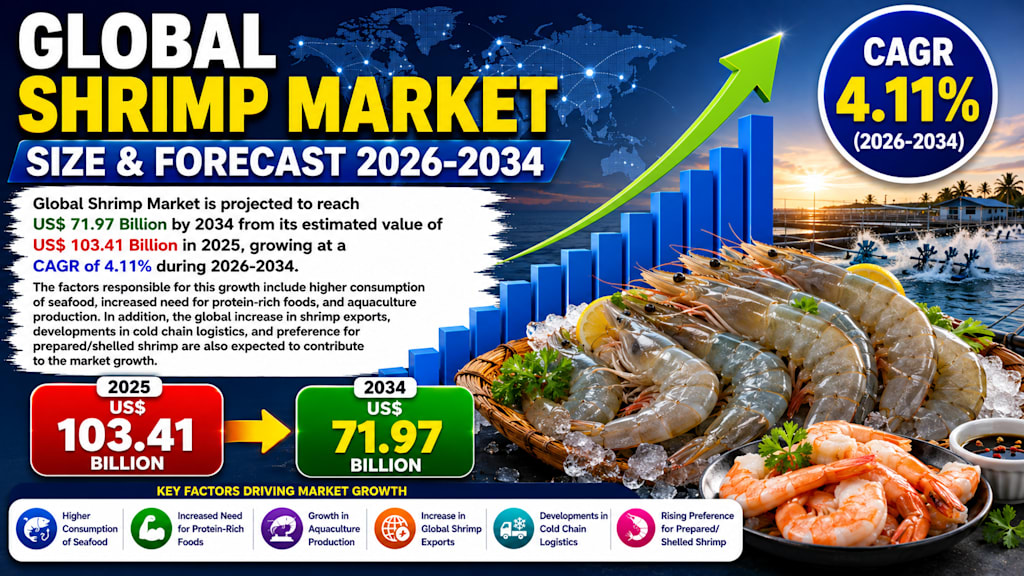
The global shrimp market continues to sit at the intersection of nutrition, convenience, and international trade. According to Renub Research, the market is projected to reach US$ 71.97 Billion by 2034 from an estimated US$ 103.41 Billion in 2025, expanding at a CAGR of 4.11% during 2026–2034. The report ties this outlook to rising seafood consumption, stronger demand for protein-rich foods, expanded aquaculture production, better cold-chain logistics, and a growing preference for prepared and shelled shrimp.
That broad story makes sense in today’s seafood aisle. Shrimp is one of the most flexible seafood products in the global diet: it is mild in flavor, easy to cook, and adaptable across grilling, frying, steaming, boiling, sautéing, and ready-meal formats. Renub Research’s report also highlights shrimp’s nutritional profile, including protein, omega-3 fatty acids, iodine, selenium, and vitamins, which helps explain why it remains popular in Asian, Mediterranean, Latin American, and North American cuisines.
What is changing most clearly is the type of shrimp consumers want. Demand is increasingly shifting away from raw, basic product toward frozen, peeled, cooked, breaded, and ready-to-cook offerings. The report links this shift to urban lifestyles, time pressure, modern retail growth, tourism, e-commerce, and the growing role of foodservice. In other words, shrimp is no longer just a commodity seafood item; it is becoming a convenience food with premium positioning in many markets.
Aquaculture remains the backbone of that growth. Renub Research says shrimp farming has become a major supply engine thanks to advances in breeding, feed, water management, disease control, biofloc systems, recirculating aquaculture systems, and genetic improvement. Major producing countries such as India, Ecuador, Vietnam, and Indonesia are expanding farm capacity to strengthen exports and improve supply stability.
The product mix also matters. Pacific white shrimp, or L. vannamei, remains the dominant species because of its productivity, adaptability, and disease resistance. Meanwhile, P. monodon holds a premium position because of its size, taste, and strong appeal in upscale foodservice and export channels. Size categories also shape demand: the 15–20 count segment is especially attractive for restaurants, hotels, and catering, while breaded and cooked shrimp are gaining from the rise of quick-service dining and frozen convenience foods.
Still, the market is not without pressure points. Shrimp farming is highly exposed to disease outbreaks such as EMS, WSSV, and AHPND, along with environmental concerns including mangrove loss, coastal degradation, and pollution. The report also flags climate change as a growing risk. On the commercial side, feed prices, fuel prices, logistics disruption, tariffs, anti-dumping measures, and import compliance burdens can all disturb margins and trade flows.
Regionally, the United States remains a major demand center because of its appetite for imported shrimp, especially from India, Ecuador, Vietnam, and Indonesia. The report says retail and foodservice are both important, and value-added products such as breaded and ready-to-cook shrimp are helping the category grow. A July 2025 example in the report is Prime Shrimp’s launch of Prime Shrimp Burgers, a cook-from-frozen product made with 80% shrimp and no STPP, which shows how the category is evolving toward cleaner labels and convenience.
The United Kingdom shows a similar pattern. Demand is supported by low-fat, high-protein diets, imported shrimp supply, and strong supermarket and restaurant usage. The report also notes the move toward sustainability-linked sourcing and mentions Three-Sixty Aquaculture’s indoor shrimp-farm project in Oostende, Belgium, backed by Marifish Inc., as an example of how innovation is pushing shrimp farming closer to urban and controlled-environment production.
India is especially important because it is both a producer and consumer. Renub Research highlights India’s strong export position in farmed shrimp, particularly Pacific white shrimp, along with domestic growth driven by urbanization, higher incomes, improved cold-chain access, organized retail, and hospitality demand. In March 2025, MPEDA introduced the SHAPHARI certification logo and Aqua Trace web GIS portal, a move aimed at improving traceability and the international reputation of Indian shrimp.
Saudi Arabia is another market to watch. The report links growth there to rising seafood consumption, changing diets, economic diversification, and food-security policy under Vision 2030. It also cites the April 2025 partnership between NEOM and Tabuk Fisheries Company to create Topian Aquaculture, which is designed to support future fish production goals. That signals how shrimp and seafood are increasingly being pulled into national food-security strategies, not just consumer trends.
Recent Developments from Key Companies
Laitram Machinery expanded its shrimp-processing footprint after acquiring Martak’s shrimp peeling business line in March 2024, strengthening its position in cold-water shrimp processing.
Prime Shrimp launched Prime Shrimp Burgers in July 2025, bringing a frozen, cook-from-frozen shrimp patty into retail and foodservice channels.
Three-Sixty Aquaculture moved beyond Britain with a new indoor shrimp-farming project in Oostende, Belgium, supported by Marifish Inc. and chef Marcus Wareing’s involvement.
Thai Union Group secured a USD 150 million Blue Loan from the Asian Development Bank in May 2025, marking a notable sustainability-finance milestone for the seafood industry in Thailand.
Thai Union also reported stronger financial performance in FY2025, with its homepage highlighting a gross profit margin of 18.9% and EPS growth of 7.2%.
High Liner Foods reported second-quarter 2025 operating results with higher volume, net sales, and adjusted EBITDA versus the prior year, showing resilience in North American frozen seafood.
High Liner Foods appointed Kimberly Stephens as Chief Financial Officer in September 2025, a leadership move that supports its ongoing growth strategy.
High Liner Foods introduced brand-new Sea Cuisine® Guinness™ Battered Fish Strips and Shrimp in February 2026, reflecting continued product innovation in value-added seafood.
Royal Greenland said its 2024 annual report reflected major operational improvements and signaled expectations of profit in 2025, showing a stronger commercial backdrop for cold-water seafood.
Royal Greenland continued leadership changes and fleet upgrades in 2025–2026, including a new CEO and a new trawler christened in Nuuk, while also noting a continuing focus on shrimp and other core species.
Final Thoughts
The shrimp market is not just growing because seafood is popular; it is growing because shrimp sits neatly inside several powerful consumer trends at once: healthy eating, easy cooking, premium dining, frozen convenience, and global trade. The biggest winners are likely to be companies that can combine farm efficiency, traceability, and value-added processing with strong distribution. In that sense, the shrimp category is moving from volume-driven supply to experience-driven consumption, and that transition is likely to shape the market through 2034.
About the Creator
Enjoyed the story? Support the Creator.
Subscribe for free to receive all their stories in your feed.
Comments
There are no comments for this story
Be the first to respond and start the conversation.