
Global Potato Starch Market Outlook 2026–2034: Clean-Label Food Demand Drives Industry Expansion
Growing demand for natural ingredients, gluten-free products, and sustainable industrial materials is reshaping the future of the global potato starch market.

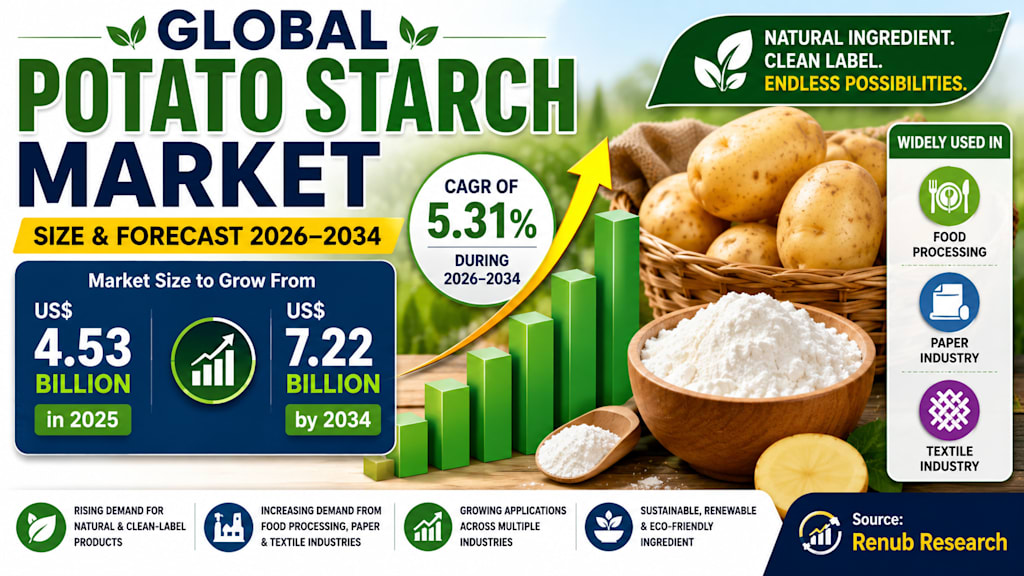
Global Potato Starch Market Overview
The global potato starch market is experiencing steady growth as food manufacturers, industrial producers, and pharmaceutical companies increasingly adopt natural and multifunctional ingredients. According to the market data provided, the potato starch market is estimated at US$ 4.53 billion in 2025 and is expected to reach US$ 7.22 billion by 2034, growing at a 5.31% CAGR during the 2026–2034 forecast period. Rising demand from food processing, paper manufacturing, textiles, pharmaceuticals, and clean-label food applications continues to support market expansion.
Potato starch is a white carbohydrate-rich powder extracted from potatoes through crushing, washing, and drying processes. It is widely recognized for its neutral taste, high viscosity, moisture-retention capability, and thickening performance. Because it is naturally gluten-free, potato starch has become increasingly important in gluten-free and plant-based food formulations.
What makes potato starch particularly attractive is its versatility. It is no longer used only as a food thickener. Today, it plays a growing role in packaging, textiles, pharmaceuticals, adhesives, biodegradable plastics, and sustainable industrial materials. As consumers and manufacturers move toward natural and environmentally friendly ingredients, potato starch is benefiting from both health-driven and sustainability-driven demand trends.
Clean-Label Food Demand Is Accelerating Market Growth
One of the biggest drivers behind the potato starch market is the rapid rise of clean-label and natural food products. Consumers worldwide are becoming more conscious about ingredient transparency and are increasingly avoiding artificial additives and synthetic stabilizers. Potato starch, being natural and plant-derived, fits well into this trend.
Food manufacturers are using potato starch as a thickening, stabilizing, and texturizing agent in soups, sauces, snacks, bakery products, noodles, frozen meals, and ready-to-eat foods. Its neutral flavor and strong moisture-retention properties help improve product texture without affecting taste.
The gluten-free movement is another major factor supporting demand. Consumers with gluten intolerance, celiac disease, or health-conscious dietary preferences are increasingly choosing gluten-free products, and potato starch is widely used as an alternative to wheat-based ingredients.
Health and wellness trends are also pushing manufacturers toward plant-based and minimally processed ingredients. Potato starch aligns well with these preferences because it is naturally sourced and perceived as safer and more sustainable than many synthetic alternatives.
Your report highlights a strategic partnership announced in June 2023 between Brenntag Specialties and Royal Avebe. The collaboration aimed to combine Brenntag’s distribution network with Royal Avebe’s expertise in potato starch production, demonstrating how supply-chain partnerships are becoming increasingly important in the nutrition and specialty ingredients sector.
Expanding Industrial Applications Are Creating New Opportunities
The potato starch market is no longer dependent solely on the food industry. Its growing industrial applications are opening new growth opportunities across several sectors.
In the paper industry, potato starch is used as a coating and binding agent to improve paper strength, printability, and overall quality. With the rise of sustainable packaging and e-commerce-related packaging demand, the paper sector continues to contribute significantly to market growth.
The textile industry also uses potato starch to improve fabric finishing, durability, and processing quality. Meanwhile, the adhesive industry benefits from potato starch’s binding and film-forming properties.
The pharmaceutical sector represents another important application area. Potato starch is used as an excipient in tablet manufacturing because it helps improve stability, drug release properties, and formulation consistency. As pharmaceutical production expands globally, demand for safe and functional starch-based ingredients is expected to rise steadily.
Manufacturers are also exploring potato starch as a sustainable alternative in biodegradable plastics and renewable materials. As industries seek environmentally friendly raw materials, starch-based bioplastics are becoming more attractive as replacements for petroleum-based materials.
In March 2026, Pendulum Therapeutics launched Superfood Gut Fuel Powder containing resistant potato starch along with other functional ingredients. The launch highlights the growing role of potato starch in functional nutrition and gut-health applications.
Processed and Convenience Foods Continue Driving Demand
The rapid growth of processed and convenience foods is another major factor boosting potato starch consumption globally. Urbanization, busy lifestyles, and changing eating habits are increasing demand for ready-to-eat and packaged food products.
Potato starch plays a crucial role in maintaining product consistency, stability, texture, and shelf life in processed foods. Its ability to withstand industrial processing conditions and high temperatures makes it particularly valuable for large-scale food manufacturing.
The report notes that India’s processed food market is expected to reach USD 470 billion by 2025 according to IBEF, highlighting the enormous growth potential for ingredient suppliers, including potato starch manufacturers.
Frozen foods, bakery items, noodles, snacks, sauces, and packaged meals all represent strong growth categories where potato starch is widely used. As consumers continue prioritizing convenience without sacrificing quality, the role of potato starch in processed food production is expected to strengthen further.
Modified Potato Starch Is Gaining Strong Momentum
Modified potato starch is becoming one of the fastest-growing segments of the market because of its improved performance characteristics. Unlike native starch, modified potato starch undergoes chemical, physical, or enzymatic treatment to improve heat resistance, texture stability, acid tolerance, and processing durability.
This makes modified starch highly suitable for industrial food applications such as sauces, frozen foods, ready meals, and processed snacks. It also performs well in industrial sectors including adhesives, textiles, and paper manufacturing because of its enhanced film-forming and binding capabilities.
At the same time, manufacturers are increasingly developing clean-label modified starch products to satisfy consumer demand for more natural formulations. This balance between performance and clean-label positioning is expected to support continued segment growth.
Native Potato Starch Remains Important
Conventional or native potato starch still maintains strong demand because of its simplicity, affordability, and natural image. Native starch is extracted directly from potatoes without chemical modification, making it attractive for consumers and manufacturers seeking minimally processed ingredients.
The food and beverage industry remains the largest consumer of native potato starch because of its excellent thickening and binding performance. Native starch is also used in traditional cooking and basic industrial applications where advanced processing stability is not essential.
However, native starch faces limitations under extreme processing conditions such as high acidity or prolonged heating, which is one reason modified starch products continue gaining market share.
Food and Beverage Applications Dominate the Market
The food and beverage segment remains the largest end-use category for potato starch. Its widespread use in soups, sauces, snacks, bakery products, processed foods, and gluten-free formulations continues to drive market demand globally.
Potato starch’s neutral taste, high viscosity, and moisture-retention properties make it highly valuable in food processing. It improves texture and consistency without altering flavor profiles, which is important for manufacturers trying to maintain product quality.
The increasing popularity of plant-based foods is also supporting demand because potato starch functions well in meat alternatives, dairy substitutes, and vegan products. The market is therefore benefiting from multiple consumer trends at the same time.
Paper and Packaging Applications Are Expanding
The paper industry represents another important growth area for potato starch. Rising demand for sustainable packaging materials is encouraging greater use of natural starch-based binders instead of synthetic chemicals.
Potato starch improves paper strength, printability, and durability, making it valuable for packaging, printing, and labeling applications. The growth of e-commerce and shipping activity is indirectly supporting demand because more packaging materials are needed worldwide.
As governments and corporations push for reduced environmental impact and biodegradable materials, potato starch is becoming increasingly attractive within sustainable packaging strategies.
Supply Volatility and Competition Remain Challenges
Despite strong growth prospects, the potato starch market faces several challenges. One of the biggest concerns is raw material supply volatility. Potato production is highly dependent on climate conditions such as rainfall, temperature, and soil quality. Poor harvests can disrupt supply and increase raw material costs.
Competition from alternative starches also remains intense. Corn starch, wheat starch, and tapioca starch are widely available and often cheaper, making them strong competitors in multiple applications.
In some industrial and food applications, competing starches may offer better performance or lower costs. The emergence of synthetic and modified starch alternatives is also increasing pressure on traditional potato starch manufacturers.
To remain competitive, producers are increasingly focusing on innovation, sustainability, and high-value specialty applications where potato starch can offer clear functional advantages.
Regional Markets Continue Expanding
The United States remains one of the most developed potato starch markets because of strong food processing, industrial manufacturing, and pharmaceutical demand. Rising interest in clean-label and gluten-free products continues supporting market expansion.
In November 2024, KMC introduced CheeseMaker CF66, a potato starch-based ingredient designed for plant-based pizza cheese applications. The product was developed to improve meltability, stretchability, and texture in dairy-free cheese alternatives.
The United Kingdom market is benefiting from rising demand for sustainable materials and clean-label foods. In June 2024, AKV partnered with Daymer Ingredients to expand access to natural and sustainable potato starch products across food manufacturing sectors.
India’s market is expanding steadily due to rapid growth in food processing, urbanization, and changing dietary habits. Although corn starch still dominates because of lower costs, potato starch is gaining ground in gluten-free and specialty applications.
Saudi Arabia remains heavily dependent on imports to meet domestic demand, but growth in packaged foods, hospitality, and industrial sectors continues supporting market development.
Recent Developments from Leading Companies
Brenntag Specialties partnered with Royal Avebe in June 2023 to strengthen potato starch distribution and supply-chain collaboration in the nutrition sector.
Pendulum Therapeutics launched Superfood Gut Fuel Powder in March 2026 using resistant potato starch for gut-health and functional nutrition applications.
KMC introduced CheeseMaker CF66 in November 2024, a potato starch-based ingredient developed for plant-based cheese alternatives.
AKV partnered with Daymer Ingredients in June 2024 to distribute sustainable potato starch products in the UK market.
Royal Avebe continued expanding specialty potato starch capabilities to support clean-label and plant-based food demand globally.
Ingredion increased focus on specialty starch innovation for food texture, stability, and sustainable ingredient applications.
Cargill continued strengthening clean-label ingredient portfolios in response to rising demand for natural food formulations.
Tate & Lyle expanded starch innovation initiatives focused on healthier food and beverage applications.
Agrana Beteiligungs-AG continued investing in starch-based sustainability solutions for industrial and food sectors.
Sudzucker AG strengthened specialty starch product development to support growing demand across food and industrial markets.
Outlook for 2026–2034
The global potato starch market is expected to maintain steady long-term growth as clean-label demand, processed food expansion, and sustainable industrial applications continue increasing. The projected rise from US$ 4.53 billion in 2025 to US$ 7.22 billion by 2034 reflects growing global demand across both food and non-food industries.
Modified potato starch is expected to gain additional momentum because of its superior processing capabilities, while native starch products will continue benefiting from consumer preference for natural ingredients.
Manufacturers that focus on sustainability, specialty applications, and clean-label innovation are likely to strengthen their market position over the next decade.
Final Thoughts
The potato starch market is evolving from a traditional food ingredient category into a broader sustainability and industrial materials story. Demand is no longer being driven only by food processing but also by pharmaceuticals, paper, adhesives, biodegradable materials, and plant-based product innovation.
As consumers increasingly prioritize natural ingredients and industries seek environmentally responsible materials, potato starch is gaining strategic importance across multiple sectors. While challenges related to raw material supply and competition remain significant, the long-term outlook for the industry remains highly positive.
About the Creator
Enjoyed the story? Support the Creator.
Subscribe for free to receive all their stories in your feed.
Comments
There are no comments for this story
Be the first to respond and start the conversation.