
Global Pipeline Integrity Management Market: Energy Safety & Forecast 2034
How aging pipeline infrastructure, predictive maintenance tools, and corrosion monitoring technologies are reshaping the global pipeline integrity market.

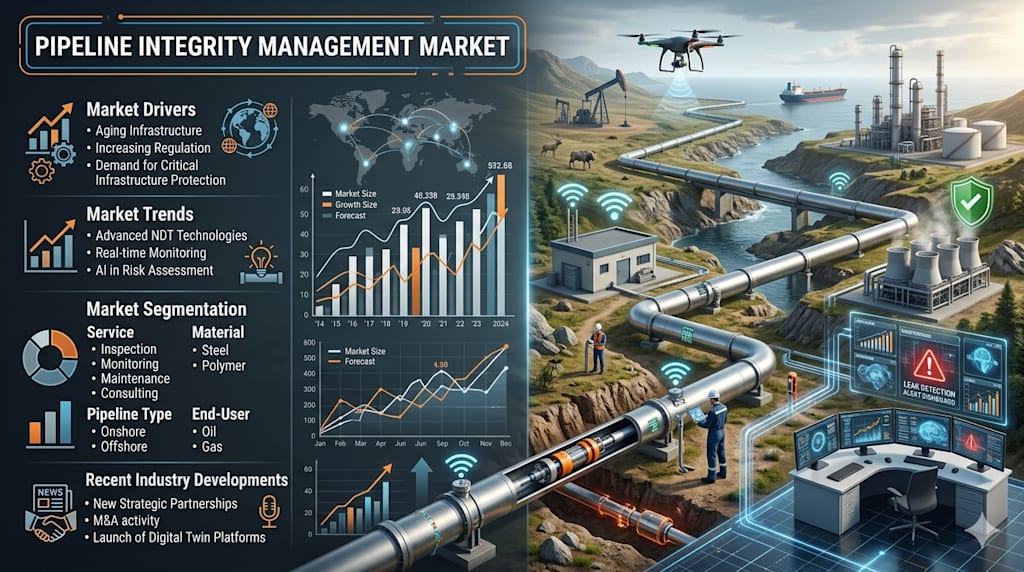
Rapid aging of global pipeline infrastructure, rising demand for natural gas, increasingly stringent regulatory frameworks, and significant technological advancements are driving pipeline integrity management market growth, supported by digital monitoring innovations, smart inspection solutions, and expanding energy infrastructure investment across key producing and consuming regions. According to IMARC Group's latest data, The global pipeline integrity management market size was valued at USD 10.9 Billion in 2025. Looking forward, IMARC Group estimates the market to reach USD 14.3 Billion by 2034, exhibiting a CAGR of 2.90% from 2026-2034. North America currently dominates the market, holding a market share of over 38.9% in 2025.
The global pipeline integrity management market is witnessing steady expansion across oil, gas, and energy transportation sectors as operators prioritize safety, regulatory compliance, and operational continuity for aging and newly built pipeline networks. Demand is driven by the widespread recognition that pipeline failures carry severe environmental and financial consequences, alongside growing governmental focus on infrastructure resilience.
Pipeline Integrity Management Market Growth Drivers:
Rapidly Aging Global Pipeline Infrastructure
Aging pipeline networks across Europe, North America, and Asia represent one of the most pressing structural challenges in the energy sector, directly fueling demand for comprehensive pipeline integrity management solutions. In Europe, many pipelines have been operational since the 1960s and 1970s, making them over 50 years old and highly susceptible to corrosion, wear, and mechanical failure. The OECD and the World Economic Forum estimate that an annual global infrastructure investment of up to USD 3.7 trillion is required, divided equally among Europe, the United States, and China, to address aging infrastructure risks including pipelines.
Rising Demand for Natural Gas Pipeline Infrastructure
The global expansion of natural gas as a transitional energy source is directly driving the build-out of new pipeline networks and elevating the importance of robust integrity management systems to protect these assets. Industry sources indicate that natural gas consumption reached 3,822.8 billion cubic meters, primarily driven by higher usage in power generation and transport sectors.
Stringent Regulatory Requirements and Government Mandates
Government bodies and regulatory agencies worldwide are tightening pipeline safety standards, creating a compulsory demand environment for pipeline integrity management solutions. In the United States, the Pipeline and Hazardous Materials Safety Administration's Risk Ranking Index Model, updated in July 2024 for 2025 planning, exemplifies proactive regulatory evolution, helping operators prioritize inspections based on multiple threat factors. Landmark government actions such as the allocation of USD 196 million in grants across 20 states to modernize leak-prone natural gas pipelines, funded through the Bipartisan Infrastructure Law, underscore the regulatory and financial weight behind pipeline integrity investment.
Pipeline Integrity Management Market Trends:
Integration of Advanced Technologies and Digital Inspection Solutions
The adoption of smart inspection and digital monitoring technologies is fundamentally transforming how pipeline operators detect, assess, and respond to integrity threats. Robotic inspection tools, sensor-based monitoring systems, high-resolution smart pigging, drone surveillance, ultrasonic testing, and magnetic flux leakage methods are enabling operators to identify corrosion, cracks, and leaks with far greater precision and speed than traditional approaches. The shift toward AI-driven predictive maintenance and cloud-based data analytics platforms is allowing operators to centralize monitoring, optimize maintenance scheduling, and make data-driven decisions that reduce unplanned downtime and operational risk.
Urbanization and Expanding Energy Infrastructure Requirements
Rapid global urbanization is intensifying the demand for upgraded energy transportation infrastructure, including expanded and better-maintained pipeline networks. According to the United Nations, it is projected that 68% of the global population will reside in cities by 2050, compared to 55% in 2018. This demographic shift is driving sustained investment in new and upgraded pipelines to serve expanding urban energy requirements across water, oil, gas, and industrial supply chains.
Strategic Partnerships, Mergers, and Competitive Innovation
Leading players in the pipeline integrity management market are actively pursuing strategic alliances, acquisitions, and technology partnerships to broaden service capabilities, expand geographic presence, and deliver more integrated pipeline safety solutions. Companies including Baker Hughes, Emerson Electric, DNV AS, Bureau Veritas, T. D. Williamson, and TUV Rheinland are integrating IoT sensors, AI analytics, and advanced inspection hardware to offer end-to-end pipeline safety ecosystems.
Recent News and Developments in the Pipeline Integrity Management Market
July 2024: South Sudan and Ethiopia agreed to develop a new cross-border pipeline connecting South Sudan's Nile state to the Gambella region of Ethiopia, significantly expanding the pipeline network across both nations and creating new demand for integrity management services in East Africa's growing energy corridor.
October 2024: The U.S. Department of Transportation's Pipeline and Hazardous Materials Safety Administration announced the allocation of USD 196 million in grants to modernize natural gas pipelines across 20 states, funding 60 targeted projects focused on repairing or replacing old, leak-prone pipelines to mitigate safety hazards and reduce environmental impacts under the Bipartisan Infrastructure Law.
March 2024: Oil and gas major Equinor ASA awarded a pipeline inspection and survey contract in the North Sea to ocean services provider DeepOcean, covering pipeline inspections, seabed mapping, pipeline surveys, and light construction work, reflecting continued operator investment in third-party integrity management partnerships for offshore assets.
February 2024: The Indian government, at the International Conference of Petroleum and Natural Gas Regulators, announced plans to increase natural gas's share in the national energy mix from 6% to 15%, directly accelerating the construction of new gas pipelines across the country and elevating demand for advanced integrity management solutions to support India's expanding gas infrastructure.
January 2026: Multiple pipeline operators across North America and Europe announced multi-year contracts with digital inspection and monitoring technology providers to deploy AI-powered predictive maintenance platforms across aging pipeline segments, reflecting the sector's growing commitment to technology-driven integrity management as a proactive risk reduction strategy.
Note: If you require specific details, data, or insights that are not currently included in the scope of this report, we are happy to accommodate your request. As part of our customization service, we will gather and provide the additional information you need, tailored to your specific requirements. Please let us know your exact needs, and we will ensure the report is updated accordingly to meet your expectations.
About the Creator
Suhaira Yusuf
I specialize in Consumer Insights, focusing on transforming detailed market data into strategic business solutions that accelerate growth and improve customer engagement.
Enjoyed the story? Support the Creator.
Subscribe for free to receive all their stories in your feed.
Comments
There are no comments for this story
Be the first to respond and start the conversation.