
Global Metal Casting Market Trends: Green Foundries, Automation Rise & Forecast to 2034
How industrial automation, energy-efficient furnaces, and precision casting technologies are driving innovation across the global metal casting market.

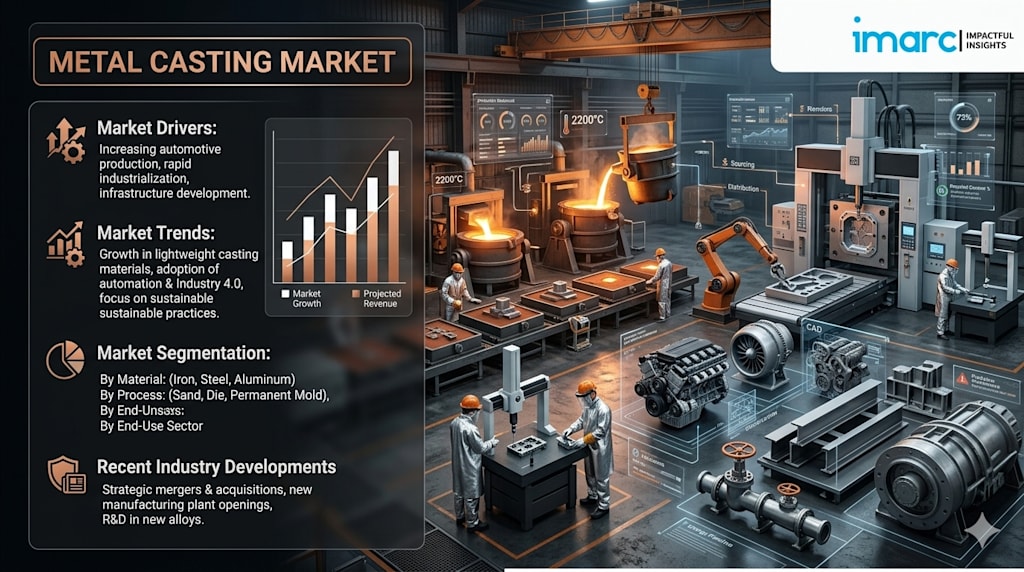
Market Overview:
Accelerated industrialization, strong demand from automotive and aerospace industries, advancements in casting technologies, and increasing global infrastructure investments are contributing to the growth of the metal casting market. The sector is also supported by the rising use of recycled metals, higher defense spending, and the integration of automation and 3D printing in foundry operations.
According to IMARC Group's latest data, the global metal casting market size reached USD 190.5 Billion in 2025 and is projected to reach USD 352.4 Billion by 2034, exhibiting a CAGR of 6.70% during 2026–2034. Asia-Pacific currently dominates the market, accounting for over 54.9% share in 2025.
The metal casting market plays a critical role in global manufacturing, supporting the production of high-strength, precision-engineered, and lightweight components across industries such as automotive, aerospace, construction, defense, and industrial machinery. Common processes include sand casting, die casting, and investment casting, while materials such as cast iron and aluminum remain widely used due to their durability and performance characteristics.
In North America, the United States holds a dominant position with approximately 84.50% regional share, supported by reshoring trends, electric vehicle production, and strict quality standards. Automotive and transportation applications account for around 51.5% of total market demand, driven by components such as alloy wheels, battery housings, and structural parts.
Request a Business Sample Report for Procurement & Investment Evaluation
Metal Casting Market Growth Drivers:
Rising Demand from Automotive and Aerospace Industries
The need for lightweight and high-strength components continues to increase across automotive and aerospace sectors. Manufacturers are focusing on improving fuel efficiency and structural performance, especially in electric vehicles, which is driving demand for aluminum and magnesium-based cast components.
Advancements in Casting Technologies
Technological developments in casting processes are improving product quality and operational efficiency. Techniques such as high-pressure die casting, investment casting, and the use of computer-aided design (CAD) and manufacturing (CAM) are reducing material waste and enhancing precision. Initiatives aimed at integrating additive manufacturing into traditional casting processes are further supporting innovation in the industry.
Growing Use of Recycled Metals
The use of recycled metals is increasing due to both environmental and economic benefits. Recycled aluminum, for example, requires significantly less energy compared to primary production, leading to reduced emissions and lower costs. This shift is encouraging manufacturers to adopt sustainable production practices.
Metal Casting Market Trends:
Dominance of Sand Casting and Cast Iron
Sand casting remains one of the most widely used processes, accounting for approximately 45.6% of the market share due to its cost-effectiveness and flexibility in producing complex components. On the material side, cast iron holds around 55.2% share, supported by its durability, wear resistance, and suitability for heavy-duty applications.
Expansion in Construction and Infrastructure Applications
Increasing investments in infrastructure development are contributing to rising demand for metal cast components. Structural elements, fittings, and load-bearing components used in bridges, transportation systems, and industrial facilities are driving consistent demand across global markets.
Growth in Defense Sector Applications
The defense sector is becoming an important contributor to market growth. Rising global military expenditure is increasing the demand for durable and high-performance cast components used in armored vehicles, aircraft, and defense equipment.
Recent News and Developments:
March 2025: Nemak expanded its aluminum casting capacity to support growing electric vehicle demand, particularly for battery and drivetrain components.
January 2025: Alcoa Corporation announced investments in advanced aluminum casting facilities in the United States to strengthen domestic manufacturing capabilities.
November 2024: Georg Fischer Casting Solutions partnered with an automotive manufacturer to develop high-pressure die casting solutions for electric vehicle platforms.
August 2024: Industry data indicated increased adoption of simulation software and digital technologies in casting operations across U.S. foundries.
May 2024: Hitachi Metals expanded production capacity for specialty cast iron and alloy steel to meet infrastructure and industrial demand.
February 2024: Precision Castparts Corp. secured a long-term agreement to supply advanced cast components for aerospace applications.
Note:
Additional data, insights, or specific analysis can be incorporated based on individual business or research requirements.
About the Creator
Suhaira Yusuf
I specialize in Consumer Insights, focusing on transforming detailed market data into strategic business solutions that accelerate growth and improve customer engagement.
Enjoyed the story? Support the Creator.
Subscribe for free to receive all their stories in your feed.
Comments
There are no comments for this story
Be the first to respond and start the conversation.