
Global IVF Market Expands Rapidly as Infertility Rates Rise and Reproductive Technology Advances
Delayed pregnancies, changing lifestyles, and breakthroughs in fertility treatments are driving strong growth in the global IVF industry.

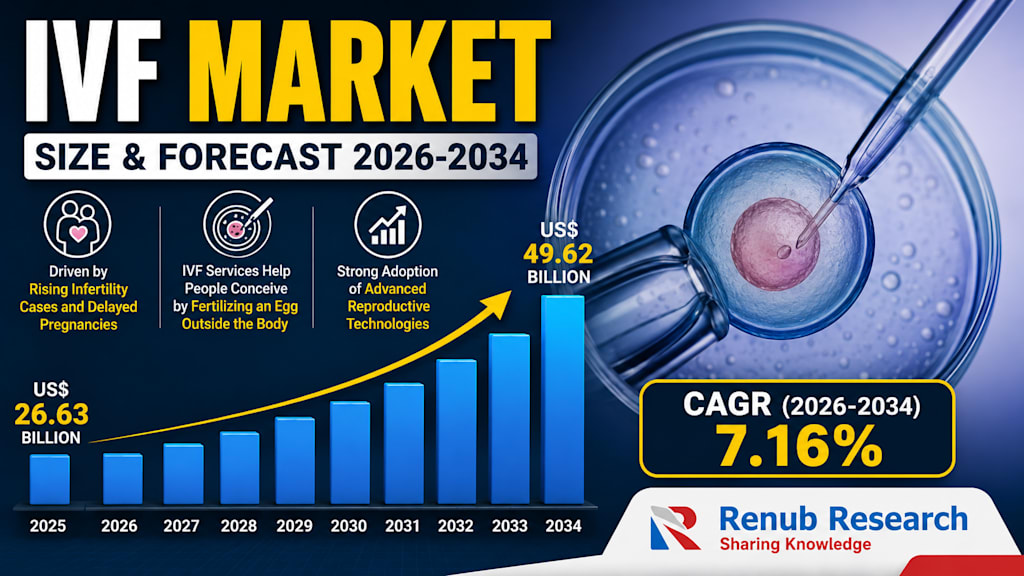
The global In Vitro Fertilization (IVF) market is entering a significant growth phase as infertility rates continue to rise worldwide and reproductive technologies become increasingly advanced and accessible. According to Renub Research, the global IVF market is projected to grow from US$ 26.63 billion in 2025 to US$ 49.62 billion by 2034, expanding at a compound annual growth rate (CAGR) of 7.16% between 2026 and 2034.
That growth reflects a profound shift in modern society. Couples are increasingly delaying parenthood due to career ambitions, financial planning, lifestyle choices, and changing social norms. At the same time, rising stress levels, obesity, environmental factors, and reproductive health disorders are contributing to increasing infertility challenges across both developed and developing nations. IVF has emerged as one of the most effective and widely accepted medical solutions to these fertility problems.
What was once considered a highly specialized and emotionally sensitive medical procedure is now becoming a mainstream healthcare service supported by technological innovation, rising awareness, expanding fertility clinics, and growing social acceptance. As reproductive medicine evolves, the IVF industry is transforming into one of the fastest-growing sectors within modern healthcare.
Understanding the growing importance of IVF
In Vitro Fertilization, commonly known as IVF, is a form of assisted reproductive technology (ART) used to help individuals and couples conceive when natural pregnancy becomes difficult or impossible. During the procedure, eggs are retrieved from the ovaries and fertilized with sperm in a laboratory under controlled conditions. Once healthy embryos develop, one or more embryos are transferred into the uterus to achieve pregnancy.
IVF is commonly recommended for patients facing infertility issues caused by blocked fallopian tubes, low sperm count, hormonal disorders, polycystic ovary syndrome (PCOS), endometriosis, unexplained infertility, or age-related fertility decline. Over the years, the procedure has evolved significantly, with improvements in embryo selection, cryopreservation, genetic testing, and laboratory technologies increasing the chances of successful pregnancies.
Today, IVF is no longer viewed as an experimental treatment. It has become a critical reproductive healthcare solution for millions of people worldwide who want to start families despite biological challenges. Growing accessibility and awareness are helping normalize fertility treatment discussions across societies that once viewed infertility as a private or stigmatized issue.
Rising infertility rates are driving global demand
One of the biggest drivers behind the IVF market is the increasing prevalence of infertility worldwide. According to the data highlighted in the Renub Research analysis, the global fertility rate fell to 2.3 children per woman in 2023, a dramatic decline compared to 4.9 children per woman during the 1950s.
Modern lifestyles are playing a major role in this trend. Stress, unhealthy diets, smoking, alcohol consumption, obesity, environmental pollution, and sedentary habits are increasingly affecting reproductive health in both men and women. In addition, many people are delaying parenthood due to career development, financial priorities, or personal lifestyle choices, which can reduce fertility with age.
Medical conditions such as PCOS, hormonal disorders, low sperm count, and endometriosis are also becoming more common. These issues often make natural conception difficult, leading many couples to seek assisted reproductive technologies like IVF. As infertility becomes a larger global health concern, demand for fertility clinics and reproductive healthcare services continues to rise.
The emotional aspect is equally important. Parenthood remains deeply meaningful for many individuals and couples, and IVF offers hope where natural conception may not be possible. That emotional and social significance continues to strengthen the market’s long-term growth potential.
Technological innovation is improving success rates
Another major reason for the rapid expansion of the IVF market is the advancement of reproductive medicine and fertility technologies. IVF procedures today are far more effective, efficient, and personalized than they were just a decade ago.
Technologies such as embryo freezing, genetic screening, advanced culture media, and time-lapse embryo monitoring are helping fertility specialists identify healthier embryos and improve pregnancy success rates. These innovations are making IVF procedures safer while increasing the likelihood of successful conception.
Cryopreservation technology has become especially important. It allows patients to freeze eggs, sperm, or embryos for future use, providing greater flexibility for family planning. This technology is increasingly popular among individuals who wish to delay parenthood due to personal or professional reasons, as well as patients undergoing medical treatments that may affect fertility.
Artificial intelligence is also beginning to influence the fertility industry. Renub Research highlights a strategic partnership announced in 2023 between AIVF Ltd. and Genea Biomedx to provide AI-based solutions for IVF clinics. AI technologies are expected to improve embryo analysis, optimize treatment planning, and enhance overall clinical efficiency in fertility care.
As research and innovation continue advancing, IVF procedures are becoming more reliable and increasingly attractive to patients seeking fertility assistance.
Social awareness and acceptance are transforming the market
One of the most significant changes in the IVF industry is the growing social acceptance of fertility treatments. Infertility was once considered a deeply private matter in many societies, preventing people from openly discussing reproductive challenges or seeking medical help. That stigma is gradually fading.
Healthcare organizations, fertility clinics, and advocacy groups are working to raise awareness about reproductive health and fertility treatment options. Media coverage, educational campaigns, and public discussions are helping normalize conversations around infertility and assisted reproduction.
Governments and healthcare systems in several countries are also becoming more supportive of fertility treatments. The launch of the Coalition for Fertility advocating for inclusive fertility policies in Europe during 2024 reflects how reproductive healthcare is gaining greater policy attention globally.
As awareness improves, more individuals are seeking professional fertility advice earlier rather than delaying treatment. This shift is expanding the patient base for IVF services across multiple regions.
Cost remains one of the industry’s biggest challenges
Despite strong growth potential, the IVF industry continues to face important barriers. The most significant challenge is cost. IVF is a highly specialized medical process involving consultations, diagnostic testing, hormone therapy, egg retrieval, fertilization, embryo culture, and embryo transfer. These procedures require advanced laboratory equipment and highly trained specialists, making treatment expensive.
In many countries, IVF procedures are not fully covered by insurance, forcing patients to pay significant out-of-pocket expenses. Multiple treatment cycles are often required before pregnancy is achieved, increasing the overall financial burden on patients and families.
The cost issue is particularly important in developing countries where fertility treatments may remain inaccessible for large segments of the population. As demand grows globally, affordability and insurance coverage are likely to remain key policy discussions within the fertility care industry.
Ethical and regulatory concerns continue to shape the industry
The IVF market also faces ethical and legal challenges related to embryo handling, genetic testing, and fertility regulations. Different countries maintain different laws regarding embryo transfer limits, donor programs, embryo freezing, and reproductive technologies.
Religious beliefs and cultural perspectives can also influence how IVF is perceived and regulated in different regions. Fertility clinics and healthcare providers must navigate these varying legal and ethical frameworks while maintaining patient trust and clinical standards.
As reproductive technologies continue advancing, discussions around ethics, embryo selection, genetic screening, and reproductive rights are expected to remain highly relevant within the industry.
Different IVF segments are expanding rapidly
Several specialized IVF segments are witnessing strong growth due to evolving patient needs and technological progress.
Fresh donor IVF remains an important treatment option for women with diminished ovarian reserve, genetic disorders, or age-related fertility decline. Because donor eggs are fertilized immediately after retrieval, fresh donor IVF often delivers high success rates.
Frozen donor IVF is also growing rapidly thanks to advances in cryopreservation technology. Frozen donor eggs and embryos offer greater scheduling flexibility and simplify donor availability. Fertility clinics increasingly operate donor egg banks that allow patients to select from a broader range of donors.
The IVF equipment market is expanding as fertility clinics invest in advanced laboratory technologies such as incubators, microscopes, embryo culture systems, and time-lapse imaging equipment. These tools help embryologists manage reproductive materials safely while improving clinical outcomes.
Cryopreservation services are also becoming increasingly important. Many individuals now choose to preserve reproductive materials for future family planning, especially those pursuing career goals or undergoing medical treatments that may impact fertility.
Meanwhile, fertility clinics themselves represent one of the most critical segments within the IVF market. Clinics are rapidly expanding worldwide to meet growing patient demand, offering services ranging from fertility testing and counseling to advanced reproductive procedures and embryo freezing.
Regional markets reveal strong opportunities
The United States remains one of the largest and most technologically advanced IVF markets globally. Delayed parenthood, strong healthcare infrastructure, advanced laboratory technologies, and increasing social awareness are all contributing to rising IVF demand. Fertility service providers continue to expand partnerships and investments within the U.S. market.
The United Kingdom IVF market is also growing steadily due to rising infertility rates and increasing public awareness about fertility treatments. Access to fertility services through both public and private healthcare systems has helped support market development. The UK has also become a hub for fertility technology innovation, including the adoption of automated embryo storage systems.
India is emerging as one of the fastest-growing IVF markets in the world. Lifestyle changes, delayed marriages, stress, and environmental conditions are contributing to increasing infertility cases across the country. India’s fertility treatment industry is also benefiting from comparatively affordable IVF procedures, attracting medical tourism from international patients. Renub Research highlights the launch of Asia’s first fully integrated home IVF solution by Seeds of Innocens during 2025 as an example of innovation within the Indian fertility sector.
Saudi Arabia’s IVF market is also expanding as healthcare infrastructure improves and awareness about reproductive medicine increases. Fertility clinics equipped with modern technologies and skilled specialists are helping more couples seek professional fertility care across the country.
Competition continues to intensify
The global IVF industry includes several major healthcare, biotechnology, and fertility technology companies competing across laboratory equipment, pharmaceuticals, reproductive technologies, and fertility services. Key players highlighted in the Renub Research report include FUJIFILM Holdings Corporation, Hamilton Thorne Ltd., Vitrolife AB, Thermo Fisher Scientific, Bayer AG, Merck & Co., The Cooper Companies, and Fortis Healthcare.
Competition increasingly revolves around treatment success rates, technological innovation, patient experience, cryopreservation quality, genetic testing capabilities, and affordability. Companies investing in AI, automation, and personalized fertility care are expected to gain strong competitive advantages in the coming years.
Final thoughts
The IVF market is no longer a niche segment of healthcare. It is rapidly becoming a mainstream solution for millions of individuals and couples navigating infertility and delayed parenthood. Rising infertility rates, technological advancements, growing awareness, and expanding fertility infrastructure are all creating strong long-term growth opportunities for the industry.
Although challenges such as high treatment costs and ethical concerns remain important, the future of the IVF market appears highly promising. As reproductive technologies continue evolving and social acceptance continues to grow, IVF is expected to play an increasingly central role in helping people achieve parenthood across the world.
About the Creator
Enjoyed the story? Support the Creator.
Subscribe for free to receive all their stories in your feed.
Comments
There are no comments for this story
Be the first to respond and start the conversation.