
Global Industrial Enzymes Market Gains Momentum as Industries Shift Toward Sustainable Manufacturing
Rising demand for eco-friendly production, clean-label food processing, and advanced enzyme engineering is driving the industrial enzymes market beyond US$ 15 billion by 2034.

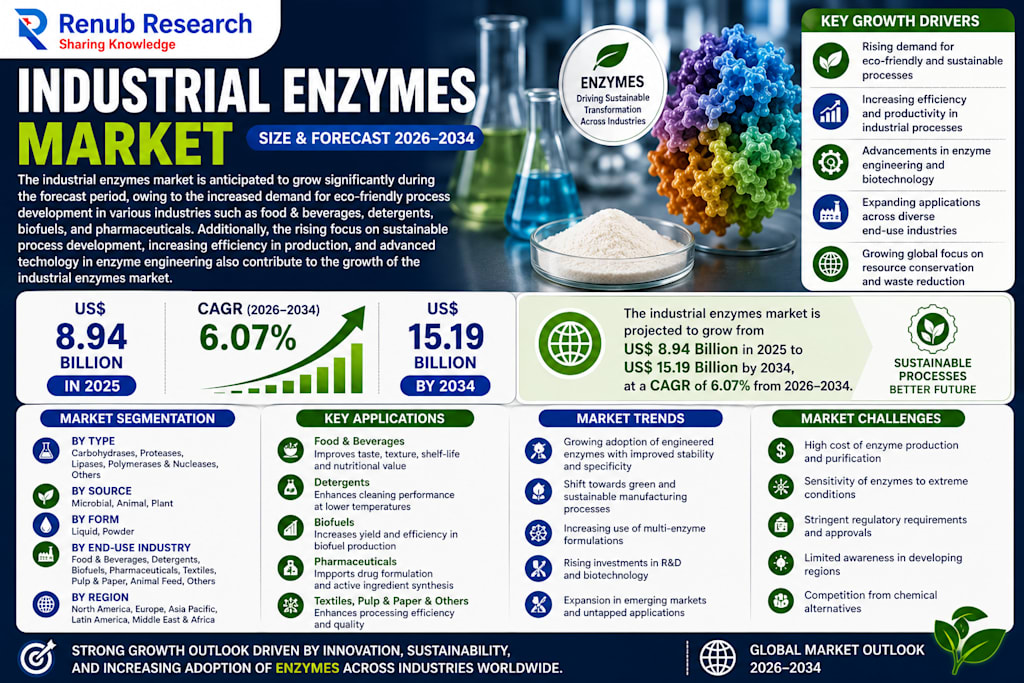
Industrial Enzymes Market Enters a New Growth Cycle
The global industrial enzymes market is experiencing strong and sustained growth as industries worldwide increasingly adopt environmentally friendly and energy-efficient production methods. From food processing and detergents to pharmaceuticals, textiles, and biofuels, industrial enzymes are becoming essential tools for improving operational efficiency while reducing environmental impact.
According to Renub Research, the industrial enzymes market is projected to grow from US$ 8.94 billion in 2025 to US$ 15.19 billion by 2034, expanding at a compound annual growth rate (CAGR) of 6.07% during 2026–2034. This growth is being fueled by rising demand for sustainable manufacturing, clean-label products, and advanced biotechnology solutions across multiple industries.
Industrial enzymes are biological catalysts derived mainly from microorganisms, plants, or animals. These enzymes accelerate chemical reactions in industrial processes while operating under milder conditions than conventional chemical treatments. Major enzyme categories include amylases, proteases, lipases, cellulases, and oxidoreductases, all of which are widely used across industries such as food and beverages, detergents, animal feed, textiles, paper and pulp, pharmaceuticals, and renewable energy.
As businesses increasingly focus on reducing emissions, conserving energy, and improving sustainability, industrial enzymes are becoming one of the most important technologies in modern industrial manufacturing.
Sustainability Is Driving Massive Demand
One of the strongest drivers behind the industrial enzymes market is the growing global emphasis on sustainable and eco-friendly manufacturing. Governments, industries, and consumers are all placing greater pressure on companies to reduce carbon emissions, minimize chemical waste, and adopt greener production processes.
Industrial enzymes offer major environmental advantages because they are biodegradable, renewable, and capable of replacing harsh chemical treatments in many industrial applications. Unlike traditional chemical processes that often require high temperatures and energy-intensive conditions, enzymes can operate efficiently under milder conditions, reducing overall energy consumption and environmental damage.
This shift toward green chemistry is helping drive adoption across industries looking to meet sustainability targets and comply with stricter environmental regulations. The report highlights VTR Biotech’s launch of next-generation xylanase and detergent enzyme solutions as an example of how companies are investing heavily in sustainable enzyme technologies.
As sustainability becomes central to corporate strategy worldwide, industrial enzymes are expected to remain critical tools for achieving long-term environmental and operational goals.
Food and Beverage Industry Remains a Major Consumer
The food and beverage sector continues to be one of the largest consumers of industrial enzymes globally. Enzymes are widely used to improve food texture, flavor, shelf life, digestibility, and production efficiency. They are particularly important in bakery products, dairy processing, brewing, beverages, and processed foods.
One major advantage of enzyme-based food processing is that it supports the growing clean-label trend. Consumers increasingly prefer foods with fewer artificial additives and preservatives, encouraging manufacturers to use natural enzyme solutions instead of synthetic chemicals.
The report references IFF’s launch of TEXSTAR™, an advanced enzymatic texturizing solution designed for dairy and plant-based fermented products. This innovation reflects how enzyme technologies are helping manufacturers meet evolving consumer expectations for texture, quality, and natural ingredients.
The continued expansion of processed food consumption and convenience food demand worldwide is expected to keep the food and beverage segment a key growth engine for the industrial enzymes industry.
Detergent Industry Drives Enzyme Adoption
The detergent industry is another major growth area for industrial enzymes. Enzymes improve cleaning performance by breaking down stains such as fats, proteins, and starches more effectively than traditional chemical detergents. Importantly, they also allow detergents to function efficiently at lower washing temperatures, reducing water and energy consumption.
As consumers increasingly demand environmentally friendly cleaning products, enzyme-based detergents are gaining popularity across residential and industrial applications. Companies are continuously developing improved enzyme formulations to deliver stronger cleaning performance while reducing environmental impact.
The push for sustainable consumer products is expected to further strengthen enzyme demand within the detergent industry over the coming years.
Advances in Enzyme Engineering Are Expanding Possibilities
Technological innovation is playing a crucial role in the growth of the industrial enzymes market. Advances in biotechnology, protein engineering, fermentation optimization, and genetic modification are allowing manufacturers to develop enzymes that are more efficient, stable, and adaptable to challenging industrial environments.
Modern enzyme engineering techniques enable companies to create customized enzyme solutions tailored to specific industrial applications. These improvements are increasing enzyme performance while also reducing production costs and expanding commercial viability.
The report highlights Bionetix International’s launch of ECL3000, an enzyme concentrate designed for cellulose degradation in industrial processes. Such innovations demonstrate how biotechnology companies are continuously expanding enzyme applications across industries while supporting sustainability goals.
As research capabilities continue improving, industrial enzymes are expected to become even more versatile and widely adopted.
High Production Costs Remain a Key Challenge
Despite their advantages, industrial enzymes still face several market challenges. One of the biggest obstacles is the relatively high cost associated with enzyme development and production. Manufacturing industrial enzymes requires advanced biotechnology facilities, sophisticated fermentation processes, and strict quality control systems, all of which contribute to higher production expenses.
These costs can make enzyme-based solutions less attractive in highly price-sensitive markets, especially for small and medium-sized manufacturers that continue relying on cheaper conventional chemicals.
Although enzyme technologies often provide long-term operational savings and environmental benefits, the initial investment can still act as a barrier to wider adoption in certain industries and regions.
Stability and Compatibility Limitations Affect Adoption
Another important challenge involves enzyme stability and compatibility under specific industrial conditions. Some enzymes may lose effectiveness when exposed to extreme temperatures, unusual pH levels, or harsh chemical environments.
Ensuring consistent enzyme performance across different manufacturing processes often requires extensive research and customization. Overcoming these stability limitations remains a major focus area for biotechnology companies and researchers.
As enzyme engineering technologies continue advancing, manufacturers are expected to improve enzyme resilience and broaden industrial applicability even further.
Lipases Market Expands Across Multiple Industries
Lipases represent one of the fastest-growing segments within the industrial enzymes market due to their broad range of applications. These enzymes catalyze reactions involving fats and fatty acids, making them valuable in food processing, dairy production, biodiesel manufacturing, detergents, and pharmaceuticals.
In detergents, lipases help remove grease and fat stains efficiently at low temperatures. In biodiesel production, they support renewable fuel manufacturing by facilitating fat and oil conversion processes. The growing interest in renewable energy and environmentally friendly manufacturing continues driving strong demand for lipase enzymes worldwide.
Proteases Continue to Dominate Usage
Proteases are among the most widely used industrial enzymes due to their versatility across industries such as food processing, detergents, pharmaceuticals, and leather treatment. These enzymes break down proteins into peptides and amino acids, improving food texture, digestibility, and flavor.
In detergent applications, proteases effectively target protein-based stains such as blood and food residues. Continuous improvements in enzyme heat resistance and efficiency are helping expand their industrial value further.
As demand for processed food and eco-friendly cleaning products continues growing globally, proteases are expected to remain one of the most important enzyme categories within the market.
Textile Industry Adopts Greener Processing Methods
The textile industry is increasingly turning toward industrial enzymes to reduce water consumption, energy use, and chemical pollution. Enzymes such as cellulases and amylases are used for desizing, bio-polishing, and denim finishing processes.
Compared to traditional chemical treatments, enzyme-based textile processing produces fewer emissions and generates less environmental waste. Growing environmental regulations and sustainability goals are encouraging textile manufacturers to adopt greener production technologies, further supporting enzyme demand.
Plant-Derived Enzymes Gain Popularity
Plant-derived enzymes are becoming increasingly attractive due to growing consumer interest in renewable and natural production methods. These enzymes are used in food processing, agriculture, and biofuel production, aligning closely with clean-label and sustainability trends.
Advancements in extraction and processing technologies are improving enzyme yield and efficiency, helping make plant-based enzymes more commercially viable. As industries seek environmentally friendly alternatives, plant-derived enzyme demand is expected to increase steadily.
United States Leads the Global Market
The United States remains one of the largest industrial enzymes markets globally due to its advanced biotechnology sector, strong research capabilities, and high demand from food processing, biofuels, detergents, and pharmaceutical industries.
The country’s strong focus on renewable fuels and sustainable manufacturing practices further supports enzyme adoption. The report also highlights the partnership expansion between Cargill and BASF to deliver enzyme solutions for the U.S. animal protein industry, reflecting the ongoing innovation within the American market.
Emerging Markets Continue to Grow
The United Kingdom market is benefiting from government initiatives promoting green manufacturing and reduced chemical use. Strong demand from the baking, brewing, and dairy industries is also supporting growth.
India’s industrial enzymes market is expanding rapidly due to industrialization, rising processed food demand, and government support for biofuel production. Increasing investment in biotechnology and local manufacturing is helping improve enzyme accessibility across the country.
Saudi Arabia’s market is still emerging but is expected to grow under Vision 2030 industrial diversification efforts and rising focus on sustainability and efficient resource utilization.
Competitive Landscape
The global industrial enzymes market includes major players such as BASF SE, Advanced Enzyme Technologies, Novozymes, DuPont Danisco, DSM, Kerry Group, Dyadic International, and Associated British Foods.
These companies are investing heavily in biotechnology research, customized enzyme solutions, and sustainable manufacturing technologies. Competition is increasingly centered around innovation, operational efficiency, and environmental performance.
Final Thoughts
The industrial enzymes market is becoming a cornerstone of sustainable industrial transformation. As industries worldwide seek cleaner, more efficient, and environmentally responsible production methods, enzymes are emerging as essential tools for achieving those goals.
With the market projected to grow from US$ 8.94 billion in 2025 to US$ 15.19 billion by 2034, the future of industrial enzymes looks highly promising. Companies that continue advancing enzyme engineering, reducing production costs, and expanding industrial applications will likely shape the next generation of sustainable manufacturing worldwide.
About the Creator
Enjoyed the story? Support the Creator.
Subscribe for free to receive all their stories in your feed.
Comments
There are no comments for this story
Be the first to respond and start the conversation.