
Global Eyewear Market Accelerates as Digital Eye Strain, Premium Lenses, and Smart Wearables Drive Industry Growth
Rising screen exposure, fashion-forward consumers, and innovation in contact lenses and smart eyewear are transforming the global eyewear industry into a high-growth lifestyle and healthcare market.

Market Overview
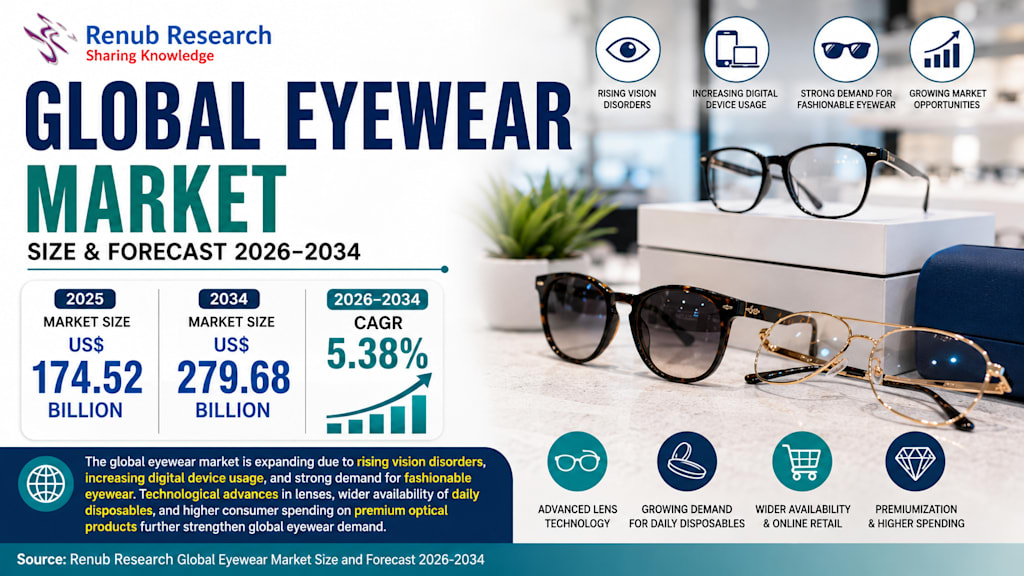
The global eyewear market is experiencing significant growth as changing lifestyles, increasing digital screen exposure, and rising awareness of eye health continue to influence consumer behavior worldwide. Eyewear has evolved beyond a basic medical necessity and is now positioned as a combination of healthcare solution, fashion accessory, and lifestyle product. According to Renub Research, the global eyewear market is projected to grow from US$ 174.52 billion in 2025 to US$ 279.68 billion by 2034, registering a CAGR of 5.38% during 2026–2034.
This strong growth reflects a major transformation in the global optical industry. Consumers today are increasingly investing in spectacles, contact lenses, sunglasses, and blue-light-filter eyewear not only for vision correction but also for comfort, protection, and style. The rapid increase in smartphone usage, remote working, gaming, and digital entertainment has intensified eye strain across all age groups, boosting demand for advanced eyewear solutions. At the same time, fashion trends and premiumization are encouraging consumers to spend more on luxury frames, customized lenses, and branded optical products.
Eyewear products today include single-vision lenses, bifocals, progressive lenses, blue-light-protection glasses, sunglasses, and various soft and rigid contact lenses. These products are distributed through optical stores, e-commerce platforms, clinics, independent showrooms, and retail chains. Technological progress in lens coatings, silicone hydrogel materials, lightweight frames, and digital lens engineering has reshaped the industry, making eyewear more comfortable, stylish, and performance-oriented than ever before.
The market is also benefiting from growing awareness regarding preventive eye care. Consumers are increasingly recognizing the importance of regular eye exams, UV protection, and digital eye protection. This awareness is especially strong among younger consumers who spend long hours in front of screens and are looking for solutions that reduce fatigue, dryness, and blurred vision. As eyewear becomes integrated into everyday life, the industry is expanding across both healthcare and fashion categories simultaneously.
Growth Drivers
One of the most important growth drivers in the eyewear market is the increasing prevalence of digital eye strain. Smartphones, tablets, laptops, gaming consoles, and streaming devices have dramatically changed visual habits worldwide. Long screen exposure often causes eye fatigue, dryness, headaches, and blurred vision, pushing consumers toward protective eyewear solutions such as blue-light-filter glasses and premium contact lenses. The demand for products that combine comfort, hydration, and digital protection has therefore risen sharply in recent years.
Innovation in daily disposable contact lenses is also playing a major role in market growth. Manufacturers are introducing technologically advanced lenses designed to improve moisture retention, oxygen flow, and comfort during extended digital device use. In November 2024, Johnson & Johnson Vision Care presented new data on its ACUVUE OASYS MAX 1-Day lenses with OptiBlue Light Filter technology, capable of blocking 60% of blue-violet light. These developments highlight how companies are positioning contact lenses as premium eye-health solutions rather than basic corrective products.
Another major growth factor is the expansion of manufacturing and research capabilities in emerging markets. Global eyewear companies are investing heavily in local production facilities to improve efficiency, strengthen regional distribution, and better serve rapidly growing consumer populations. In July 2024, Carl Zeiss Meditec AG opened a new R&D and manufacturing facility in China to strengthen its presence in the country’s expanding eye-care sector. Such investments help manufacturers respond faster to regional demand while also accelerating innovation in coatings, ophthalmic devices, and smart eyewear technologies.
The increasing demand for premium corrective solutions is another strong market driver. More consumers are seeking advanced products that offer improved hydration, comfort, and visual precision. This trend became even stronger after Bausch + Lomb introduced INFUSE for Astigmatism in June 2024, focusing on visual stability and moisture retention for daily disposable users. Premium contact lenses, especially silicone hydrogel and toric designs, are gaining popularity among young professionals and first-time wearers who want convenience without compromising eye health.
Market Challenges
Despite strong growth momentum, the global eyewear market still faces several challenges. One major issue is price sensitivity, especially in developing regions where premium glasses and advanced contact lenses remain unaffordable for many consumers. Limited access to optometrists and professional diagnostic services further restricts adoption in low-income and rural areas. Many consumers continue to delay eye exams or rely on inexpensive non-prescription eyewear, which may worsen long-term vision problems.
Another growing challenge is the environmental impact of eyewear waste. Daily disposable contact lenses contribute to microplastic pollution when disposed of improperly, while petroleum-based plastic frames add to global waste concerns. Although companies are experimenting with recycled plastics and bio-acetate materials, sustainable eyewear production still remains relatively limited compared to total industry demand. Manufacturers are under increasing pressure to create eco-friendly products without significantly increasing prices or compromising comfort and durability.
Balancing innovation, sustainability, affordability, and premium quality is becoming one of the defining challenges of the eyewear industry. Companies that successfully address these concerns are likely to gain a strong competitive advantage over the next decade.
United States Eyewear Market
The United States remains one of the most influential eyewear markets globally, driven by high awareness of eye health, strong purchasing power, and widespread digital device usage. Consumers increasingly prefer premium lenses, daily disposable contact lenses, and blue-light-filter eyewear. The country benefits from a large network of optometrists, ophthalmologists, and optical retail chains, alongside rapidly expanding e-commerce eyewear platforms. Fashion-driven frame trends and strong insurance coverage also contribute to market growth. Rising cases of myopia and presbyopia are expected to further increase demand for advanced eyewear solutions across all age groups.
Germany Eyewear Market
Germany has a mature and technologically advanced eyewear market supported by strong optometric services and high-quality manufacturing capabilities. Consumers prioritize precision lens engineering, durable materials, and advanced coatings. Demand for progressive lenses, blue-light glasses, and premium daily disposables continues to grow as digital device use rises and the population ages. Germany also remains a key center for optical innovation, supported by the presence of major lens manufacturers and diagnostic technology companies. Sustainability trends are additionally boosting demand for recyclable frames and eco-friendly eyewear materials.
China Eyewear Market
China is one of the fastest-growing eyewear markets due to rising myopia rates, urbanization, and increasing middle-class income. Heavy screen exposure and academic pressure among younger populations have accelerated demand for prescription glasses and contact lenses. The country is also benefiting from expanding manufacturing and R&D investments from global optical companies. Online eyewear platforms, fashion-conscious consumers, and growing awareness of eye health continue to support market expansion. Demand for premium contact lenses, cosmetic lenses, and blue-light protection products is expected to rise significantly over the coming years.
Saudi Arabia Eyewear Market
Saudi Arabia is witnessing increasing demand for eyewear due to rising screen usage, stronger awareness of vision care, and growing retail infrastructure. The country’s young population is contributing to higher demand for contact lenses, sunglasses, and fashionable eyewear. Vision 2030 healthcare initiatives are improving access to optometry services and diagnostic facilities, while higher disposable income is supporting premium eyewear purchases. Polarized sunglasses, luxury frames, and daily disposable lenses are becoming increasingly popular among urban consumers.
Smart Eyewear Emerging as a Major Industry Trend
One of the most exciting developments in the eyewear industry is the rapid rise of smart eyewear. Smart glasses are no longer viewed as experimental gadgets. They are becoming commercially viable lifestyle products that combine fashion, connectivity, entertainment, and productivity. In February 2025, EssilorLuxottica announced plans to increase smart-glasses production capacity to 10 million units annually by 2026, supported by expanded manufacturing operations in China and Southeast Asia. The company’s partnership with Meta and the growing popularity of Ray-Ban Meta smart glasses show how wearable technology is entering the mainstream consumer market.
The smart eyewear segment is also expanding through collaborations focused on augmented reality and immersive retail experiences. In August 2024, Innovative Eyewear partnered with Geenee Inc. to improve virtual eyewear shopping through AR-powered technology. Their Lucyd Kiosk introduced virtual try-on features, audio previews, and interactive digital experiences for retail environments. Such innovations are reshaping how consumers discover, test, and purchase eyewear products both online and in physical stores.
Recent Developments Companies in Vocal Format
EssilorLuxottica announced plans to scale smart-glasses production to 10 million units annually by 2026.
Johnson & Johnson Vision Care introduced advanced ACUVUE OASYS MAX 1-Day lenses with blue-light-filter technology.
Carl Zeiss Meditec AG expanded manufacturing and R&D operations in China to strengthen regional growth.
Bausch + Lomb launched INFUSE for Astigmatism to improve hydration and comfort for daily disposable wearers.
Innovative Eyewear unveiled the Reebok Smart Eyewear collection featuring open-ear audio and voice-assistant compatibility.
Innovative Eyewear partnered with Geenee Inc. to enhance virtual try-on and AR shopping experiences.
Ray-Ban Meta smart glasses crossed more than 2 million units sold since launch, reflecting strong consumer adoption.
Hoya Corporation continues investing in advanced lens technologies focused on precision and visual comfort.
Cooper Vision remains a major player in premium contact lens innovation and silicone hydrogel development.
Burberry Group and Prada continue strengthening the luxury eyewear segment through premium branded collections.
Segment Outlook
The global eyewear market includes three primary product categories: spectacles, sunglasses, and contact lenses. Spectacles continue to dominate due to the rising prevalence of myopia, hyperopia, and presbyopia worldwide. Contact lenses are gaining popularity among younger consumers seeking convenience and cosmetic appeal, while sunglasses remain important for both fashion and UV protection.
By end user, the market serves men, women, and children. Children’s eyewear is becoming increasingly important because of rising screen exposure and growing cases of childhood myopia. Women continue to represent a strong segment for fashion-driven eyewear, while men are increasingly adopting blue-light glasses and premium optical products.
Distribution channels include optical stores, independent brand showrooms, online stores, and retail chains. E-commerce is becoming one of the fastest-growing channels because it provides greater convenience, virtual try-on technology, and access to a wider product range. However, physical optical stores still play a critical role because prescription accuracy and professional eye exams remain essential in the purchasing process.
Final Thoughts
The global eyewear market is evolving rapidly as healthcare, technology, and fashion continue to converge. Rising digital eye strain, increasing awareness of vision health, and growing demand for premium and smart eyewear products are transforming the industry into one of the most dynamic segments within consumer healthcare. Renub Research’s forecast of US$ 279.68 billion by 2034 highlights the enormous commercial opportunity ahead for manufacturers, retailers, and technology providers. Companies that combine comfort, sustainability, advanced technology, and fashionable design are expected to lead the next generation of eyewear innovation. In the years ahead, eyewear will no longer be viewed simply as a corrective tool. It will increasingly become a connected lifestyle product that blends health, identity, and technology into everyday living.
About the Creator
Enjoyed the story? Support the Creator.
Subscribe for free to receive all their stories in your feed.
Comments
There are no comments for this story
Be the first to respond and start the conversation.