
Global Coffee Market Poised for Steady Expansion as Consumer Habits Evolve Worldwide
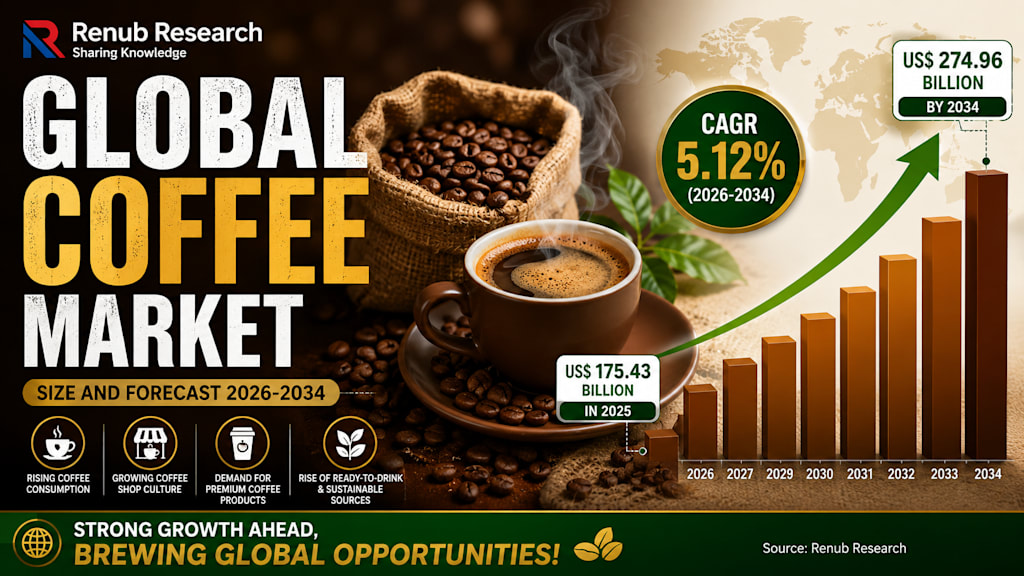
From café culture to e-commerce, premium beans to ready-to-drink formats, the global coffee industry is entering a new phase of growth supported by shifting lifestyles, expanding urban consumption, and rising demand for convenience and quality. The market is projected to rise from US$ 175.43 Billion in 2025 to US$ 274.96 Billion by 2034, reflecting a CAGR of 5.12% from 2026 to 2034.

Global Coffee Market Overview
Coffee is no longer just a morning beverage. In many parts of the world, it has become a daily ritual, a social habit, a workplace companion, and in some cases, even a lifestyle statement. That cultural shift is one of the strongest reasons the global coffee market continues to move upward. According to Renub Research, the market is expected to grow steadily through the forecast period, supported by rising coffee consumption, café culture, better product availability, and the growing popularity of ready-to-drink coffee and sustainable sourcing.
What makes the coffee industry especially interesting is that it is growing across both mature and emerging markets. In the United States, the United Kingdom, and much of Europe, coffee is already deeply embedded in daily routines. At the same time, Asia-Pacific and Latin America are seeing sharp growth as urbanization, higher incomes, and café culture reshape consumer behavior. That combination of established demand and new market expansion gives the global coffee sector a strong long-term growth story.
At the heart of this growth is consumer habit. Coffee is one of the most widely consumed caffeinated drinks in the world, and its appeal extends far beyond taste alone. Consumers value aroma, flavor, convenience, and caffeine content, while manufacturers benefit from the product’s adaptability across multiple formats such as whole beans, ground coffee, instant coffee, espresso, and ready-to-drink beverages. The result is a market that keeps expanding because it can serve almost every kind of consumer profile, from traditional brewers to on-the-go urban buyers.
Growth Drivers of the Global Coffee Market
One of the most powerful drivers of the market is the rise in global coffee consumption. The file notes that more than 2.25 billion cups of coffee are consumed every day, which speaks to both the scale and resilience of demand. Coffee has shifted from being a traditional product to something much broader: a cultural habit and a social connector. This has helped the market spread beyond historically strong regions and into newer economies where café culture and premium coffee habits are now developing rapidly.
Premiumization is another major force reshaping the industry. Modern coffee consumers are increasingly selective. They want better beans, single-origin sourcing, artisanal roasts, and distinctive flavor profiles. Specialty coffee shops have also helped consumers become more aware of roast quality, brewing methods, and origin stories. This has allowed brands to move beyond basic commodity pricing and introduce more premium offerings, which improves margins while deepening customer loyalty. In many markets, consumers are willing to pay more for transparency, craftsmanship, and a stronger story behind the product.
Sustainability has also become central to brand value. Coffee buyers are paying more attention to whether products are organic, fair-trade, or environmentally responsible. That matters because today’s consumers are not just buying taste; they are buying trust. Brands that show ethical sourcing, responsible farming, and clear supply-chain practices are more likely to win repeat purchases. For producers and retailers, sustainability is no longer a side message. It is becoming part of the main value proposition.
Product innovation is broadening the market even further. Ready-to-drink coffee, cold brew, instant specialty blends, and pod-based coffee systems are increasingly popular because they fit modern lifestyles. Consumers want speed, consistency, and convenience without giving up flavor. The rise of e-commerce has supported this shift as well, since buyers can now explore a larger range of brands, formats, and price points online. Direct-to-consumer models, subscription services, and digital retail channels are helping coffee brands build tighter relationships with their customers.
Challenges of the Global Coffee Market
The market is not without challenges. Coffee production is highly exposed to climate conditions, pests, and natural disruptions. When crop yields fluctuate, prices can become volatile, affecting producers, processors, and consumers alike. Supply chain disruptions and geopolitical uncertainty can also increase operating costs. In a market as globally connected as coffee, even regional shocks can have international consequences.
Environmental pressure is another serious concern. Climate change is affecting the geographic zones where coffee can be cultivated, while deforestation, water use, and chemical input concerns continue to shape the sustainability debate. Meeting environmental expectations will require more investment in responsible farming, certification systems, and farmer education. That may raise costs in the short term, but in the long run it is likely to become essential for preserving both supply and brand reputation.
Coffee Segment Outlook
The instant coffee segment remains one of the strongest contributors to overall market demand. Its success comes from convenience, affordability, and long shelf life. It does not require brewing equipment, which makes it especially attractive in emerging markets and busy households. Manufacturers are also improving the quality of instant coffee through better processing methods, including freeze-drying, and are introducing premium instant variants for consumers who want something faster without sacrificing too much taste. This makes instant coffee an important bridge between mass-market convenience and rising consumer expectations.
Ground coffee continues to appeal to consumers who value freshness and a more traditional brewing experience. It remains particularly strong in North America and Europe, where home brewing has long been part of consumer culture. Ground coffee is favored for drip machines, French presses, and manual brewing methods because it gives drinkers more control over strength and flavor. The growing popularity of specialty blends and single-origin beans has further supported this segment, proving that even in a convenience-driven market, there is still strong demand for a richer and more customized coffee experience.
Coffee sales through convenience stores are also important, especially in urban and on-the-go environments. The file highlights the growing role of coffee convenience centers, which serve ready-to-drink coffee and other coffee beverages in settings that match busy consumer routines. Late-night availability, accessibility, and urban mobility all help these outlets capture demand from commuters, students, and working professionals. In many cities, convenience formats are becoming an essential part of the coffee ecosystem.
Online coffee sales are expanding rapidly as e-commerce becomes more central to consumer shopping behavior. This channel gives buyers access to a wide selection of products and brands, while also allowing producers to showcase product quality, origin, and brewing details more effectively. For smaller and premium brands, online retail is especially useful because it creates a direct relationship with consumers and helps them stand out in a crowded market. The file identifies online coffee as the fastest-growing segment among coffee retailers, which reflects the broader digital shift in consumer buying patterns.
Regional Market Insights
The United States remains one of the largest and most developed coffee markets in the world. Coffee is a daily necessity for a huge portion of the population, and premiumization continues to drive growth through specialty coffee, cold coffee, pods, subscriptions, and ready-to-drink products. Sustainability and e-commerce are also helping brands stay relevant in a mature market. The file notes that, according to the USDA, the United States imported the second-largest volume of coffee beans, with imports expected to rise to 22.3 million bags based on projected growth in domestic coffee demand.
The United Kingdom also shows strong momentum. Coffee consumption has surged over the past decade as café culture expands and younger consumers increasingly choose coffee over tea. Urban centers remain the core of demand, but home consumption is also growing thanks to coffee machines, pods, and premium ground coffee. Ethical sourcing and fair-trade preferences matter strongly in the UK market, while instant coffee and ready-to-drink beverages still maintain a firm place in everyday routines. The British Coffee Association data cited in the file underscores this scale, with around 95 million cups consumed daily in the UK.
India represents one of the most dynamic growth stories in the sector. Coffee consumption is no longer limited to southern regions; it is spreading into metropolitan areas and tier-2 cities as lifestyles become more urban and younger consumers adopt café culture. Instant coffee remains important because it is affordable and easy to prepare, while specialty and premium offerings are gaining ground among urban buyers. The rise of foodservice and e-commerce is making coffee more accessible, and India’s own coffee-producing capacity adds another layer of strength to the market.
Saudi Arabia is another market worth watching closely. Coffee there carries both cultural significance and modern commercial potential. Traditional Arabic coffee remains important, but demand is growing for espresso-based drinks, specialty coffee, and premium café experiences. The market is supported by urbanization, a young population, luxury hospitality, and tourism expansion. The file also notes the country’s strategic plans to expand national coffee production, including ambitions to plant additional coffee trees and boost annual output over the next decade.
Competitive Landscape
The competitive landscape includes many of the world’s best-known coffee and beverage names. Major companies such as Starbucks, Nescafe, The Kraft Heinz Company, Luckin Coffee, J.M. Smucker, Coca-Cola, Dutch Bros, Keurig Dr Pepper, and JDE Peet’s all operate in this space with different strategies, formats, and consumer segments. Their strengths lie in scale, brand recognition, innovation, and distribution reach, but each is also adapting to changing expectations around convenience, quality, and sustainability.
Final Thoughts
Looking ahead, the coffee market appears well-positioned for steady and durable growth. The winning formulas are already visible: premium products, sustainable sourcing, stronger digital distribution, and flexible formats that match modern routines. At the same time, regional markets are becoming more diverse in how they consume coffee, which creates room for both global giants and niche specialty brands to thrive. The market is evolving from a simple beverage category into a broad consumer ecosystem shaped by taste, identity, technology, and lifestyle.
The global coffee market is growing not just because people drink more coffee, but because coffee has become more meaningful in everyday life. It is a product of routine, comfort, social connection, premium experience, and convenience all at once. With the market projected to reach US$ 274.96 Billion by 2034 from US$ 175.43 Billion in 2025, the next decade is likely to bring even more innovation, stronger competition, and deeper consumer engagement across every major region.
About the Creator
Enjoyed the story? Support the Creator.
Subscribe for free to receive all their stories in your feed.
Comments
There are no comments for this story
Be the first to respond and start the conversation.