
Global Chocolate Market Witnesses Strong Growth as Premium and Artisanal Products Gain Popularity
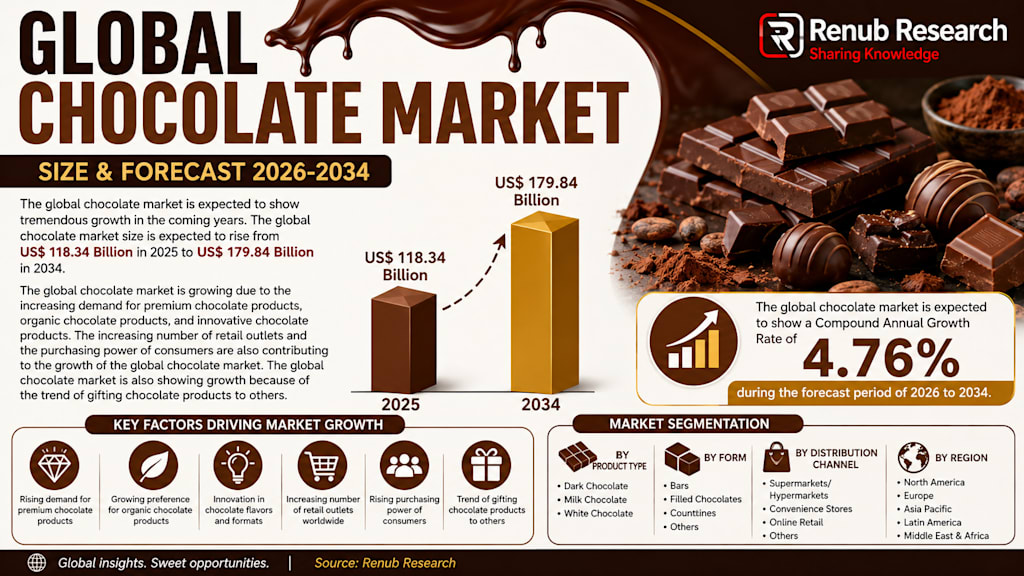
The global chocolate market is projected to rise from US$ 118.34 billion in 2025 to US$ 179.84 billion by 2034, supported by premiumization, gifting trends, and expanding retail channels.

Chocolate continues to evolve from a treat into a global lifestyle product
Chocolate has long been one of the world’s most loved indulgences, but the modern chocolate industry is evolving far beyond traditional confectionery. Consumers today are seeking premium experiences, healthier ingredients, ethical sourcing, unique flavors, and luxury packaging, turning chocolate into both an everyday snack and a lifestyle product.
According to the latest market outlook, the global chocolate market is expected to grow from US$ 118.34 billion in 2025 to US$ 179.84 billion by 2034, registering a CAGR of 4.76% during the forecast period from 2026 to 2034. The market’s expansion is being supported by increasing demand for premium and artisanal chocolate, the growth of online retail platforms, rising disposable incomes, and the continued popularity of chocolate gifting worldwide.
Chocolate remains one of the most versatile products in the food industry. It is used in confectionery products such as chocolate bars, pralines, candies, and truffles, while also serving as a key ingredient in cakes, pastries, cookies, brownies, beverages, desserts, and even wellness-focused food products.
Premium and artisanal chocolate are transforming consumer expectations
One of the strongest growth drivers in the global chocolate market is the rising demand for premium chocolate products. Consumers are becoming increasingly selective about quality, cocoa content, flavor profiles, ingredient sourcing, and packaging aesthetics. This has encouraged manufacturers to develop luxury and artisanal chocolate offerings that provide a more refined experience.
Premium chocolates often feature higher cocoa percentages, organic ingredients, fair-trade cocoa sourcing, and innovative flavors. Attractive gift packaging and limited-edition collections have also become important selling points, especially during festive seasons and holidays.
The source highlights an example from August 2024 when Chocoladefabriken Lindt & Sprüngli AG expanded its Lindor product line with new flavors including Lindor Dark 70% Mint, Lindor Pistachio, Lindor Tiramisu, and Lindor Irish Cream limited edition. These launches demonstrate how chocolate brands are constantly innovating to satisfy consumers searching for unique taste experiences.
Consumers in North America and Europe are especially willing to spend more on luxury chocolate products, and this willingness to pay premium prices is significantly contributing to market growth.
Retail expansion and e-commerce are reshaping chocolate sales
The rapid growth of supermarkets, hypermarkets, convenience stores, and online retail platforms has significantly improved the accessibility of chocolate products worldwide. Large retail chains now dedicate extensive shelf space to chocolate because of strong consumer demand and high profit margins.
At the same time, e-commerce has transformed how consumers purchase chocolate products. Online shopping platforms provide access to premium, imported, seasonal, and specialty chocolates that may not always be available in physical stores. Chocolate companies are increasingly developing their own digital storefronts to offer direct-to-consumer experiences, subscription services, and gifting options.
The source also notes that CIRANDA launched a new e-commerce website in February 2025 to strengthen its online presence and provide easier access to organic and fair-trade food ingredients.
Online retail is especially important for premium gifting categories, where consumers value convenience, customization, and home delivery services.
Emerging economies are becoming major growth markets
The chocolate industry is witnessing rapid expansion in emerging economies across Asia-Pacific, Latin America, and the Middle East. Rising disposable incomes, urbanization, and changing consumer lifestyles are encouraging greater spending on indulgent products such as chocolate.
The growing middle-class population in countries such as India, Indonesia, Thailand, Brazil, and Saudi Arabia is playing a crucial role in expanding chocolate consumption. Younger consumers are also strongly influenced by Western food trends, which has increased demand for confectionery and premium snack products.
Multinational chocolate manufacturers are investing heavily in these markets to capture long-term growth opportunities. Smaller packaging formats, affordable pricing strategies, and festive gifting campaigns are helping brands appeal to broader consumer groups.
The report notes that Switzerland remains the global leader in per capita chocolate consumption, with annual consumption rates of approximately 8–9 kilograms per person, while the United States continues to represent one of the largest chocolate markets globally.
Dark chocolate is becoming increasingly popular
Dark chocolate has emerged as one of the fastest-growing product categories due to increasing consumer awareness about health and wellness. Compared to milk chocolate and white chocolate, dark chocolate contains higher cocoa content and lower sugar levels, making it more appealing to health-conscious consumers.
Dark chocolate is widely associated with antioxidant properties and potential heart health benefits. Consumers increasingly view it as a healthier indulgence option, particularly in developed markets such as Europe and North America.
Chocolate manufacturers are also using dark chocolate in gourmet desserts, snack bars, bakery products, and premium confectionery lines. The popularity of cocoa-rich chocolate products with cocoa concentrations between 60% and 90% continues to grow among consumers seeking both indulgence and wellness.
Milk and white chocolate still dominate mass consumption
Although dark chocolate is growing rapidly, milk chocolate and white chocolate remain the largest and most widely consumed categories worldwide. Milk chocolate continues to attract consumers because of its smooth texture, sweet flavor, and broad appeal across all age groups.
White chocolate also maintains strong popularity due to its buttery flavor and versatility in bakery items, desserts, pastries, and gift products. Chocolate manufacturers continue introducing variations containing nuts, fruits, caramel, cookies, and other ingredients to maintain consumer interest and product diversity.
These products remain highly visible in supermarkets, convenience stores, and retail outlets because they appeal to mainstream consumers and generate consistent sales volumes.
Hypermarkets and supermarkets remain critical distribution channels
Hypermarkets and supermarkets continue to play a major role in global chocolate sales. These retail environments provide consumers with access to multiple brands, pricing options, promotional offers, and seasonal products in one location.
Chocolate companies heavily depend on these large retail chains for product visibility and customer reach. Strategic shelf placement and promotional displays often encourage impulse purchases, especially during major holidays such as Christmas, Easter, Halloween, and Valentine’s Day.
Discount campaigns and store-brand products also help attract budget-conscious shoppers while expanding overall chocolate consumption.
Convenience stores continue to drive impulse purchases
Convenience stores are another important sales channel because they cater to quick and spontaneous buying behavior. Located in transportation hubs, residential neighborhoods, fuel stations, and busy urban centers, these stores make chocolate products easily accessible during travel or short shopping trips.
Chocolate bars, snack-sized products, and confectionery items are especially popular in convenience stores because consumers often purchase them impulsively. Attractive product displays near checkout counters further encourage sales.
Manufacturers frequently launch products specifically designed for convenience store formats, including smaller packaging sizes and portable snack options.
Online chocolate retail is expanding rapidly
Online retail stores have become increasingly important for the chocolate industry because consumers value convenience and product variety. Through digital platforms, shoppers can access international brands, luxury chocolates, gift collections, and seasonal offerings that may not always be available in local retail stores.
Online channels also allow chocolate manufacturers to strengthen relationships with consumers through direct marketing, customized recommendations, and personalized gifting solutions. As internet access and smartphone usage continue to rise globally, online chocolate sales are expected to grow steadily in the coming years.
The United States remains one of the largest chocolate markets
The United States continues to represent one of the biggest and most mature chocolate markets in the world. Chocolate consumption is deeply integrated into American consumer culture, especially during holidays and celebrations such as Valentine’s Day, Halloween, Christmas, and Easter.
Consumers in the country are increasingly demanding premium, organic, and high-cocoa-content chocolate products. Dark chocolate demand is also growing because of health-related consumer preferences.
The report highlights that Puratos announced plans in February 2026 to launch the world’s first chocolate product for professionals made with cultured cocoa. This reflects how innovation continues to shape the future of the industry.
India is emerging as one of the fastest-growing chocolate markets
India’s chocolate industry has expanded rapidly over the last decade due to urbanization, changing lifestyles, rising incomes, and increasing exposure to Western food habits. Chocolate is becoming increasingly popular among younger consumers, especially during birthdays, festivals, and gifting occasions.
Manufacturers are introducing smaller and more affordable product packs to target price-sensitive consumers across different economic segments. The expansion of supermarkets and retail chains has also improved chocolate accessibility throughout the country.
The report notes that Reliance Consumer Products Limited signed a memorandum of understanding with Finnish company Fazer in March 2026 to manufacture and distribute premium chocolates in India. This highlights the growing importance of India as a strategic growth market for global confectionery brands.
Health concerns and cocoa supply risks remain major challenges
Despite strong growth prospects, the chocolate industry faces several important challenges. Cocoa price volatility remains a major concern because cocoa production is heavily concentrated in West African countries such as Ivory Coast and Ghana. Weather disruptions, political instability, labor issues, and export challenges can significantly affect cocoa supply and production costs.
Climate change is also impacting cocoa farming through shifting rainfall patterns and increased plant disease risks. Rising cocoa prices may eventually force manufacturers to increase retail prices or reduce product sizes, potentially affecting demand.
At the same time, consumers are becoming more health-conscious and increasingly concerned about sugar, calories, and fat content in traditional chocolate products. Governments and health organizations are promoting sugar reduction initiatives, encouraging manufacturers to innovate with healthier formulations, reduced-sugar recipes, and functional ingredients.
Balancing taste, texture, indulgence, and health benefits remains one of the industry’s biggest long-term challenges.
Final thoughts
The global chocolate market is entering a new era shaped by premiumization, innovation, sustainability, and evolving consumer preferences. Chocolate is no longer viewed simply as confectionery; it is increasingly associated with luxury, wellness, gifting, and lifestyle experiences.
The projected rise from US$ 118.34 billion in 2025 to US$ 179.84 billion by 2034 reflects the industry’s strong global momentum. As consumer demand continues shifting toward premium products, healthier ingredients, ethical sourcing, and online convenience, chocolate manufacturers will need to remain highly innovative and adaptable.
The future of the chocolate industry will likely belong to brands that can successfully combine indulgence, sustainability, quality, and emotional connection in a highly competitive global marketplace.
About the Creator
Enjoyed the story? Support the Creator.
Subscribe for free to receive all their stories in your feed.
Comments
There are no comments for this story
Be the first to respond and start the conversation.