
Global Chlor-Alkali Market to Reach USD 205.19 Billion by 2035 at 9.7% CAGR
Global Chlor-Alkali Market: Trends, Growth Drivers, and Future Outlook

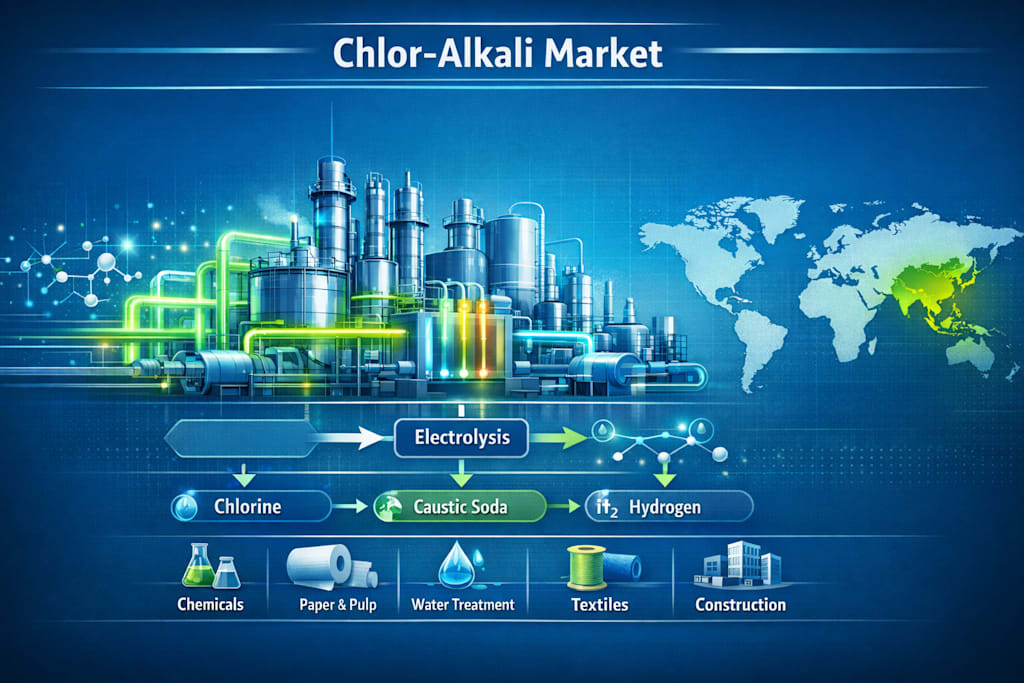
Chlor-Alkali Market Size and Outlook
The Global Chlor-Alkali Market is expected to experience strong growth, expanding from approximately USD 81.30 billion in 2025 to around USD 205.19 billion by 2035. This reflects a compound annual growth rate (CAGR) of 9.7% over the forecast period from 2026 to 2035. The expansion is largely fueled by increasing demand for caustic soda in alumina processing and pulp & paper manufacturing, along with rising chlorine usage in water treatment and PVC production.
Market Overview
Chlor-alkali chemicals—primarily caustic soda, chlorine, and soda ash—are essential building blocks for numerous industries. These chemicals are produced through the electrolysis of brine and are widely used in applications such as water purification, PVC manufacturing, pharmaceuticals, and paper production.
The industry plays a critical role in sectors like construction, textiles, and aluminum refining by supplying fundamental raw materials. Production is typically carried out using three types of technologies: membrane cells, diaphragm cells, and older mercury-based systems.
Market Highlights
- The Global Chlor-Alkali Market is valued at USD 81.30 billion in 2025 and is expected to grow to USD 205.19 billion by 2035, registering a CAGR of 9.7%.
- Asia-Pacific leads the market with a 41.3% share, equivalent to USD 33.3 billion.
- Caustic soda is the dominant segment, accounting for 47.3% of the market.
- Membrane cell processes hold the leading position with a 61.2% share.
- The pulp and paper industry is the largest application segment, representing 34.6% of total demand.
- Chemical processing and manufacturing contribute the highest share at 31.4%.
Product Insights
Caustic soda is the leading product segment, accounting for 47.3% of the market in 2025. Its dominance is attributed to its extensive use in industries such as alumina refining, pulp and paper production, and chemical manufacturing. It is also widely used for neutralization processes and in the production of soaps and detergents.
Production Process Insights
Membrane cell technology leads the production segment with a 61.2% share in 2025. This method is favored for its energy efficiency and ability to produce high-purity outputs. Compared to older technologies, membrane cells consume less electricity and generate fewer emissions, making them the preferred choice for modern, environmentally compliant facilities.
Application Insights
The pulp and paper industry is the largest application segment, holding a 34.6% share in 2025. Chlor-alkali products are essential in this sector for breaking down wood chips and bleaching paper. Consistent demand is supported by long-term supply agreements between chemical producers and paper mills.
End-User Insights
Chemical processing and manufacturing represent the largest end-user segment, accounting for 31.4% of the market. This sector relies heavily on chlorine for producing intermediates and solvents, and on caustic soda for chemical synthesis and neutralization. Many large chemical complexes include integrated chlor-alkali units to ensure uninterrupted supply.
Regional Insights
Asia-Pacific dominates the global market, holding a 41.3% share valued at USD 33.3 billion. Countries such as China, India, Japan, and South Korea host large-scale production facilities. Rapid industrialization, urbanization, and infrastructure development are driving strong demand for PVC, caustic soda, and related chemicals in the region.
North America remains a key market, with major production hubs located along the Gulf Coast. Facilities in the United States and Canada are typically advanced and integrated with downstream chemical operations. The region emphasizes energy efficiency improvements and incremental capacity expansion to meet stable demand.
Regulatory Landscape
Environmental regulations are becoming stricter worldwide, particularly regarding emissions and the use of mercury-based technologies. The Minamata Convention on Mercury has accelerated the global phase-out of mercury cell systems, pushing manufacturers to invest in cleaner membrane-based technologies to comply with international standards.
Market Drivers
Growth in pulp and paper production and alumina refining is significantly increasing the demand for caustic soda. Expanding packaging needs and rising aluminum consumption globally are reinforcing long-term demand for chlor-alkali products.
Market Restraints
Chlor-alkali production is highly energy-intensive, with electricity costs accounting for a large portion of total expenses. Fluctuating power prices can significantly impact profitability, especially in regions with expensive energy sources.
Growth Opportunities
Innovations in membrane cell technology are reducing energy consumption and improving efficiency. New materials and system upgrades are enhancing output quality while lowering operational costs, making production more competitive.
Emerging Trends
Companies are increasingly adopting digital tools such as advanced analytics, machine learning, and digital twins to optimize plant performance. These technologies help reduce downtime, improve energy efficiency, and extend equipment lifespan.
Key Companies
- Tata Chemicals Limited expanding its chlor-alkali capacity in India, the company benefits from a diversified portfolio and strong domestic presence. Investments in sustainable technologies support long-term growth.
- Occidental Petroleum Corporation through its OxyChem division, it maintains a strong position in North America with integrated operations and access to cost-efficient raw materials.
- Formosa Plastics Corporation operates globally integrated facilities producing chlor-alkali products alongside PVC and specialty chemicals, ensuring resilience across markets.
- Hanwha Solutions Corporation focuses on sustainable production by integrating renewable energy with chemical manufacturing, strengthening its position in green chemistry.
Conclusion
The chlor-alkali market is set for sustained and robust growth over the coming decade, driven by its indispensable role across multiple industrial value chains. Rising demand from key sectors such as pulp and paper, alumina refining, water treatment, and PVC manufacturing continues to reinforce its importance globally.
About the Creator
Yash Mule
SEO Specialist with 10+ years of experience at Evolvance Market Research. Expert in technical SEO, content strategy, and data-driven optimization, with a proven track record of significantly increasing organic traffic and search rankings.
Enjoyed the story? Support the Creator.
Subscribe for free to receive all their stories in your feed.
Comments
There are no comments for this story
Be the first to respond and start the conversation.