
Global Cell and Gene Therapy Third-Party Logistics Market to Reach US$ 20.98 Billion by 2033 Amid Rising Demand for Personalized Medicine
Advanced Cold Chain Infrastructure and Growing Clinical Trials Fuel Expansion of the Cell and Gene Therapy Logistics Industry Worldwide

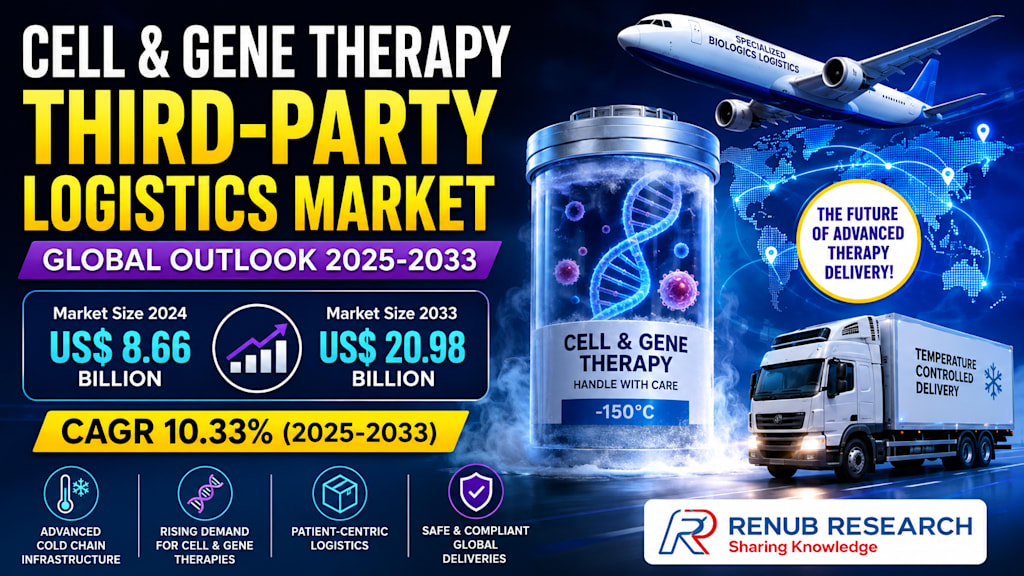
The global Cell and Gene Therapy Third-Party Logistics Market is witnessing remarkable growth as healthcare systems across the world rapidly embrace personalized medicine and advanced biologic therapies. According to Renub Research, the market is projected to grow from US$ 8.66 billion in 2024 to US$ 20.98 billion by 2033, expanding at a CAGR of 10.33% from 2025 to 2033.
The increasing adoption of cell and gene therapies for cancer, neurological disorders, cardiovascular diseases, and rare genetic conditions is creating a strong need for specialized logistics infrastructure. Unlike conventional pharmaceuticals, these therapies are extremely sensitive to temperature fluctuations and handling conditions, requiring highly sophisticated transportation and storage systems.
Third-party logistics (3PL) providers are now becoming essential partners for biotechnology and pharmaceutical companies by ensuring safe, compliant, and timely delivery of these advanced therapies across global healthcare networks.
Rising Demand for Personalized Medicine Accelerates Market Growth
One of the most important factors driving the growth of the cell and gene therapy logistics market is the worldwide shift toward personalized medicine.
Traditional treatments often follow a generalized approach, but modern therapies are increasingly designed specifically for individual patients based on their genetic profile and disease condition. Cell and gene therapies represent the future of precision medicine because they directly target the root causes of diseases rather than simply managing symptoms.
However, personalized therapies introduce highly complex logistical challenges. Treatments frequently involve live cells, viral vectors, or patient-derived biological materials that must be transported under tightly controlled conditions. Even minor temperature deviations can compromise product efficacy and patient safety.
As a result, logistics companies are heavily investing in:
Ultra-low temperature freezers
Cryogenic shipping containers
Real-time tracking systems
AI-driven monitoring technologies
Secure packaging solutions
Specialized storage facilities
These innovations are transforming the global healthcare supply chain and enabling safer delivery of life-saving therapies.
Clinical Trial Expansion Creates New Opportunities
The rapid increase in clinical trials involving cell and gene therapies is another major contributor to market expansion.
Biotechnology and pharmaceutical firms are aggressively developing innovative therapies for both common and rare diseases. As these therapies progress from research to commercialization, demand for specialized logistics services continues to rise.
Clinical trials often span multiple countries and healthcare centers, requiring highly coordinated transportation systems capable of maintaining product integrity throughout the supply chain.
Additionally, many advanced therapies require direct-to-patient delivery or transportation to specialized treatment centers, adding another layer of complexity to logistics operations.
Third-party logistics providers are responding by offering:
Customized shipping programs
Scalable cold-chain solutions
Real-time visibility platforms
Regulatory compliance support
Emergency transportation services
The growing number of Investigational New Drug (IND) applications globally is expected to further strengthen demand for advanced logistics solutions throughout the forecast period.
Technological Advancements Reshaping Healthcare Logistics
Technology is playing a transformative role in the evolution of the cell and gene therapy logistics market.
Advanced digital tools are helping logistics providers overcome major operational challenges related to temperature monitoring, shipment visibility, route optimization, and regulatory compliance.
Some of the most impactful innovations include:
Real-Time Monitoring Systems
IoT-enabled sensors now allow logistics providers to continuously monitor temperature, humidity, vibration, and location during transportation. Any deviations trigger instant alerts, helping prevent product damage.
Artificial Intelligence and Predictive Analytics
AI-powered route optimization improves delivery efficiency while minimizing transit delays. Predictive analytics also helps anticipate supply chain disruptions before they occur.
Blockchain Integration
Blockchain technology enhances supply chain transparency and traceability by securely documenting every step of the transportation process.
Smart Packaging Solutions
Innovative packaging materials with extended thermal protection are improving the safety and reliability of temperature-sensitive shipments.
Together, these technologies are significantly improving the efficiency, scalability, and reliability of cell and gene therapy logistics worldwide.
Patient-Centric Logistics Becomes a Key Industry Trend
As personalized medicine grows, healthcare logistics is becoming increasingly patient-centric.
Patients receiving cell and gene therapies often require individualized treatment schedules and direct coordination between manufacturers, hospitals, laboratories, and caregivers. Logistics providers are adapting by creating customized delivery systems focused on patient convenience and treatment continuity.
Modern patient-centric logistics services now include:
Door-to-door delivery models
Real-time shipment tracking
Specialized handling protocols
Faster delivery timelines
Dedicated customer support teams
This approach improves patient confidence while ensuring therapies arrive safely and efficiently.
The growing importance of patient-focused logistics is expected to remain a major trend shaping the future of the industry.
Challenges Facing the Cell and Gene Therapy Logistics Industry
Despite strong growth potential, the market continues to face several operational and regulatory challenges.
Temperature Sensitivity
Cell and gene therapies are highly vulnerable to temperature fluctuations. Maintaining strict temperature control throughout transportation is critical to preserving therapeutic effectiveness.
Any failure in the cold chain can result in product degradation, financial losses, and potential risks to patient safety.
Packaging Complexity
These therapies require specialized packaging solutions capable of protecting products from physical damage, contamination, and environmental exposure.
Packaging systems must also comply with strict regulatory standards across different countries.
Regulatory Compliance
Global logistics providers must navigate complex international regulations governing biological product transportation, storage, and documentation.
Differences in regional compliance requirements can create operational challenges for multinational shipments.
High Operational Costs
Maintaining cryogenic storage systems, specialized transportation fleets, and advanced monitoring infrastructure significantly increases logistics costs.
However, growing market demand is encouraging continued investment in infrastructure and innovation.
United States Leads the Global Market
The United States remains the largest market for cell and gene therapy third-party logistics due to its advanced biotechnology ecosystem and strong investment in personalized medicine.
The country hosts a large number of biotechnology firms, clinical research organizations, and advanced therapy developers. This creates strong demand for highly specialized logistics services.
American logistics companies are increasingly focusing on:
Ultra-cold storage capabilities
Nationwide treatment center networks
Regulatory expertise
Real-time supply chain visibility
Rapid-response transportation services
As FDA approvals for advanced therapies continue to rise, the United States is expected to maintain its dominant market position throughout the forecast period.
Germany Emerges as a Major European Hub
Germany is becoming one of Europe’s leading centers for cell and gene therapy logistics.
The country benefits from strong healthcare infrastructure, advanced pharmaceutical manufacturing capabilities, and strict quality standards. Biotech hubs such as Frankfurt and Düsseldorf are driving demand for specialized logistics services.
German logistics providers are investing heavily in:
AI-powered logistics optimization
Temperature-controlled transportation
Advanced warehousing systems
Regulatory compliance technologies
The country’s growing role in clinical research and biopharmaceutical manufacturing is expected to support continued market growth.
China Expands Rapidly Through Biotechnology Investments
China’s cell and gene therapy logistics market is growing rapidly due to major investments in biotechnology and healthcare innovation.
The Chinese government continues to support the expansion of precision medicine and advanced therapeutics through policy initiatives and funding programs.
As the number of clinical trials and commercialization activities increases, demand for sophisticated logistics infrastructure is rising across the country.
Technologies such as IoT tracking systems and AI-driven route management are improving operational efficiency and enhancing supply chain reliability.
China is expected to become one of the fastest-growing regional markets over the next decade.
Saudi Arabia Strengthens Biotech Infrastructure Under Vision 2030
Saudi Arabia is actively developing its biotechnology and healthcare ecosystem as part of its Vision 2030 economic diversification strategy.
The country is investing in advanced cold-chain infrastructure and biopharmaceutical manufacturing capabilities to support the growth of cell and gene therapies.
Strategic partnerships between government agencies and biotechnology firms are helping localize production and improve healthcare accessibility.
This transformation is creating new opportunities for specialized logistics providers capable of managing complex biological supply chains throughout the Middle East region.
10 Recent Developments by Major Companies
1. Cardinal Health
In January 2025, Cardinal Health launched Advanced Therapy Connect, a unified ordering platform designed specifically for cell and gene therapies.
2. McKesson Corporation
In October 2024, McKesson introduced InspiroGene™, a specialized business focused on supporting commercialization and logistics for advanced therapies.
3. DHL
DHL expanded its cryogenic logistics infrastructure to strengthen support for global biologics transportation.
4. Kuehne+Nagel
The company enhanced its pharma cold-chain capabilities with advanced temperature-monitoring technologies.
5. Cencora Corporation
Cencora increased investments in specialty pharmaceutical distribution and patient-support logistics services.
6. EVERSANA
EVERSANA expanded integrated commercialization and logistics solutions for biotechnology companies.
7. Arvato SE
Arvato strengthened its healthcare logistics network across Europe to support advanced therapy transportation.
8. Cryoport Systems
Cryoport continued expanding global cryogenic shipping infrastructure for cell and gene therapies.
9. UPS Healthcare (Marken)
UPS Healthcare enhanced real-time monitoring capabilities for biologic shipments worldwide.
10. AmerisourceBergen
The company broadened specialty logistics solutions to improve patient access to advanced therapies globally.
Market Segmentation Analysis
By Type
Clinical
Commercial
By Product
Cell Therapies
Gene Therapies
By Therapeutic Area
Oncology
Neurology
Cardiovascular Diseases
Ophthalmology
Infectious Diseases
Others
By End Use
Biopharmaceutical Companies
CDMOs/CMOs
Others
Regional Market Coverage
North America
United States
Canada
Europe
Germany
France
Italy
Spain
United Kingdom
Belgium
Netherlands
Turkey
Asia-Pacific
China
Japan
India
South Korea
Australia
Thailand
Malaysia
Indonesia
New Zealand
Latin America
Brazil
Mexico
Argentina
Middle East & Africa
Saudi Arabia
United Arab Emirates
South Africa
Competitive Landscape
Leading companies operating in the global cell and gene therapy third-party logistics market include:
Cencora Corporation
Cardinal Health
McKesson Corporation
EVERSANA
Knipper Health
Arvato SE
DHL
Kuehne+Nagel
These organizations are focusing on strategic partnerships, infrastructure expansion, advanced cold-chain technologies, and digital transformation to strengthen their competitive position in the evolving market landscape.
Final Thoughts
The global cell and gene therapy third-party logistics market is entering a transformative growth phase driven by rapid advancements in biotechnology, increasing clinical trial activity, and rising demand for personalized medicine.
As advanced therapies become more widely commercialized, logistics providers will play an increasingly critical role in ensuring safe, compliant, and efficient product delivery across global healthcare systems.
Companies that invest in cold-chain innovation, AI-powered supply chain management, and patient-centric logistics solutions are expected to lead the next generation of healthcare logistics transformation.
With the market projected to surpass US$ 20.98 billion by 2033, the future of cell and gene therapy logistics appears exceptionally promising.
About the Creator
Enjoyed the story? Support the Creator.
Subscribe for free to receive all their stories in your feed.
Comments
There are no comments for this story
Be the first to respond and start the conversation.