
Global Automotive Paints Market Forecast 2026–2034: Vehicle Production, EV Growth, and Eco-Friendly Coatings Drive Industry Expansion
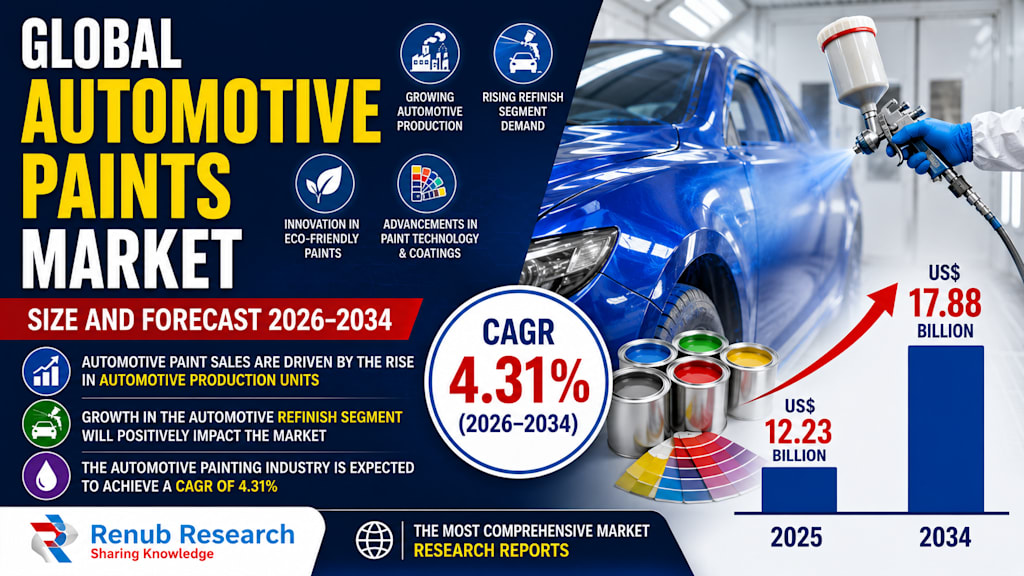
The global automotive paints industry is evolving rapidly as automakers focus on vehicle aesthetics, durability, sustainability, and advanced coating technologies. According to Renub Research, the automotive paints market is projected to grow from US$ 12.23 Billion in 2025 to US$ 17.88 Billion by 2034, expanding at a CAGR of 4.31% during 2026–2034.

The global automotive industry is changing faster than ever before. Electric vehicles are reshaping transportation, consumers are demanding personalized vehicle designs, and environmental regulations are forcing manufacturers to adopt cleaner technologies. Amid all these transformations, one market quietly playing a critical role is automotive paints.
Automotive paints are far more than cosmetic coatings. They protect vehicles from corrosion, extreme temperatures, UV radiation, chemicals, moisture, and scratches while also delivering the color, gloss, and visual appeal that strongly influence buying decisions. From factory-finished luxury vehicles to repair and customization shops, automotive paints are essential across the entire automotive value chain.
As global vehicle production rises and consumer demand for premium finishes continues growing, the automotive paints industry is experiencing steady expansion. According to Renub Research, the global automotive paints market is expected to increase from US$ 12.23 Billion in 2025 to US$ 17.88 Billion by 2034, registering a CAGR of 4.31% during the forecast period from 2026 to 2034.
The market’s growth is being supported by increasing automotive production, rapid expansion of electric vehicles, rising demand for vehicle customization, and technological innovations focused on eco-friendly coatings.
Automotive Paints Have Become a Strategic Industry Component
Automotive paints are specialized coating materials designed specifically for vehicle surfaces. These coatings typically consist of multiple layers, including primers, base coats, clear coats, and electrocoats, each serving a different functional purpose. Together, these layers provide protection, visual enhancement, and long-term durability.
The automotive paint system is engineered to withstand harsh environmental conditions such as sunlight exposure, humidity, road debris, chemical pollutants, and temperature fluctuations. Modern coatings also improve scratch resistance, gloss retention, and overall vehicle lifespan.
There are two major categories within the industry: original equipment (OE) paints used during vehicle manufacturing and refinish paints used for repairs, restorations, and customization after vehicles enter the market. Both segments are expanding steadily as automotive ownership rises globally.
Consumer expectations are also changing. Buyers increasingly view vehicles as lifestyle products rather than simple transportation tools. This shift has elevated the importance of color variety, premium finishes, and visual uniqueness in vehicle design, creating strong opportunities for paint manufacturers worldwide.
Rising Global Vehicle Production Is Fueling Market Growth
One of the most important drivers of the automotive paints market is the continued increase in global vehicle production and sales. Passenger cars, commercial vehicles, and electric vehicles all require multiple coating layers during manufacturing, directly supporting demand for automotive paints.
Emerging economies in Asia-Pacific, Latin America, and parts of the Middle East are witnessing rising vehicle ownership due to growing urbanization, higher disposable incomes, and expanding middle-class populations. At the same time, developed markets continue supporting stable demand through replacement purchases and electric vehicle adoption.
Electric vehicles are becoming particularly important for the future of the industry. EV manufacturers often emphasize sleek aesthetics, lightweight materials, and advanced coatings that improve vehicle efficiency and durability. This is increasing demand for innovative paint systems compatible with modern EV designs.
Renub Research highlights that global vehicle sales exceeded 80 million units by November 2025, with electric vehicle adoption expected to grow substantially over the coming decade. As automotive production capacity continues expanding worldwide, paint demand is expected to rise alongside it.
The direct relationship between automotive manufacturing volumes and paint consumption ensures long-term market stability for coating suppliers.
Vehicle Customization Trends Are Driving Premium Paint Demand
The growing consumer preference for personalized and visually distinctive vehicles is another major force shaping the automotive paints industry. Modern buyers increasingly seek unique colors, metallic finishes, matte coatings, pearlescent effects, and custom paint designs that reflect personal style and lifestyle preferences.
Customization has become especially important in premium passenger cars, luxury vehicles, sports cars, and electric vehicles, where aesthetics play a central role in brand identity. Automakers now offer a broader range of factory paint options than ever before, while aftermarket customization services are also expanding rapidly.
The refinish segment is benefiting significantly from this trend. Vehicle owners are investing more in repainting, restoration, repair, and personalization services, increasing demand for high-performance refinish coatings. Insurance-related repairs and aging vehicle populations are also supporting long-term growth in the refinish market.
In September 2025, Xiaomi EV introduced its Xiaomi Customization Service for select electric vehicle models, offering expanded personalization features for consumers seeking premium automotive experiences.
As vehicle ownership increasingly intersects with lifestyle and branding, the market for premium automotive paint solutions is expected to remain strong.
Eco-Friendly Coatings Are Reshaping the Industry
Sustainability has become one of the most influential trends in the global automotive paints market. Governments worldwide are implementing stricter regulations regarding volatile organic compounds (VOCs), hazardous chemicals, and industrial emissions, pushing manufacturers toward environmentally friendly coating technologies.
In response, companies are increasingly developing waterborne coatings, powder coatings, and low-VOC paint systems that reduce environmental impact without sacrificing durability or appearance. Waterborne coatings, in particular, are gaining strong momentum because they significantly reduce solvent emissions compared to traditional solvent-based systems.
Automotive manufacturers are rapidly adopting these sustainable technologies to comply with environmental standards while improving operational efficiency and workplace safety. At the same time, consumers are becoming more aware of sustainability issues, further encouraging demand for greener manufacturing practices.
Technological advancements in resin chemistry, color pigments, and application systems are improving the performance of eco-friendly paints. Modern sustainable coatings now offer strong scratch resistance, corrosion protection, UV durability, and premium finishes comparable to traditional systems.
In November 2025, Covestro and Nippon Paint announced a strategic partnership focused on developing sustainable and high-performance coatings for automotive and industrial applications.
As environmental regulations continue tightening globally, eco-friendly coatings are expected to dominate the future of the automotive paints industry.
Waterborne Paints Are Expanding Rapidly
Among technology segments, waterborne automotive paints are experiencing particularly strong growth. These coatings use water as the primary carrier instead of solvents, significantly reducing VOC emissions and improving environmental compliance.
Waterborne base coats are increasingly preferred by automakers because they provide high-quality finishes while supporting sustainability goals. Improvements in drying performance, durability, and application consistency are helping waterborne systems compete effectively with conventional solvent-based technologies.
The transition toward waterborne coatings is especially strong in developed markets where environmental regulations are strictest. However, adoption is also increasing in emerging economies as global automotive manufacturers standardize sustainable production practices across international facilities.
As sustainability becomes central to automotive manufacturing strategies, waterborne paint technologies are expected to play an increasingly important role in future market growth.
Primer, Base Coat, and Electrocoat Segments Remain Essential
Primer coatings continue to hold a vital role within automotive paint systems. Primers create strong adhesion between vehicle surfaces and top coatings while also providing corrosion resistance and surface smoothness. Modern primers are increasingly designed for lightweight materials such as aluminum and composite structures used in electric vehicles.
The base coat segment remains heavily influenced by consumer preferences and automotive design trends. Base coats determine the visible color and visual effects of vehicles, including solid colors, metallic finishes, matte appearances, and pearlescent effects. Continuous innovation in pigments and special-effect materials is expanding the range of customization possibilities available to consumers.
Electrocoat, or E-coat technology, is also becoming increasingly important because of its superior corrosion resistance and uniform coating application. Since E-coat serves as the first protective layer applied to vehicle bodies, it plays a crucial role in long-term vehicle durability and structural protection.
Together, these segments highlight the technical complexity and innovation driving the automotive paints industry forward.
Raw Material Costs and Regulations Remain Major Challenges
Despite positive growth prospects, the automotive paints market faces several important challenges. One major concern is volatility in raw material prices. Automotive paints rely heavily on petrochemical-derived materials such as resins, pigments, solvents, and additives, all of which are vulnerable to fluctuations in global oil prices and supply-chain disruptions.
Rising raw material costs create pressure on profit margins, especially because automotive manufacturers often negotiate long-term supply contracts with strict pricing conditions.
Environmental regulations also present operational challenges for paint manufacturers. Companies must invest heavily in research and development to meet evolving global standards regarding VOC emissions, hazardous chemicals, and industrial waste management. While large multinational firms may have the resources to adapt, smaller manufacturers often struggle with compliance costs and technological upgrades.
Balancing sustainability, cost management, and product performance will remain one of the industry’s biggest priorities over the coming years.
Passenger Cars Continue to Dominate the Market
The passenger cars segment remains the largest contributor to the automotive paints market due to the enormous global scale of passenger vehicle production. Every vehicle requires multiple paint layers for protection and aesthetics, making passenger cars a critical demand driver.
Electric and hybrid passenger vehicles are creating additional opportunities because manufacturers increasingly emphasize premium finishes and advanced coating technologies to differentiate their products. The rising popularity of electric vehicles is expected to strengthen demand for lightweight, durable, and environmentally friendly coatings.
The passenger car refinish market also remains highly important due to accidents, repairs, restoration projects, and long-term maintenance needs. Aging vehicle populations in several countries continue supporting stable aftermarket demand.
Regional Markets Continue Expanding
The United States remains one of the world’s largest automotive paints markets because of its strong automotive industry, large vehicle population, and significant refinish demand. Growing electric vehicle production and environmental regulations supporting waterborne coatings are further strengthening the market. In May 2025, PPG Industries announced plans to invest USD 380 million in a new aerospace coatings and sealants manufacturing facility in North Carolina.
The United Kingdom market is increasingly driven by sustainability initiatives and premium automotive manufacturing. Luxury vehicle brands and strict environmental standards continue supporting demand for high-quality and eco-friendly coating systems.
India is emerging as one of the fastest-growing automotive paints markets due to rapid expansion of vehicle manufacturing, rising domestic automobile demand, and government support for industrial development. In May 2022, BASF expanded its Automotive Coatings Application Center in Mangalore to strengthen customer support capabilities in India.
Saudi Arabia’s market is primarily driven by the automotive refinish segment because of the country’s large vehicle population and harsh climatic conditions. High temperatures and sandy environments increase demand for durable, UV-resistant coatings capable of protecting vehicle surfaces over time.
Final Thoughts
The global automotive paints market is entering a new phase of steady and technology-driven growth. According to Renub Research, the market is expected to expand from US$ 12.23 Billion in 2025 to US$ 17.88 Billion by 2034, registering a CAGR of 4.31% during 2026–2034.
The market’s evolution is being shaped by rising vehicle production, expanding electric mobility, growing consumer demand for customization, and increasing adoption of environmentally friendly coating technologies. At the same time, innovation in waterborne coatings, advanced pigments, and automated application systems is improving both sustainability and performance.
Although challenges related to raw material costs and regulatory compliance remain significant, the long-term outlook for the industry remains highly positive. As vehicles continue becoming more advanced, connected, and design-focused, automotive paints will remain an essential part of the automotive manufacturing ecosystem worldwide.
About the Creator
Enjoyed the story? Support the Creator.
Subscribe for free to receive all their stories in your feed.
Comments
There are no comments for this story
Be the first to respond and start the conversation.