
Global Atherectomy Devices Market Accelerates as Minimally Invasive Cardiovascular Treatments Gain Wider Adoption
Rising peripheral artery disease cases, technological advancements, and growing demand for minimally invasive vascular procedures are driving strong growth in the global atherectomy devices industry.

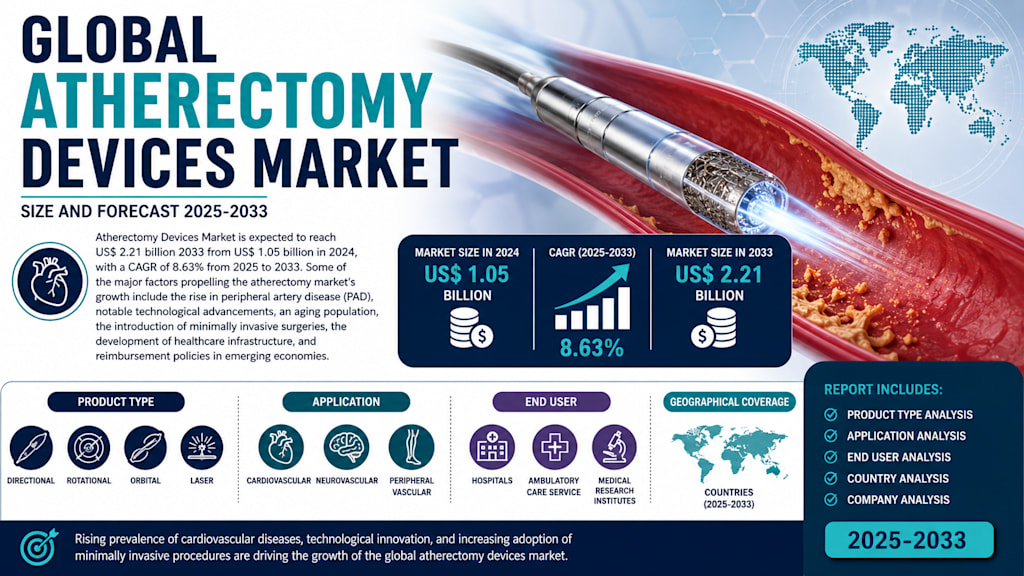
Atherectomy devices market enters a high-growth healthcare era
The global atherectomy devices market is entering a period of rapid expansion as healthcare systems increasingly prioritize minimally invasive cardiovascular treatments. According to the latest industry analysis, the Atherectomy Devices Market is projected to grow from US$ 1.05 billion in 2024 to US$ 2.21 billion by 2033, registering a CAGR of 8.63% between 2025 and 2033.
The market’s growth reflects the rising burden of peripheral artery disease (PAD), coronary artery disease (CAD), obesity, diabetes, and other cardiovascular disorders worldwide. Atherectomy devices are becoming increasingly important because they offer physicians a minimally invasive method for removing arterial plaque while improving blood circulation and reducing patient recovery time.
As healthcare providers move toward advanced interventional procedures that improve outcomes while minimizing surgical complications, atherectomy systems are becoming essential tools across cardiovascular and peripheral vascular treatment settings.
What are atherectomy devices and why are they important?
Atherectomy devices are specialized medical systems designed to remove plaque buildup from arteries. These devices physically cut, grind, shave, or vaporize plaque deposits that obstruct blood flow. They are commonly used in patients suffering from peripheral artery disease or coronary artery disease where arterial narrowing can lead to pain, mobility limitations, stroke risk, or heart complications.
Unlike traditional open surgery, atherectomy procedures are minimally invasive, often resulting in shorter hospital stays, reduced recovery periods, and fewer complications. Physicians frequently prefer atherectomy for patients who may not be ideal candidates for balloon angioplasty or stent placement.
The market includes several device categories such as directional atherectomy, rotational atherectomy, orbital atherectomy, and laser atherectomy systems. Each technology addresses different plaque characteristics and vascular conditions, giving physicians more flexibility in treatment planning.
Rising PAD cases continue to fuel market expansion
One of the strongest drivers behind market growth is the increasing prevalence of peripheral artery disease worldwide. PAD occurs when narrowed arteries reduce blood flow to the limbs, often causing pain, fatigue, and severe mobility limitations.
The report highlights that aging populations, obesity, diabetes, and sedentary lifestyles are significantly contributing to the global rise in PAD cases. In the United States alone, an estimated 8 to 12 million people suffer from PAD, with 6.5 million diagnoses among individuals over the age of 40.
As the number of PAD patients increases globally, demand for minimally invasive treatment options continues to rise. Atherectomy procedures help restore arterial patency by removing plaque buildup directly from blood vessels, improving circulation and reducing symptoms without requiring highly invasive surgery.
The broader cardiovascular disease burden is also contributing to growth. Conditions such as high cholesterol, hypertension, obesity, and diabetes continue to expand worldwide, increasing the need for advanced vascular intervention technologies.
Technological advancements are transforming treatment precision
Technology innovation is reshaping the competitive landscape of the atherectomy devices industry. Modern systems are becoming safer, more precise, and easier for physicians to operate.
Advancements in rotational, laser, and orbital atherectomy technologies are improving plaque removal while minimizing vessel trauma. The integration of real-time imaging systems such as intravascular ultrasound (IVUS) and optical coherence tomography (OCT) is also enhancing procedural accuracy by helping physicians visualize arterial blockages more clearly during interventions.
These innovations are improving patient outcomes while reducing procedural risks and treatment times. Newer ergonomic device designs are also making procedures more efficient for healthcare professionals, supporting wider adoption in hospitals and specialty vascular centers.
One important development mentioned in the report occurred in August 2022 when AngioDynamics announced that the Auryon Atherectomy System received expanded 510(k) clearance to include arterial thrombectomy applications.
Minimally invasive procedures are becoming the preferred approach
Healthcare systems globally are increasingly shifting toward minimally invasive procedures because they lower hospitalization costs, shorten recovery periods, and improve patient satisfaction. Atherectomy aligns perfectly with this trend.
Patients undergoing minimally invasive vascular procedures generally experience smaller incisions, reduced blood loss, fewer post-operative complications, and quicker recovery compared to traditional surgical methods. This has increased physician and patient preference for catheter-based vascular interventions.
The trend is especially important for elderly patients who may face higher risks from open surgical procedures. Since cardiovascular diseases disproportionately affect older populations, the demand for safer and less invasive solutions is expected to continue rising throughout the forecast period.
Emerging markets are creating new opportunities
Emerging economies are becoming increasingly important growth regions for atherectomy device manufacturers. Countries across Asia-Pacific, Latin America, and the Middle East are investing heavily in healthcare infrastructure, modern medical technologies, and advanced cardiovascular care services.
Rising disposable incomes, expanding healthcare access, and growing awareness of minimally invasive procedures are accelerating adoption in these regions. Governments are also supporting healthcare modernization initiatives that improve access to advanced vascular treatments.
India, Saudi Arabia, Brazil, and several Southeast Asian markets are expected to see particularly strong growth over the next decade as cardiovascular disease prevalence continues to rise alongside aging populations and lifestyle-related health risks.
High costs remain a major industry challenge
Despite strong growth potential, the atherectomy devices market still faces several barriers. One of the most significant challenges is the high cost associated with these systems and procedures.
Advanced atherectomy technologies involve expensive manufacturing processes, sophisticated imaging integration, and specialized procedural tools. Hospitals and healthcare providers in low- and middle-income countries may struggle to invest in such technologies.
For patients, treatment costs can also be substantial, especially in healthcare systems with limited reimbursement support. This financial barrier can limit procedure adoption in cost-sensitive regions.
Manufacturers therefore face the challenge of balancing technological innovation with affordability and accessibility.
Shortage of skilled specialists affects adoption
Another critical challenge highlighted in the report is the shortage of trained operators capable of performing atherectomy procedures effectively. These interventions require advanced technical expertise and specialized training to ensure precision and minimize complications.
Different atherectomy systems require different operational skills, particularly laser and rotational technologies. Training programs can be costly and time-intensive, limiting the number of qualified professionals in many healthcare systems.
This challenge is particularly significant in developing markets where access to specialized cardiovascular training remains limited. Expanding physician education and procedural training programs will therefore be essential for broader market penetration.
North America continues to dominate global demand
North America currently leads the global atherectomy devices market due to its advanced healthcare infrastructure, strong reimbursement systems, and high prevalence of cardiovascular disease.
The United States remains the largest contributor to regional growth. Rising numbers of elderly patients, increasing obesity rates, and high cholesterol prevalence continue to drive demand for vascular interventions.
The report references May 2023 census data estimating that elderly Americans account for 16.8% of the total U.S. population. In addition, a CDC report from May 2024 noted that approximately 25 million American adults suffer from high cholesterol, further increasing cardiovascular disease risks.
These trends are expected to sustain strong demand for minimally invasive arterial treatment technologies.
Europe maintains strong adoption momentum
Europe remains another major regional market due to rising cardiovascular disease incidence and increasing awareness of minimally invasive therapies. Germany stands out because of its advanced healthcare system, strong reimbursement support, and growing elderly population.
Risk factors such as obesity, diabetes, and high cholesterol are contributing to increased PAD prevalence across European populations. Hospitals and healthcare providers are therefore investing more heavily in advanced vascular intervention technologies.
India and Saudi Arabia emerge as high-growth markets
India is rapidly becoming one of the fastest-growing atherectomy device markets due to rising cardiovascular disease cases, expanding healthcare access, and increased awareness of minimally invasive procedures.
The country’s large population base and increasing incidence of diabetes and obesity are expected to support long-term demand growth. Government healthcare initiatives and investments in medical infrastructure are also encouraging market expansion.
Saudi Arabia is similarly witnessing strong growth as healthcare modernization efforts continue under national transformation programs. Investments in advanced cardiovascular care and growing awareness of PAD treatment options are supporting demand for atherectomy technologies.
Product segmentation reflects evolving clinical demand
The market is segmented into directional, rotational, orbital, and laser atherectomy devices. Each category serves specific procedural and clinical requirements depending on plaque composition and vascular conditions.
Applications span cardiovascular, neurovascular, and peripheral vascular treatments, while hospitals remain the dominant end-user segment due to the complexity of vascular procedures and availability of advanced imaging systems.
Ambulatory care centers are also gaining relevance as minimally invasive procedures increasingly move toward outpatient treatment environments.
Competitive landscape remains innovation-driven
The competitive environment includes several leading medical device manufacturers actively investing in technological advancement, imaging integration, and product expansion. Key companies covered in the report include:
- Boston Scientific Corporation
- Abbott Laboratories
- Medtronic plc
- Cardinal Health
- Terumo Corporation
- Integer Holdings Corporation
- Becton, Dickinson and Company
- AngioDynamics Inc.
Ten recent developments shaping the industry
AngioDynamics expanded Auryon Atherectomy System capabilities through 510(k) clearance for arterial thrombectomy.
Boston Scientific continues strengthening minimally invasive vascular treatment portfolios.
Abbott Laboratories remains focused on cardiovascular intervention innovation.
Medtronic continues advancing catheter-based vascular technologies globally.
Terumo Corporation is expanding interventional cardiovascular device offerings.
Becton, Dickinson and Company continues investing in vascular access and intervention technologies.
Growing integration of OCT and IVUS imaging is improving procedural accuracy.
New ergonomic atherectomy systems are reducing physician handling complexity.
Emerging market healthcare investments are increasing access to advanced vascular care.
Hospitals are increasingly shifting toward minimally invasive PAD treatment protocols.
Final thoughts
The global atherectomy devices market is entering a transformative period driven by rising cardiovascular disease prevalence, technological innovation, and growing preference for minimally invasive treatments. As healthcare systems seek more effective ways to manage PAD and arterial blockages, atherectomy technologies are becoming increasingly central to modern vascular care.
With the market projected to grow from US$ 1.05 billion in 2024 to US$ 2.21 billion by 2033, manufacturers, healthcare providers, and investors are expected to focus heavily on innovation, physician training, imaging integration, and expanding access across emerging economies. The companies capable of combining procedural precision, affordability, and clinical efficiency will likely define the next generation of vascular intervention leadership.
About the Creator
Enjoyed the story? Support the Creator.
Subscribe for free to receive all their stories in your feed.
Comments
There are no comments for this story
Be the first to respond and start the conversation.