
Global Air Taxi Market to Reach USD 7.74 Billion by 2033 as eVTOL Innovation Redefines Urban Transportation
Electric Air Mobility Emerges as the Next Frontier in Sustainable, Congestion-Free Travel

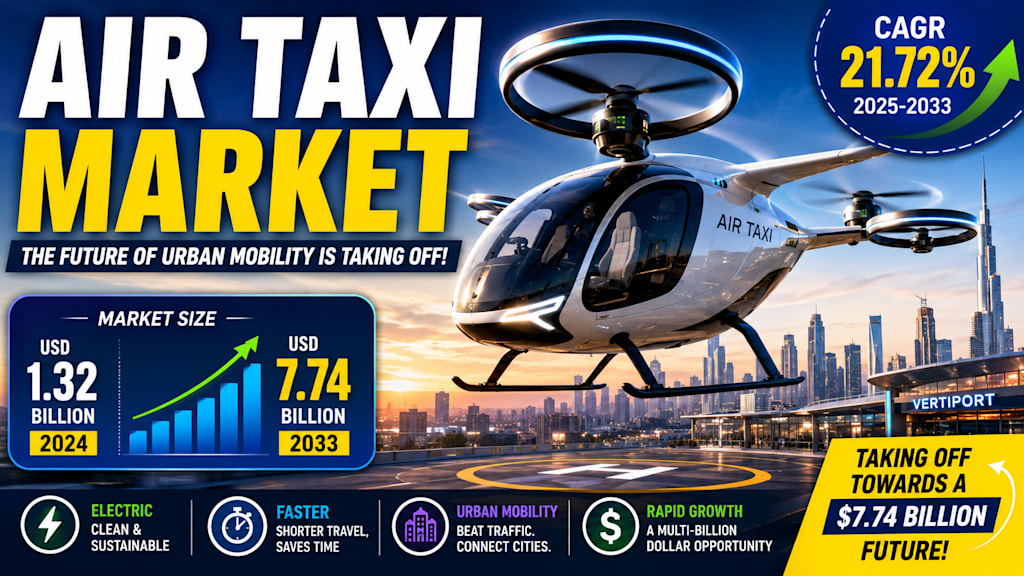
The global air taxi industry is rapidly transitioning from a futuristic concept to a commercially viable transportation solution. According to market estimates, the Global Air Taxi Market was valued at USD 1.32 billion in 2024 and is projected to reach USD 7.74 billion by 2033, expanding at a remarkable CAGR of 21.72% during the forecast period. Growing investments in electric vertical takeoff and landing (eVTOL) aircraft, increasing urban congestion, supportive regulatory frameworks, and advancements in autonomous aviation technologies are driving the sector's rapid growth.
As major metropolitan areas worldwide struggle with traffic congestion and infrastructure limitations, air taxis are emerging as a transformative mobility solution capable of dramatically reducing travel times while supporting sustainability goals.
Understanding the Air Taxi Revolution
Air taxis are compact aircraft designed to provide short-distance, on-demand transportation services. Most next-generation air taxis utilize eVTOL technology, enabling vertical takeoff and landing without requiring conventional airport runways. This capability allows operations from rooftops, dedicated vertiports, and small urban hubs.
The concept forms a critical component of the broader Urban Air Mobility (UAM) ecosystem, which aims to leverage low-altitude airspace for efficient passenger transportation within and between cities.
Unlike traditional helicopters, modern air taxis are designed to be quieter, more environmentally friendly, and cost-effective. Their primary applications include:
Urban commuting
Airport transfers
Business travel
Emergency medical services
Tourism transportation
Regional connectivity
Remote area access
Countries including the United States, Germany, China, the UAE, and Saudi Arabia are actively investing in air taxi infrastructure and pilot programs, positioning themselves as leaders in the future aviation landscape.
Technological Advancements Accelerating Market Growth
eVTOL Technology Drives Industry Innovation
The most significant catalyst behind air taxi market expansion is the rapid advancement of electric vertical takeoff and landing technology.
Recent improvements in battery energy density, lightweight composite materials, electric propulsion systems, and flight control software have dramatically enhanced the performance and safety of air taxi aircraft.
Leading manufacturers are developing aircraft capable of:
Flying distances of 100–300 kilometers
Carrying multiple passengers
Operating with significantly lower noise levels
Producing zero direct emissions
Reducing operating costs compared to helicopters
Several successful test flights and demonstration programs have strengthened investor confidence and accelerated commercialization efforts.
In June 2025, UK-based aerospace company Vertical Aerospace strengthened its partnership with Bristow Group to support the deployment of commercial air taxi services, highlighting the growing momentum behind eVTOL adoption.
Battery Innovation Enhances Commercial Viability
Battery technology remains a key determinant of air taxi performance. Improvements in lithium-ion battery efficiency, charging speeds, and energy storage capacity are enabling aircraft manufacturers to extend flight ranges while maintaining safety standards.
As battery costs continue declining, the economics of air taxi operations become increasingly attractive for commercial operators, investors, and urban mobility providers.
Urban Congestion Creates Strong Demand
Cities Need Faster Transportation Alternatives
Traffic congestion costs major economies billions of dollars annually through lost productivity, increased fuel consumption, and environmental damage.
In many large cities, daily commuting times continue to rise despite investments in public transportation and road infrastructure.
Air taxis offer a compelling solution by utilizing previously untapped urban airspace. Trips that may require over an hour by road can potentially be completed in just 15 to 20 minutes using air taxi services.
This time-saving advantage is particularly attractive for:
Corporate executives
Business travelers
Emergency responders
High-value tourists
Medical transport providers
As urban populations continue growing, the demand for alternative mobility solutions is expected to strengthen substantially.
Rising Investments Fuel Commercialization
Strong Capital Inflows Support Industry Development
The air taxi sector has attracted billions of dollars in funding from venture capital firms, aerospace manufacturers, technology companies, and government-backed innovation programs.
Public-private partnerships are playing a critical role in developing:
Aircraft manufacturing facilities
Vertiport infrastructure
Charging networks
Air traffic management systems
Pilot training programs
In October 2024, Hyundai-backed Joby Aviation secured an additional $500 million investment commitment from Toyota Motor Corporation. This strategic funding supports aircraft certification efforts and manufacturing scale-up initiatives, demonstrating continued confidence in the industry's future.
Major aerospace companies and automotive manufacturers increasingly view air mobility as a long-term growth opportunity, further accelerating investment activity.
Key Challenges Facing the Industry
Infrastructure Development Remains Critical
While aircraft technology is progressing rapidly, supporting infrastructure remains one of the industry's largest obstacles.
Commercial air taxi operations require:
Vertiports
Passenger terminals
Charging stations
Maintenance facilities
Air traffic integration systems
Building this infrastructure within dense urban environments presents logistical and financial challenges. Available real estate is often limited and expensive, requiring careful planning and collaboration among stakeholders.
Additionally, integrating low-altitude air taxi traffic with existing aviation systems requires advanced traffic management solutions capable of safely coordinating aircraft, drones, and traditional aviation operations.
High Costs Limit Early Adoption
Air taxi aircraft remain expensive assets, with individual vehicles often costing between $1 million and $5 million.
Certification expenses, manufacturing complexity, maintenance requirements, and infrastructure investments contribute to elevated operating costs.
As a result, initial commercial services are expected to target premium customers willing to pay higher fares for time savings and convenience.
Achieving mass-market adoption will depend on:
Manufacturing scale
Battery cost reductions
Fleet standardization
Operational efficiency improvements
Infrastructure expansion
Until these factors mature, affordability may remain a barrier for widespread consumer adoption.
Electric Air Taxi Segment Leads Market Expansion
Electric air taxis represent the fastest-growing segment within the industry.
Benefits include:
Zero tailpipe emissions
Lower operating costs
Reduced noise pollution
Simplified maintenance
Enhanced sustainability
Many electric air taxis are designed to carry between two and six passengers, making them ideal for urban transportation applications.
Industry pioneers such as Joby Aviation, Lilium, and Archer Aviation are advancing certification programs and preparing for commercial launch.
As charging infrastructure improves and battery technologies mature, electric air taxis are expected to dominate future urban air mobility networks.
Turboshaft Air Taxis Maintain Niche Applications
Although electric propulsion dominates future mobility discussions, turboshaft-powered air taxis continue to serve specific use cases.
These aircraft offer:
Greater range
Higher payload capacities
Proven operational reliability
However, they also generate:
Higher emissions
Greater noise levels
Increased fuel costs
Consequently, turboshaft-powered models are more likely to be used for regional transportation, offshore operations, and hybrid aviation concepts rather than urban passenger mobility.
Multicopter Designs Gain Attention
Multicopter air taxis utilize multiple small rotors to achieve stable vertical flight.
Advantages include:
Operational redundancy
Compact footprints
Simpler aircraft architecture
Compatibility with rooftop vertiports
Many autonomous air taxi concepts rely on multicopter configurations because of their enhanced maneuverability and safety characteristics.
Current limitations include shorter flight ranges and lower passenger capacities, but ongoing battery advancements may significantly improve performance in coming years.
Passenger Capacity Trends
Four-Passenger Models Dominate Early Deployments
The four-passenger segment is expected to become the industry's initial commercial sweet spot.
These aircraft offer:
Balanced economics
Simplified certification pathways
Adequate payload capacity
Efficient urban operations
Many leading developers are focusing on four-passenger configurations to accelerate market entry and maximize operational flexibility.
Larger Aircraft Target Regional Mobility
Air taxis capable of carrying more than six passengers are designed primarily for:
Regional transportation
Airport shuttles
Tourism routes
Island connectivity
These aircraft may offer lower per-passenger operating costs but require more complex infrastructure and certification processes.
Regional Market Analysis
United States Leads Global Innovation
The United States remains the world's most advanced air taxi market.
Key companies including Joby Aviation, Archer Aviation, and Wisk Aero are progressing toward regulatory certification.
Major metropolitan areas such as Los Angeles, Miami, and New York are expected to become early commercial deployment hubs.
In May 2025, Archer was selected as the Official Air Taxi Provider for the LA28 Olympic and Paralympic Games, highlighting growing confidence in the commercial readiness of eVTOL technology.
Germany Strengthens European Leadership
Germany has emerged as Europe's leading air taxi innovation center.
Companies such as Volocopter and Lilium are driving aircraft development and certification initiatives.
The country's strong engineering ecosystem, sustainability objectives, and collaboration with the European Union Aviation Safety Agency support rapid industry advancement.
Germany's roadmap envisions progressive deployment of Advanced Air Mobility services through 2032.
China Accelerates Autonomous Air Mobility
China's air taxi market benefits from extensive government support and technological investment.
Leading developer EHang has conducted numerous autonomous flight demonstrations and continues advancing certification efforts.
Cities such as Guangzhou and Shenzhen are testing low-altitude mobility systems that could support large-scale deployment.
In April 2025, AutoFlight launched construction of a new production and testing facility in Wuhan, strengthening China's manufacturing capabilities.
Saudi Arabia Invests in Future Mobility
Saudi Arabia is integrating air taxi technologies into its Vision 2030 transformation strategy.
Projects including NEOM and The Line are expected to incorporate advanced aerial transportation networks.
In May 2025, FlyNow Arabia and Saudi Arabia's Ministry of Transport announced plans for the Kingdom's first air taxi application supporting both passenger and cargo transport services.
The country's willingness to invest heavily in emerging transportation infrastructure positions it as a future regional leader.
Competitive Landscape
The air taxi market features a mix of aerospace giants, mobility startups, and technology innovators competing to shape the future of urban aviation.
Major industry participants include:
Honeywell International Inc.
Airbus SE
Hyundai Motor Company
Joby Aviation
Kitty Hawk Corporation
Neva Aerospace Ltd.
Skyway Air Taxi
Fly Aeolus
Ab Corporate Aviation
Talkeetna Air Taxi Inc.
Future Outlook
The global air taxi industry is approaching a pivotal commercialization phase. Advances in eVTOL technology, battery systems, autonomous flight capabilities, and supportive regulations are steadily transforming air taxis from experimental prototypes into practical transportation solutions.
While infrastructure development, certification challenges, and affordability concerns remain significant hurdles, growing investment and government support are accelerating industry progress. By 2033, air taxis are expected to play an increasingly important role in urban mobility ecosystems, helping cities reduce congestion, improve connectivity, and advance sustainability goals.
As commercialization expands across North America, Europe, Asia-Pacific, and the Middle East, air taxis may become one of the most disruptive transportation innovations of the coming decade.
About the Creator
Enjoyed the story? Support the Creator.
Subscribe for free to receive all their stories in your feed.
Comments
There are no comments for this story
Be the first to respond and start the conversation.