
Global Advanced Electrode Binder Chemicals Market Outlook: EV Demand Driving Rapid Expansion
Advanced Electrode Binder Chemicals Market: Growth, Trends, and Forecast to 2035

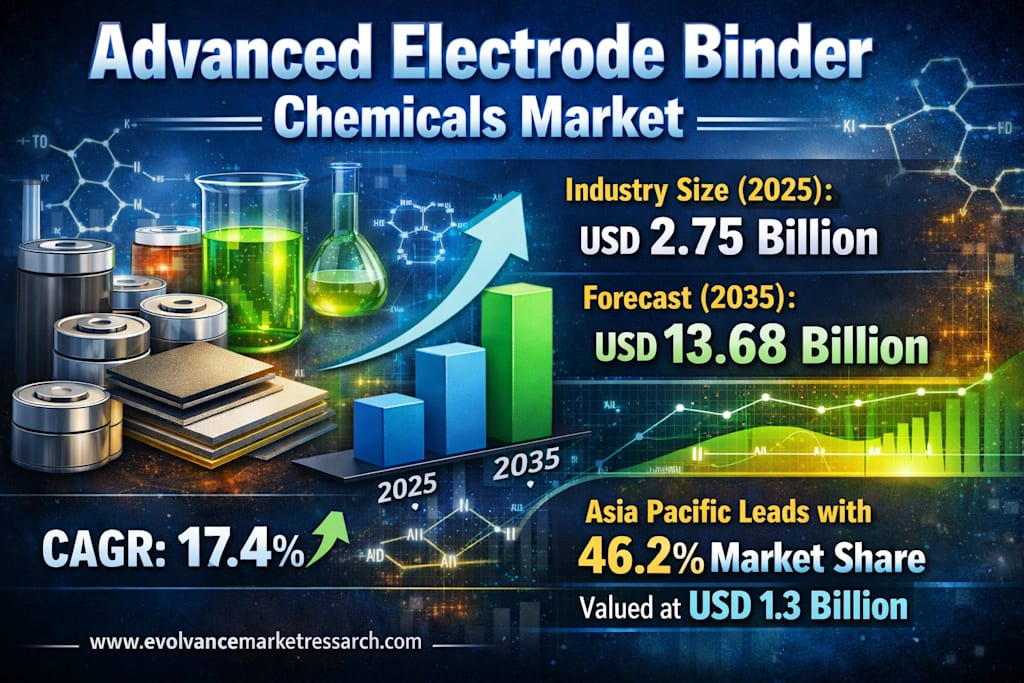
Advanced Electrode Binder Chemicals Market Size & Outlook
The global Advanced Electrode Binder Chemicals Market is projected to grow significantly, reaching approximately USD 13.68 billion by 2035, up from USD 2.75 billion in 2025, at a CAGR of 17.4% between 2026 and 2035.
This growth is being driven by the rapid expansion of lithium-ion battery production, particularly for electric vehicles (EVs). Battery manufacturers are increasingly demanding high-performance binder materials that improve cycle life and energy density.
Market Highlights
- The Global Advanced Electrode Binder Chemicals Market valued at USD 2.75 Billion in 2025, reaching USD 13.68 Billion by 2035 at a CAGR of 17.4%.
- Asia Pacific leads with a 46.2% market share, valued at USD 1.3 Billion.
- PVDF dominates the product type segment with a 43.6% share.
- Lithium-ion batteries represent the top battery type segment at 53.2%.
- Powder form commands 67.3% of the form segment.
- Water-based binders lead binder type with 63.2% share.
- Anode binders dominate electrode type with 72.1% share.
- Wet coating process holds 59.6% of the technology segment.
- Graphite-based anodes top the application segment at 61.7%.
- Electric Vehicles drive the end-use segment with 47.3% share.
Request a Sample Report with the Latest 2026 Data & Forecasts
Market Overview
Advanced electrode binder chemicals are specialized polymers used in battery electrodes to hold active materials together and bind them to current collectors.
They play a critical role in maintaining electrode integrity while allowing ion flow during repeated charge-discharge cycles. Without effective binders, batteries degrade quickly, reducing both lifespan and performance.
Cathode applications predominantly use PVDF with solvent-based systems, while anode formulations are increasingly shifting toward water-based SBR-CMC systems. This creates two distinct cost and supply structures within the market.
Product Type Insights
Polyvinylidene Fluoride (PVDF) led the market with a 43.6% share in 2025, driven by its strong electrochemical stability and compatibility with high-performance cathodes such as NMC and NCA.
However, shifting market dynamics are emerging. Kureha Corporation reported a 22.0% year-on-year decline in its Advanced Materials segment in 2024, largely due to reduced PVDF binder demand in EV markets.
Battery Type Insights
Lithium-ion battery systems dominated the market with a 53.2% share in 2025, supported by mature supply chains and massive global production capacity.
China’s battery output exceeded 940 GWh in 2024, according to the National Bureau of Statistics of China. This scale drives strong demand for binder materials like PVDF and CMC/SBR.
Form Insights
Powder-based binders held a commanding 67.3% share in 2025, owing to their superior storage stability and flexibility in formulation.
Manufacturers favor powder formats for their longer shelf life, easier transportation, and compatibility with both solvent-based and water-based slurry systems.
Type Insights
Water-based binders accounted for 63.2% of the market in 2025, driven by environmental regulations and cost advantages over solvent-based systems such as NMP.
The transition away from NMP is accelerating due to rising recovery costs, stricter workplace safety standards, and sustainability requirements from automotive OEMs.
Emerging fluorine-free and siloxane-based binders demonstrate over 1.4× higher lifespan stability compared to PVDF, further supporting the shift toward water-based solutions.
Electrode Type Insights
Anode binders dominated with a 72.1% share in 2025, primarily due to the widespread use of water-based SBR-CMC systems in graphite anodes.
The large-scale production of lithium-ion batteries sustains strong demand for these cost-effective and environmentally friendly binder systems.
For example, South Korea’s lithium-ion battery exports reached USD 9.8 billion in 2024, according to Korean Statistical Information Service, highlighting the industrial scale of electrode manufacturing.
Application Insights
Graphite-based anodes led the market with a 61.7% share in 2025, supported by their dominant role in commercial lithium-ion batteries.
Graphite remains the preferred anode material due to its proven performance and compatibility with SBR-CMC binder systems, which are optimized to manage volume expansion during charge cycles.
End-Use Industry Insights
Electric vehicles accounted for 47.3% of the market in 2025, making them the leading end-use segment. According to the United States International Trade Commission, the U.S. imported USD 13.1 billion worth of lithium-ion batteries in 2024, reflecting strong EV-driven demand.
EV manufacturers impose stringent performance requirements—such as high energy density, long cycle life, and thermal stability—which continue to push innovation in binder chemistry across the battery supply chain.
Asia Pacific Market Insights
Asia Pacific leads the global market with a 46.2% share, reaching approximately USD 1.3 billion in 2025. This dominance is structurally anchored in the region’s battery manufacturing scale.
North America Market Insights
North America is undergoing a structural shift from a reliance on imports to building a domestic production base for binder chemicals.
The U.S. Department of Energy allocated USD 7 billion in Battery Materials Processing Grants in 2024, accelerating the development of local supply chains for electrode materials, including binders.
Regulatory Landscape
European regulations targeting PFAS (which include PVDF materials) are a major market disruptor. These rules are pushing manufacturers to accelerate the development of environmentally compliant binder alternatives, particularly for use in the European market.
EV Battery Expansion
Battery production is scaling faster than EV sales, driving bulk procurement of binder chemicals. Large-scale manufacturers prefer suppliers capable of maintaining consistent quality across high-volume contracts.
Emerging Trends
Dry Electrode Processing
A major shift is underway toward dry electrode manufacturing, which eliminates liquid slurry processing.
This requires entirely new binder functionalities:
- Traditional binders like PVDF and SBR are not directly compatible
- New solutions include fibrillated polymers and dry-processable materials
- This transition is expected to reshape both product development and supply chains.
Competitive Landscape
Kureha Corporation
A leading PVDF binder producer, though recent declines in EV demand highlight the need to diversify into next-generation chemistries.
Arkema S.A.
Strong player in fluoropolymer binders, benefiting from vertically integrated production and its well-known Kynar product line.
Solvay S.A.
Focuses on advanced polymer solutions and is well-positioned within Europe’s battery ecosystem, particularly in developing compliant binder alternatives.
Daikin Industries Ltd.
A major fluorochemical manufacturer with strong global production capacity, continuing to invest in PVDF despite increasing regulatory pressure.
Conclusion
The Advanced Electrode Binder Chemicals Market is entering a phase of rapid transformation. While growth is driven by EV adoption and battery scaling, the industry is simultaneously navigating regulatory challenges and technological shifts.
About the Creator
Yash Mule
SEO Specialist with 10+ years of experience at Evolvance Market Research. Expert in technical SEO, content strategy, and data-driven optimization, with a proven track record of significantly increasing organic traffic and search rankings.
Enjoyed the story? Support the Creator.
Subscribe for free to receive all their stories in your feed.
Comments
There are no comments for this story
Be the first to respond and start the conversation.