
Geopolymer Market Records Remarkable Growth with Eco-Friendly Materials
How sustainable construction practices, carbon reduction goals, and eco-friendly materials are accelerating adoption and innovation across the geopolymer market

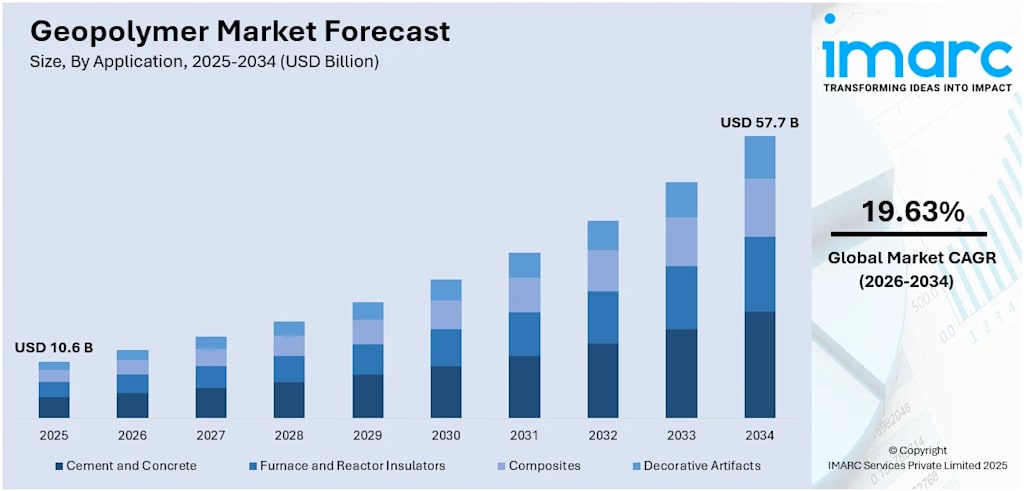
Accelerating urban development, strict environmental regulations, and the urgent need to lower industrial carbon footprints are driving geopolymer demand, supported by the integration of industrial by-products, green-building mandates, and innovative material formulations. According to IMARC Group’s latest data, The global geopolymer market size was valued at USD 10.6 Billion in 2025. Looking forward, IMARC Group estimates the market to reach USD 57.7 Billion by 2034, exhibiting a CAGR of 19.63% from 2026-2034.
Geopolymers now represent a rapidly growing segment within the global industrial materials sector, achieving widespread recognition as a high-performance alternative to traditional binders. Demand is driven by rising environmental accountability, infrastructure modernization projects that require exceptional material durability, and a concerted push toward a circular economy by reusing industrial wastes. Ongoing supply chain optimization, corporate investments in low-carbon manufacturing, and the commercialization of specialized formulations for fire resistance and waste encapsulation are further accelerating uptake.
Request "Geopolymer Market" Trends and Analysis Report Sample
Geopolymer Market Growth Drivers:
- Rising Focus on Sustainable Construction
The global push to lower carbon emissions forces infrastructure planners to look beyond carbon-heavy structural options. Traditional cement manufacturing releases massive volumes of carbon dioxide, driving stricter compliance needs among engineering firms. Geopolymers answer this challenge directly by offering an alternative that releases drastically fewer greenhouse gases during manufacturing. Because these systems use chemical activation rather than high-temperature kiln firing, they drastically lower industrial energy consumption. This shift is highly obvious in public infrastructure tenders, where choosing carbon-neutral materials directly helps contractors win valuable municipal development contracts.
- Growing Demand for Waste Management Solutions
Industrial operations produce immense streams of waste material, making landfill diversion a critical priority for corporate sustainability officers. Geopolymers thrive in this environment by turning waste management liabilities into high-value manufacturing assets. The cross-linking structure of geopolymer matrices encapsulates heavy metals and hazardous elements, preventing toxic leaching into local soil and groundwater. This makes them highly effective for building landfill liners, industrial waste caps, and specialized containment units. Using these polymers lets companies meet strict regional environmental protection laws while simultaneously building stable, long-lasting structural barriers.
- Superior Structural Durability and Chemical Resistance
Engineers increasingly specify geopolymers for harsh environments due to their outstanding material resilience compared to standard concrete. These materials tolerate extreme temperatures, resist acid attacks, and maintain structural integrity during intense fire exposure without structural spalling. This makes them ideal for chemical processing facilities, marine infrastructure exposed to saltwater, and heavy industrial flooring. By minimizing long-term cracking and material degradation, these formulations cut ongoing maintenance costs and extend the lifespan of civic architecture, proving highly cost-effective for asset owners over decades of continuous operation.
Geopolymer Market Trends:
- Integration of Industrial By-Products as Primary Raw Materials
Manufacturing operations are shifting heavily toward circular economic models by utilizing abundant industrial waste streams like fly ash from power plants and blast furnace slag from steel production. This approach stabilizes raw material supply chains and protects producers from the price volatility of mined minerals. Utilizing these readily available industrial by-products lowers production costs while maintaining high structural performance. Companies capitalize on this trend by setting up localized blending facilities near major steel and power plants, optimizing shipping logistics and providing cheap, sustainable materials directly to regional development markets.
- Advancements in One-Part Geopolymer Formulations
A major operational trend is the transition from complex two-part liquid systems to user-friendly, dry-mix one-part formulations. Historically, handling highly alkaline chemical solutions on active job sites presented safety and mixing challenges for construction crews. Modern one-part geopolymers allow workers to simply add water to a pre-packaged dry blend, mimicking traditional concrete preparation techniques. This innovation eliminates specialized labor requirements, fits perfectly into existing commercial mixing equipment, and speeds up project timelines, driving faster commercial adoption across residential and commercial real estate projects.
- Expansion into High-Performance Fireproof Coatings and Insulators
Beyond heavy structural applications, geopolymers find substantial utilization in specialized industrial coatings and thermal barriers. Their natural chemical structure provides superior heat resistance, making them ideal for fireproofing steel frameworks, offshore drilling platforms, and automotive engine bays. Manufacturers formulate these materials into thin, sprayable coatings that protect vital infrastructure during sudden thermal spikes. This application expands the addressable market into aviation, marine defense, and high-tech manufacturing facilities where traditional organic polymers fail under high-heat operational conditions.
Recent News and Developments in Geopolymer Market
- August 2025: Wagners expanded international distribution of its Earth Friendly Concrete, securing supply agreements for major European rail infrastructure projects requiring low-carbon pre-cast components.
- September 2025: Betolar PLC launched a series of AI-driven material optimization tools, allowing ready-mix concrete producers to precisely analyze and adjust local industrial slag chemistry for consistent geopolymer performance.
- October 2025: CEMEX announced a strategic research partnership with a leading technical institute to develop ultra-durable geopolymer binders specifically tailored for marine structures and deep-sea industrial foundations.
Note: If you require specific details, data, or insights that are not currently included in the scope of this report, we are happy to accommodate your request. As part of our customization service, we will gather and provide the additional information you need, tailored to your specific requirements. Please let us know your exact needs, and we will ensure the report is updated accordingly to meet your expectations.
About the Creator
Andrew Sullivan
Hello, I’m Andrew Sullivan. I have over 9+ years of experience as a market research specialist.
Enjoyed the story? Support the Creator.
Subscribe for free to receive all their stories in your feed.
Comments
There are no comments for this story
Be the first to respond and start the conversation.