
Generative AI Market Trends: Large Language Models, Enterprise Adoption & Forecast to 2034
How large language models, enterprise automation, and AI-powered workflows are transforming operational efficiency and innovation strategies in the generative AI market

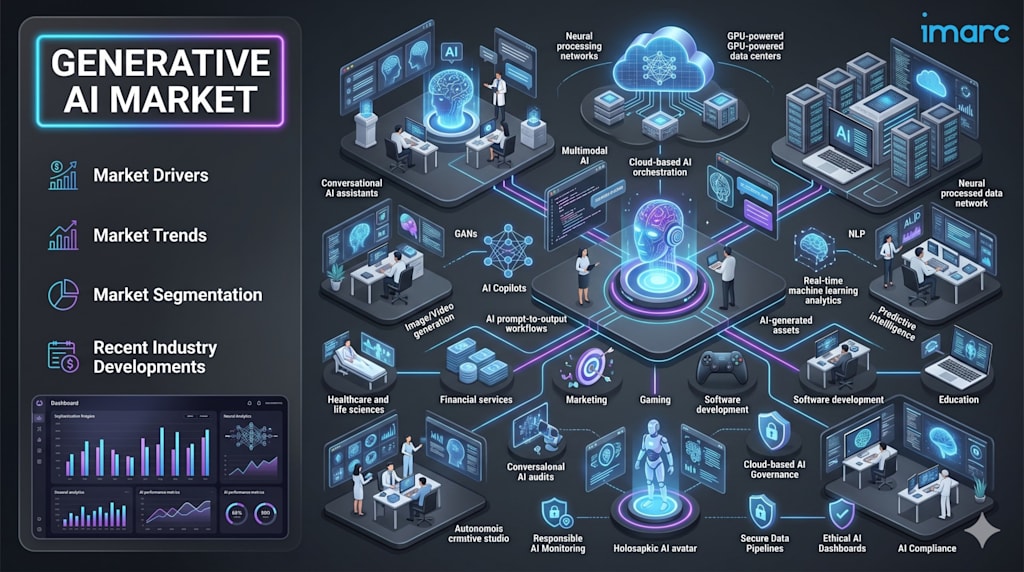
According to IMARC Group's latest research publication, The global generative AI market was valued at USD 17.17 Billion in 2025 and is projected to reach USD 68.50 Billion by 2034, exhibiting a CAGR of 16.12% during 2026-2034. Rising private enterprise adoption, rapid advances in foundation model capabilities, expanding applications across healthcare and media, and growing demand for automated content generation are the primary factors propelling the market. As per Stanford University, private investment in generative AI reached USD 33.9 Billion globally in 2024, reflecting an 18.7% year-over-year increase.
How AI Is Reshaping the Future of the Generative AI Market
- Foundation Model Deployment at Enterprise Scale: Organizations across industries are moving beyond pilot programs to embed generative AI into production-scale workflows, fundamentally reshaping software development, content creation, and customer engagement operations. Falling inference costs and expanding API accessibility are encouraging enterprises to integrate AI-powered content generation, code automation, and data analytics into core business processes. Microsoft announced plans to invest USD 80 Billion in AI-focused data center infrastructure in 2025, underscoring the scale at which hyperscalers are committing resources to support this transition from experimentation to operational deployment across global enterprise markets.
- Generative Adversarial Networks for High-Fidelity Content Creation: Generative adversarial networks command a 66.9% majority share of the technology type segment, driven by superior performance in image synthesis, data augmentation, and creative content generation across media, healthcare imaging, and enterprise applications. Continued improvements in training stability, higher-resolution output capabilities, and conditional generation techniques are enabling commercial deployments in medical imaging, synthetic data generation, and digital advertising production. These advances are reinforcing the technology's dominant position against competing architectures, with autoencoders accounting for 21.8% of the remaining segment through their role in anomaly detection and representation learning across financial services and cybersecurity.
- Automated Content Generation Across Creative and Enterprise Workflows: Businesses are increasingly leveraging generative AI for marketing, documentation, code generation, and creative production, driven by the need to scale output volumes while compressing production timelines and reducing costs. Adobe reported that its Firefly generative AI models were used to create over 22 Billion assets as of April 2025, illustrating the pace at which AI-driven content creation tools are being integrated into professional creative workflows at scale. This acceleration is expanding demand for generative AI solutions across media and entertainment, which accounts for 24.8% of the application segment, with automated video production, AI-generated music, and personalized content delivery platforms all contributing to sustained growth.
- Healthcare and Life Sciences AI Transformation: Generative AI is being deployed for drug discovery acceleration, medical imaging analysis, clinical documentation automation, and personalized treatment planning, creating substantial growth opportunities in regulated healthcare environments. The healthcare application segment is expanding faster than the overall market, driven by the recognition that AI-powered diagnostic tools can meaningfully improve clinical accuracy and reduce administrative burden on healthcare professionals. In November 2025, researchers at the University of California, Berkeley and the University of California, San Francisco unveiled Pillar-0, an open-source AI model capable of examining medical images and identifying conditions with an unmatched level of diagnostic precision, representing a significant milestone in AI-assisted clinical care.
- Agentic AI and Autonomous Workflow Execution: The emergence of AI agents capable of planning, reasoning, and executing multi-step tasks autonomously is opening transformative opportunities across enterprise operations, customer service, and software development. Generative intelligence dominates the application segment at 34.7%, reflecting enterprise demand for AI-powered reasoning, decision support, and workflow orchestration that moves beyond simple content generation to autonomous action. In August 2025, Gartner predicted that enterprise applications integrated with task-specific AI agents would represent one of the fastest-growing deployment categories, with agent-led orchestration enabling AI to handle end-to-end execution while human operators retain strategic oversight.
- Cloud Infrastructure and Edge AI Deployment: Cloud-native AI platforms with GPU-as-a-service offerings, model optimization tools, and hybrid deployment capabilities are becoming standard components of enterprise generative AI adoption strategies. Amazon Web Services reported that Amazon Bedrock was powering generative AI deployments for more than 100,000 organizations globally as of late 2025, illustrating the extent to which cloud infrastructure has become the primary delivery mechanism for enterprise AI capabilities. Edge inference solutions are further extending generative AI into real-time applications in healthcare, manufacturing, and autonomous systems, enabling deployment in environments where low latency and data sovereignty requirements make pure cloud approaches impractical.
Generative AI Industry Overview
North America commands 40.6% of the global generative AI market, led by the United States housing the majority of leading AI research organizations, hyperscaler cloud providers, and a mature venture capital ecosystem that continues to direct substantial capital toward foundation model development and enterprise AI application platforms. The region's deep technology talent pools, established enterprise software distribution networks, and favorable innovation policy environments are further reinforcing its position as the world's largest generative AI market. In January 2026, George Mason University established the Virginia AI Data Center Research Lab at Mason Square, supported by a USD 1.5 Million federal grant to advance AI-driven digital infrastructure and workforce development, reflecting the continued mobilization of public and academic resources in support of AI capacity building across the United States.
Asia-Pacific accounts for 22.5% of the global market and represents the highest-growth regional segment through the forecast period, driven by large-scale government AI initiatives, rapid enterprise digital transformation, and expanding technology startup ecosystems in China, India, Japan, and South Korea. Japanese enterprises accelerated adoption of localized generative AI models in 2025, with SoftBank Group expanding AI partnerships to support multilingual enterprise deployments. In December 2025, Nomura Research Institute launched its AI Co-Creation Model with Microsoft Japan and partners, targeting 100 enterprise projects and training 500 AI specialists, representing a structured effort to embed generative AI across Japanese industries through institutional integration programs. Regional cloud providers and telecom operators across Asia-Pacific also accelerated generative AI service deployments in early 2026, focusing on customer service automation, smart manufacturing, and digital government applications.
Europe holds 24.3% of the global market, with the European Commission actively shaping AI adoption through structured funding programs and regulatory frameworks designed to accelerate responsible deployment across industrial sectors. The European Commission's GenAI4EU initiative, which is surpassing its initial commitment of EUR 500 Million announced in January 2024 with close to EUR 700 Million in funding planned across Horizon Europe and the Digital Europe Programme, represents the continent's flagship effort to support the development and deployment of generative AI across Europe's strategic industrial ecosystems. The initiative builds on the AI Continent Action Plan presented in April 2025 and the Apply AI strategy published in October 2025, targeting an increase in AI adoption among European companies beyond the current rate of 13.5%, which highlights the significant untapped potential for generative AI growth across EU member states.
The responsible AI governance imperative is emerging as a market-shaping force globally. A 2025 report from HCLTech and MIT Technology Review Insights found that 87% of business executives surveyed recognize the critical importance of responsible AI implementation, while a separate 2025 Gartner survey reported that 54% of cybersecurity respondents experienced an attack on enterprise AI applications in the prior 12 months. These figures are accelerating investment in AI safety, transparency, and governance infrastructure as organizations recognize that sustainable generative AI adoption requires robust oversight frameworks alongside capability deployment.
Generative AI Market Trends and Drivers
The rapid advancement of foundation model capabilities is the primary structural driver of the global generative AI market. Continuous improvements in large language model architectures, multimodal AI systems integrating text, image, video, and audio generation within unified frameworks, and reasoning-capable models are steadily expanding the scope of practical enterprise applications. The convergence of multiple modalities within single foundation models is enabling seamless cross-modal content creation workflows that were previously impossible without integrating multiple specialized systems, substantially reducing the technical complexity of enterprise AI adoption.
Enterprise demand for automated content generation at scale is accelerating investment across the market. Businesses in marketing, legal, financial services, and software development are deploying generative AI to produce documentation, code, reports, and customer communications at volumes that human workforces alone cannot sustain, creating persistent and growing demand for scalable generative AI platforms and API services across every major industry vertical.
The democratization of foundation model access through open-source releases is lowering barriers to entry for small and mid-sized enterprises and stimulating innovation in fine-tuning, domain-specific adaptation, and cost-effective deployment strategies. This trend is broadening participation in the generative AI ecosystem well beyond the large technology companies that dominated initial market development, accelerating adoption across mid-market enterprises and emerging economy organizations that previously faced cost and infrastructure barriers to deploying AI at production scale.
Regulatory frameworks are increasingly providing the governance certainty that regulated industries require to commit to large-scale generative AI deployments. As AI-specific legislation matures across major jurisdictions, the compliance pathways that were previously unclear for healthcare, financial services, and government applications are becoming better defined, enabling organizations in these sectors to accelerate adoption with greater confidence in their ability to meet evolving regulatory obligations.
Leading Companies Operating in the Global Generative AI Industry
- Microsoft
- OpenAI
- Amazon.com, Inc.
- NVIDIA Corporation
- Adobe
Generative AI Market Report Segmentation
By Offering Type:
- Image
- Video
- Speech
- Others
By Technology Type:
- Generative Adversarial Networks
- Autoencoders
- Others
Generative adversarial networks represent the largest technology type segment at 66.9% in 2025, driven by strong demand for high-fidelity image synthesis, data augmentation in healthcare imaging, and creative content generation across media and advertising industries. Autoencoders at 21.8% serve critical functions in anomaly detection, dimensionality reduction, and representation learning across manufacturing, cybersecurity, and financial services.
By Application:
- Generative Intelligence
- Media and Entertainment
- Healthcare
- Others
Generative intelligence dominates the application segment at 34.7% in 2025, reflecting enterprise preference for AI-driven decision support, automated reasoning, and intelligent workflow orchestration. Media and entertainment at 24.8% is expanding through automated video production, AI-generated music and sound design, and personalized content delivery platforms. Healthcare is the fastest-growing application sub-segment, expanding at a rate exceeding the overall market through deepening clinical AI applications and advancing diagnostic imaging tools.
Regional Insights:
- North America (United States, Canada)
- Asia Pacific (China, Japan, India, South Korea, Australia, Indonesia, Others)
- Europe (Germany, France, United Kingdom, Italy, Spain, Russia, Others)
- Latin America (Brazil, Mexico, Others)
- Middle East and Africa
North America exhibits clear dominance in the generative AI market at 40.6% in 2025, driven by the concentration of leading AI research laboratories, hyperscaler cloud infrastructure investments, and deep venture capital ecosystems within the United States. Asia-Pacific at 22.5% is the fastest-growing region, supported by large-scale government AI strategies, rapid enterprise digital transformation, and expanding technology ecosystems across China, India, Japan, and South Korea.
Recent News and Developments in the Generative AI Market
- May 2026: OpenAI released GPT-5.5 Instant as the new default ChatGPT model, following the earlier release of GPT-5.5 with enhanced agentic coding, computer use, and deep research capabilities, marking the continued advancement of frontier foundation model capabilities for both consumer and enterprise applications globally.
- April 2025: Adobe reported that its Firefly generative AI models had been used to create over 22 Billion assets, underscoring the rapid acceleration of AI-driven content creation across media, marketing, and professional creative industries, and demonstrating the scale at which enterprise generative AI tools are being deployed in production workflows.
- January 2026: George Mason University established the Virginia AI Data Center Research Lab at Mason Square, supported by a USD 1.5 Million grant, to advance AI-driven digital infrastructure and workforce development, reflecting the continued expansion of academic and public sector investment in generative AI research capacity across the United States.
- December 2025: Nomura Research Institute launched its AI Co-Creation Model in partnership with Microsoft Japan, targeting 100 enterprise AI projects and training 500 AI specialists to accelerate generative AI adoption across Japanese industries through structured integration programs covering automation, customer service, and business innovation applications.
- November 2025: Researchers at the University of California, Berkeley and the University of California, San Francisco unveiled Pillar-0, an open-source generative AI model capable of examining medical images and identifying conditions with a high level of diagnostic precision, advancing the application of generative AI in clinical healthcare settings.
- October 2025: The European Commission published the Apply AI strategy building upon the GenAI4EU initiative, with close to EUR 700 Million in planned funding across Horizon Europe and the Digital Europe Programme to accelerate the deployment of generative AI solutions across Europe's industrial ecosystems and raise the current enterprise AI adoption rate of 13.5% across EU member states.
- September 2024: Stanford University published findings confirming that private investment in generative AI reached USD 33.9 Billion globally in 2024, representing an 18.7% year-over-year increase and reaffirming the sustained momentum of venture capital and corporate investment flows into the generative AI ecosystem across all major global markets.
Note: If you require specific details, data, or insights that are not currently included in the scope of this report, we are happy to accommodate your request. As part of our customization service, we will gather and provide the additional information you need, tailored to your specific requirements. Please let us know your exact needs, and we will ensure the report is updated accordingly to meet your expectations.
About the Creator
Abhay Rajput
I am working in market research company that provides market and business research intelligence across the globe.
Enjoyed the story? Support the Creator.
Subscribe for free to receive all their stories in your feed.
Comments
There are no comments for this story
Be the first to respond and start the conversation.