
GCC Modular Construction Market Gains Momentum with Smart Building
Smart Infrastructure Development, Faster Project Delivery, and Sustainable Building Solutions Accelerating GCC Modular Construction Market Growth

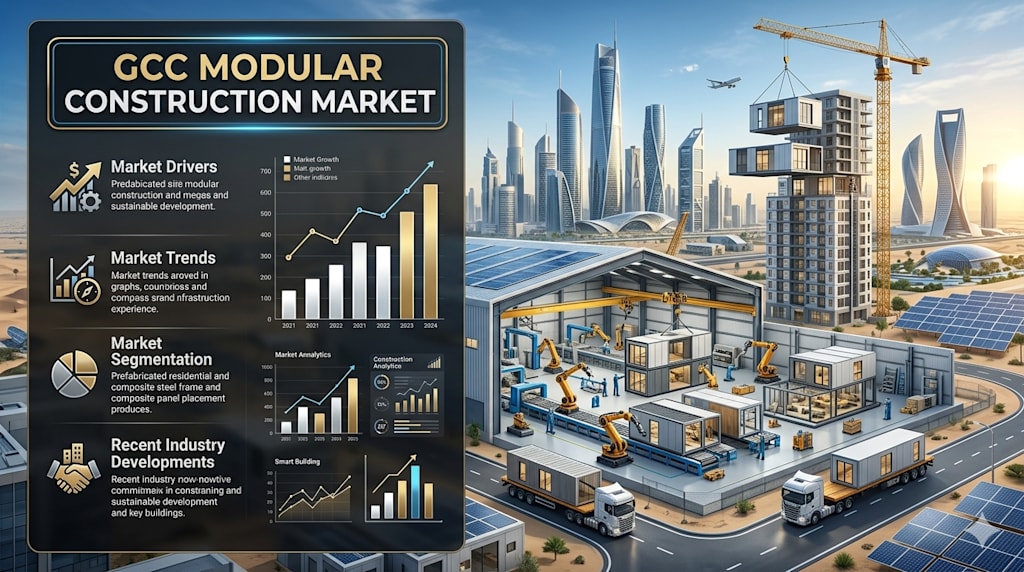
Market Overview
The modular construction market in the GCC region is witnessing significant growth, driven by rapid urbanization, increasing infrastructure investments, and growing demand for cost-effective and time-efficient construction solutions. Modular construction involves manufacturing building components in off-site facilities and assembling them on-site, improving project efficiency, quality control, and sustainability.
The GCC modular construction market size reached USD 2.1 Billion in 2025 and is projected to grow significantly, reaching approximately USD 3.4 Billion by 2034. This reflects a compound annual growth rate (CAGR) of 5.64% during 2026–2034.
This growth is primarily driven by increasing adoption of prefabricated construction methods, rising smart city developments, and growing focus on sustainable infrastructure projects across GCC countries.
As the construction industry continues to modernize, the market is becoming more technology-driven, environmentally sustainable, and operationally efficient.
Analyze Market Potential with Expert Insights — Download the Sample
Key Drivers Fueling Market Growth
Rising Demand for Faster Construction Solutions
Modular construction techniques significantly reduce project completion time, making them increasingly popular for residential, commercial, healthcare, and hospitality projects.
Expansion of Smart City and Infrastructure Projects
Large-scale smart city initiatives, industrial developments, and transportation infrastructure projects across the GCC are boosting demand for modular building systems.
Growing Focus on Sustainable Construction Practices
Governments and developers are increasingly adopting modular construction methods to reduce material waste, carbon emissions, and overall environmental impact.
Role of Technology and Innovation
Advanced Prefabrication and Automation Technologies
Manufacturers are increasingly using robotics, automated assembly systems, and digital fabrication technologies to improve construction precision and productivity.
Integration of Building Information Modeling (BIM)
BIM technologies are enhancing project planning, design coordination, and construction efficiency throughout modular construction projects.
Smart and Energy-Efficient Modular Buildings
Companies are developing energy-efficient modular structures integrated with smart technologies, sustainable materials, and advanced insulation systems.
GCC Modular Construction Industry Trends & Drivers
The market is being reshaped by increasing demand for prefabricated residential units, modular commercial buildings, and portable infrastructure solutions.
Additionally, the growing popularity of sustainable urban development, green buildings, and labor-efficient construction methods is positively influencing market expansion.
Construction companies are also focusing on digital construction technologies, AI-powered project management systems, and innovative modular designs to strengthen competitiveness and operational efficiency.
The increasing investments in healthcare facilities, educational institutions, tourism infrastructure, and industrial projects are further supporting the GCC modular construction industry outlook.
GCC Modular Construction Market Segmentation
Type Insights:
- Permanent
- Relocatable
Module Type Insights:
- Four-Sided
- Open-Sided
- Partially open-sided
- Mixed Modules and Floor Cassettes
- Modules Supported by a Primary Structure
- Others
Material Insights:
- Steel
- Concrete
- Wood
- Plastic
- Others
End Use Insights:
- Residential
- Commercial
- Education
- Retail
- Hospitality
- Healthcare
- Others
Country Insights:
- Saudi Arabia
- United Arab Emirates
- Qatar
- Kuwait
- Oman
- Bahrain
Competitive Landscape
The GCC modular construction market is highly competitive, with the presence of construction companies, modular building manufacturers, engineering firms, and infrastructure developers.
Competition is driven by project delivery speed, product quality, cost efficiency, sustainability standards, technological innovation, and customization capabilities. Companies are increasingly investing in advanced manufacturing facilities, digital construction technologies, and eco-friendly modular solutions to strengthen market position.
Market Outlook
The GCC modular construction market is expected to witness substantial growth through 2034, supported by rising infrastructure investments, increasing demand for rapid construction solutions, and growing adoption of sustainable building practices.
As governments and private developers continue to prioritize operational efficiency, environmental sustainability, and smart infrastructure development, companies will need to focus on innovation, automation, and scalable modular construction technologies.
In the coming years, the market will continue to evolve—becoming more digitally integrated, environmentally responsible, and aligned with the future of smart urban development across the GCC region.
About the Creator
Jackleen Jackleen
Hi, I’m Jackleen Jackleen, a passionate content writer who loves creating clear, engaging, and value-driven content. I enjoy turning ideas into impactful stories that connect with readers.
Enjoyed the story? Support the Creator.
Subscribe for free to receive all their stories in your feed.
Comments
There are no comments for this story
Be the first to respond and start the conversation.