
GCC Hydroxypropyl Methylcellulose Market Report 2026–2034 | Construction and Pharma Trends
How Expanding Construction Activities, Pharmaceutical Applications, and Demand for Sustainable Materials Are Driving Market Growth.

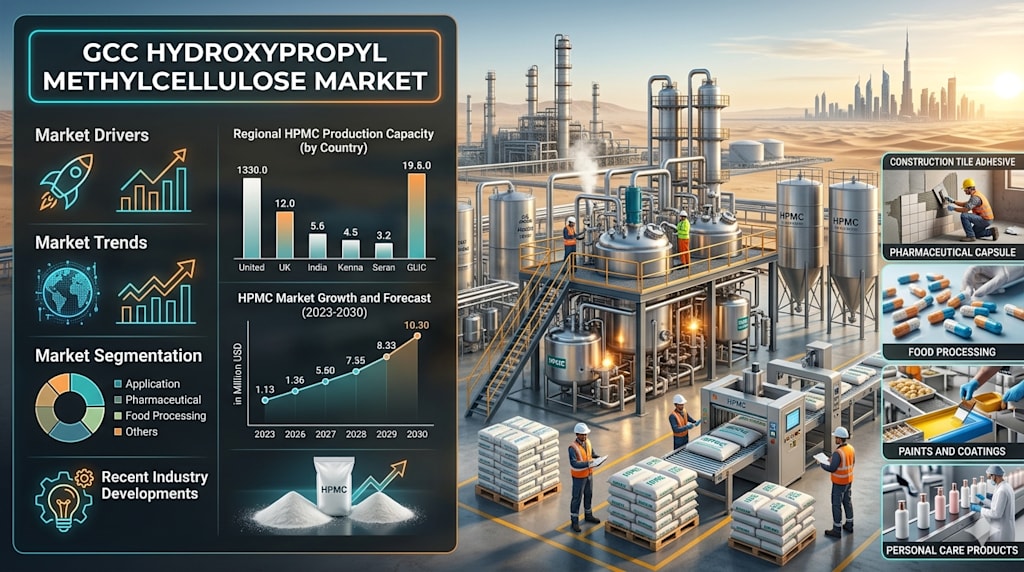
Market Overview
The hydroxypropyl methylcellulose (HPMC) market in the GCC region is witnessing strong growth, driven by rising demand from construction, pharmaceutical, food processing, and personal care industries. HPMC is a semi-synthetic polymer widely used as a thickener, stabilizer, emulsifier, and water-retaining agent across various industrial applications.
The GCC hydroxypropyl methylcellulose market size reached USD 10.4 Million in 2025 and is projected to grow significantly, reaching approximately USD 20.8 Million by 2034. This reflects a compound annual growth rate (CAGR) of 7.80% during 2026–2034.
This growth is primarily driven by increasing utilization of HPMC in cement-based construction materials, expanding pharmaceutical manufacturing activities, and growing demand for biodegradable and sustainable additives.
As industrial requirements evolve, the market is becoming more innovation-driven, application-focused, and aligned with sustainable manufacturing trends.
Analyze Market Potential with Expert Insights — Download the Sample
Key Drivers Fueling Market Growth
- Rising Demand from Construction Industry
HPMC is extensively used in tile adhesives, wall putties, mortars, and cement-based products due to its excellent water retention and workability properties. The rapid expansion of infrastructure and real estate projects across GCC countries is significantly boosting market demand.
- Expanding Pharmaceutical and Cosmetic Applications
The pharmaceutical sector is increasingly utilizing HPMC in controlled-release tablets, capsule formulations, ophthalmic solutions, and cosmetic products because of its biocompatibility and stabilizing properties.
- Growing Preference for Sustainable and Biodegradable Materials
Industries are increasingly adopting eco-friendly and biodegradable polymers to reduce environmental impact and comply with sustainability initiatives across the GCC region.
Role of Technology and Innovation
- Advancements in Polymer Manufacturing Technologies
Manufacturers are focusing on improving production efficiency, product purity, and customization capabilities for industrial-specific HPMC applications.
- Development of High-Performance Construction Additives
Advanced HPMC formulations are improving the durability, flexibility, and bonding performance of modern construction materials.
- Innovation in Food and Pharmaceutical Formulations
HPMC is increasingly being used as a vegetarian gelatin substitute, emulsifier, and stabilizer in processed foods and pharmaceutical formulations, supporting product innovation across industries.
GCC Hydroxypropyl Methylcellulose Industry Trends & Drivers
The market is being reshaped by increasing investments in infrastructure projects, healthcare manufacturing, and advanced industrial materials across GCC countries.
Additionally, rising demand for ready-to-eat food products and processed food formulations is positively influencing HPMC consumption in the food industry.
Manufacturers are also focusing on research and development activities, sustainable production technologies, and customized polymer solutions to strengthen market competitiveness.
The growing adoption of HPMC in paints, coatings, adhesives, textiles, and personal care products is further supporting the expansion of the GCC hydroxypropyl methylcellulose market.
GCC Hydroxypropyl Methylcellulose Market Segmentation
Breakup by End Use:
- Construction
- Pharmaceuticals (Including Cosmetics)
- Food Industry
- Others
Breakup by Country:
- Saudi Arabia
- UAE
- Qatar
- Oman
- Kuwait
- Bahrain
Competitive Landscape
The GCC hydroxypropyl methylcellulose market is highly competitive, with the presence of specialty chemical manufacturers, polymer producers, and international industrial material suppliers.
Competition is driven by product quality, customization capabilities, pricing strategies, sustainability initiatives, and technological innovation. Companies are increasingly focusing on advanced formulations, regional distribution expansion, and strategic partnerships to strengthen market position.
Market Outlook
The GCC hydroxypropyl methylcellulose market is expected to witness substantial growth through 2033, supported by increasing construction activities, pharmaceutical expansion, and growing adoption of sustainable industrial materials.
As demand for multifunctional, biodegradable, and high-performance polymer solutions continues to rise, manufacturers will need to focus on innovation, operational efficiency, and application-specific product development.
In the coming years, the market will continue to evolve—becoming more technology-driven, environmentally sustainable, and aligned with the GCC’s industrial diversification and infrastructure development goals.
About the Creator
Jackleen Jackleen
Hi, I’m Jackleen Jackleen, a passionate content writer who loves creating clear, engaging, and value-driven content. I enjoy turning ideas into impactful stories that connect with readers.
Enjoyed the story? Support the Creator.
Subscribe for free to receive all their stories in your feed.
Comments
There are no comments for this story
Be the first to respond and start the conversation.