
GCC Catheter Market to Surpass USD 1.28 Billion by 2033 Amid Rising Demand for Minimally Invasive Healthcare Solutions
GCC healthcare transformation, chronic disease burden, and technological innovation are accelerating catheter adoption across hospitals and specialty care centers

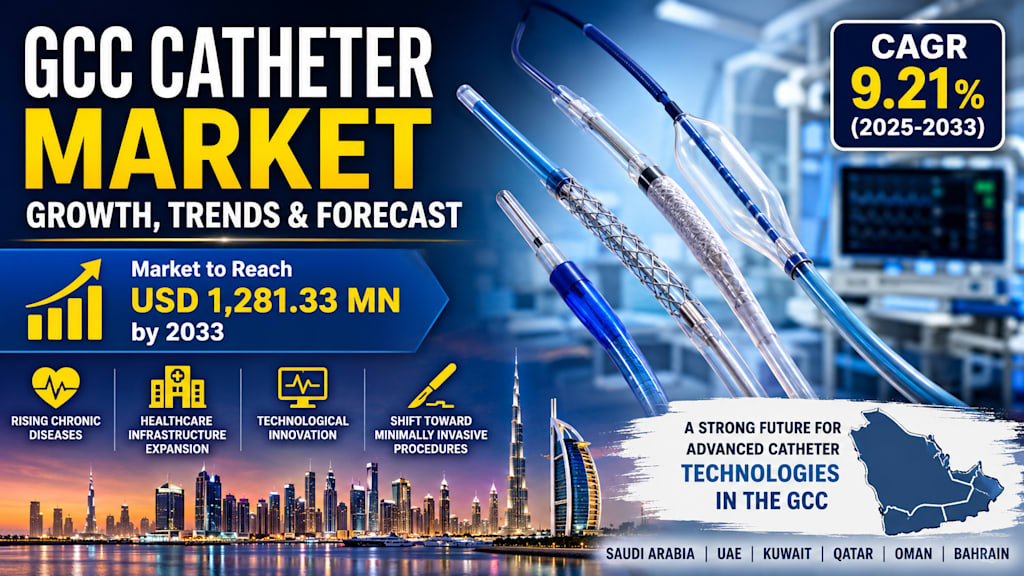
The GCC catheter market is witnessing rapid expansion as healthcare systems across the Gulf region continue modernizing at an unprecedented pace. Increasing prevalence of cardiovascular disorders, diabetes, kidney diseases, and other chronic illnesses is fueling the demand for advanced catheter-based procedures in countries such as Saudi Arabia, the UAE, Kuwait, Qatar, Oman, and Bahrain.
According to Renub Research, the GCC Catheter Market was valued at USD 579.83 million in 2024 and is projected to reach USD 1,281.33 million by 2033, growing at a CAGR of 9.21% from 2025 to 2033.
The market’s strong momentum reflects a wider transformation taking place in GCC healthcare ecosystems. Governments are investing heavily in hospital infrastructure, digital healthcare technologies, medical tourism, and minimally invasive treatment capabilities to improve patient outcomes and reduce long-term healthcare costs.
Rising Chronic Diseases Are Driving Catheter Demand Across GCC Nations
The growing burden of chronic diseases remains one of the biggest factors supporting catheter market expansion in the GCC region. Conditions such as cardiovascular diseases, diabetes, urinary disorders, and chronic kidney diseases often require catheterization during diagnosis, treatment, and long-term patient care.
Healthcare experts across the Middle East continue warning about the increasing incidence of non-communicable diseases due to sedentary lifestyles, obesity, smoking, and changing dietary patterns. Cardiovascular disorders alone account for a significant portion of deaths across the GCC, increasing demand for cardiovascular therapeutic and diagnostic catheters.
The region’s aging population is another major growth catalyst. Elderly patients frequently require urinary catheters, intravascular catheters, and cardiovascular interventions, resulting in higher demand across hospitals and long-term care facilities.
As GCC governments continue prioritizing healthcare modernization, hospitals are rapidly upgrading their surgical and diagnostic capabilities to manage the growing patient burden more efficiently.
Minimally Invasive Procedures Gain Massive Popularity
One of the strongest trends reshaping the GCC catheter market is the increasing preference for minimally invasive procedures. Patients and healthcare providers are shifting away from traditional open surgeries toward catheter-based interventions that reduce complications, shorten recovery times, and improve clinical outcomes.
Modern catheters now feature enhanced flexibility, better navigation capabilities, reduced infection risks, and improved patient comfort. These technological improvements are supporting greater adoption across cardiology, neurology, urology, and vascular specialties.
The demand for angioplasty, embolization procedures, neurovascular interventions, and urinary management solutions continues rising throughout the Gulf region. Hospitals are also investing in advanced imaging systems and robotic-assisted surgical technologies that complement catheter-based procedures.
Healthcare professionals across Saudi Arabia and the UAE increasingly prefer minimally invasive treatment pathways because they lower hospitalization durations and optimize healthcare resource utilization.
Healthcare Infrastructure Investments Continue Accelerating
The GCC region is undergoing a healthcare infrastructure boom, creating substantial opportunities for catheter manufacturers and medical device suppliers.
Saudi Arabia’s Vision 2030 initiative has emerged as one of the most ambitious healthcare transformation programs in the region. The Kingdom is aggressively investing in new hospitals, specialty care centers, and smart healthcare systems to enhance medical access and attract international healthcare providers.
Similarly, the UAE continues strengthening its position as a leading medical tourism destination through investments in world-class hospitals and advanced treatment technologies.
New healthcare facilities are increasingly equipped with catheterization labs, interventional cardiology centers, and specialized surgical units, significantly increasing catheter demand across the region.
Private healthcare operators are also expanding aggressively, especially in urban centers such as Riyadh, Dubai, Abu Dhabi, and Doha, where demand for premium healthcare services continues growing rapidly.
Cardiovascular Catheters Dominate Market Growth
Among all product categories, cardiovascular catheters are emerging as one of the fastest-growing segments in the GCC market. Rising heart disease cases and growing demand for interventional cardiology procedures are strengthening segment growth.
Advanced cardiovascular catheters, including drug-eluting technologies and bioresorbable stent systems, are improving treatment outcomes and procedural efficiency. These innovations are helping physicians perform highly precise interventions with reduced complications.
The region’s growing preference for minimally invasive cardiac surgeries is also supporting the expansion of cardiovascular catheter adoption.
As cardiovascular disease rates continue climbing across GCC countries, hospitals are expected to increase investments in advanced cardiology infrastructure and catheterization technologies.
Microcatheters Witness Strong Adoption in Neurovascular Procedures
Microcatheters are gaining popularity throughout the GCC due to their crucial role in neurovascular and peripheral vascular procedures. These devices enable physicians to navigate highly complex vascular pathways with exceptional precision.
Growing incidences of aneurysms, stroke-related conditions, and peripheral artery diseases are increasing demand for microcatheters across specialty hospitals and advanced surgical centers.
The development of highly flexible and precision-engineered microcatheters is improving procedural success rates and supporting broader adoption among interventional radiologists and neurosurgeons.
Healthcare providers across the Gulf region are increasingly integrating advanced neurovascular technologies into their treatment portfolios, strengthening long-term market opportunities.
Urinary and Intermittent Catheters See Rising Demand
Urinary catheter usage is also expanding steadily across GCC countries due to growing cases of urinary retention, neurogenic bladder disorders, and postoperative care requirements.
Intermittent catheters are becoming increasingly preferred because they reduce infection risks compared to traditional indwelling catheters. Their convenience and patient-friendly design make them suitable for both hospital and home-care settings.
Healthcare providers are placing greater emphasis on infection prevention and patient comfort, which is accelerating adoption of advanced urinary catheter technologies.
The growing trend toward home healthcare and long-term chronic disease management is expected to further support this segment over the coming years.
Short Peripheral Intravenous Catheters Gain Momentum
Short Peripheral Intravenous Catheters (PIVCs) are witnessing widespread usage across GCC hospitals and outpatient facilities for administering medications and fluids.
These catheters remain essential in emergency departments, ambulatory care centers, and surgical units due to their ease of insertion and lower complication risks.
Rising hospitalization rates, increasing outpatient procedures, and growing surgical volumes are supporting demand for short PIVCs throughout the GCC healthcare system.
Healthcare institutions are also emphasizing safer vascular access technologies, encouraging adoption of integrated and closed PIVC systems.
Saudi Arabia Leads the GCC Catheter Market
Saudi Arabia continues dominating the GCC catheter market due to its large population base and substantial healthcare investments.
Under Vision 2030, the Kingdom is investing billions into healthcare modernization, digital transformation, and medical infrastructure development. The establishment of new healthcare facilities is significantly increasing demand for advanced medical devices, including catheters.
The country’s high burden of diabetes and cardiovascular diseases is also accelerating catheter adoption across hospitals and specialty clinics.
Saudi Arabia’s strong focus on localized healthcare manufacturing and medical technology partnerships is expected to create additional growth opportunities for global catheter manufacturers entering the region.
UAE Emerges as a Major Innovation Hub
The UAE catheter market is expanding rapidly because of the country’s sophisticated healthcare infrastructure and growing medical tourism industry.
Hospitals across Dubai and Abu Dhabi are increasingly adopting advanced catheterization technologies and minimally invasive surgical systems to enhance patient care standards.
The UAE’s strong regulatory environment and openness to medical innovation are encouraging global medical device companies to expand regional operations within the country.
Healthcare providers are also investing heavily in robotic surgery, interventional radiology, and advanced cardiovascular treatment capabilities, supporting sustained catheter demand growth.
Kuwait Continues Strengthening Healthcare Capabilities
Kuwait is steadily strengthening its healthcare ecosystem through investments in hospital modernization and advanced treatment technologies.
The rising prevalence of lifestyle-related diseases is increasing the need for sophisticated catheterization procedures and interventional treatments.
Government initiatives focused on improving healthcare quality and patient safety are creating favorable conditions for advanced catheter adoption across public and private hospitals.
As healthcare spending continues rising in Kuwait, demand for specialized medical devices and minimally invasive treatment solutions is expected to increase further.
Regulatory Challenges and Cost Concerns Remain Key Obstacles
Despite strong growth prospects, the GCC catheter market still faces several operational challenges.
The high cost of advanced catheter technologies and interventional procedures may limit accessibility in certain healthcare facilities, particularly smaller institutions operating under budget constraints.
Regulatory complexities also remain a challenge for international manufacturers entering GCC markets. Each country maintains distinct approval frameworks and compliance requirements, often extending product launch timelines.
Medical device companies must therefore invest significantly in regulatory compliance, localization strategies, and regional partnerships to successfully expand across the Gulf market.
Competitive Landscape Intensifies Across GCC Region
The GCC catheter market is highly competitive, with major global medical device companies strengthening their regional presence through partnerships, product launches, and innovation-driven strategies.
Leading players operating in the market include:
- Abbott Laboratories
- Edwards Lifesciences
- Becton Dickinson and Company
- Boston Scientific Corporation
- Medtronic plc
- Johnson & Johnson
- Stryker Corporation
- Teleflex Incorporated
These companies are focusing heavily on innovation, strategic collaborations, physician training programs, and regional distribution expansion to strengthen their competitive positioning.
10 Recent Developments Shaping the GCC Catheter Market
In February 2024, Zylox-Tonbridge received UAE Ministry of Health approval for multiple advanced catheter and stent products, including ZENFluxion™ and ZENFlow™ PTA Balloon Catheters.
Transit Scientific announced successful utilization of its XO Cath embolic delivery microcatheter for uterine artery embolization through transradial access in August 2024.
Johnson & Johnson expanded its regional medical device portfolio with the launch of the Cereglide aspiration catheter across Europe, the Middle East, and Africa.
Saudi Arabia accelerated healthcare infrastructure investments under Vision 2030, creating stronger demand for advanced catheterization technologies.
GCC hospitals increased investments in minimally invasive surgical systems and catheterization laboratories during 2024.
Demand for integrated and closed PIVC systems increased due to rising emphasis on infection prevention and patient safety.
Private healthcare providers across the UAE expanded interventional cardiology and neurovascular treatment capabilities.
Microcatheter adoption increased significantly in neurovascular and embolization procedures across GCC specialty hospitals.
Healthcare providers across Kuwait enhanced investments in advanced vascular access technologies and minimally invasive treatment solutions.
Rising adoption of home healthcare solutions boosted demand for intermittent urinary catheters across GCC countries.
Future Outlook Remains Highly Positive
The future of the GCC catheter market appears exceptionally promising as healthcare transformation continues accelerating across the region.
Growing chronic disease prevalence, rising healthcare expenditures, technological innovation, and increasing demand for minimally invasive procedures are expected to sustain long-term market growth.
Governments throughout the GCC remain committed to expanding healthcare accessibility, improving patient outcomes, and integrating advanced medical technologies into national healthcare systems.
As hospitals continue modernizing and healthcare awareness rises among populations, catheter-based procedures are likely to become increasingly common across cardiology, neurology, urology, and critical care settings.
Final Thoughts
The GCC catheter market is entering a dynamic growth phase fueled by healthcare modernization, demographic shifts, and rapid technological progress. With strong government backing, expanding hospital infrastructure, and increasing acceptance of minimally invasive treatments, the region is becoming an increasingly attractive destination for global medical device manufacturers.
Saudi Arabia and the UAE are expected to remain major growth engines, while emerging opportunities across Kuwait, Qatar, Oman, and Bahrain will further diversify regional demand.
As innovation continues transforming patient care standards, catheter technologies will play an increasingly critical role in shaping the future of healthcare across the Gulf region.
About the Creator
Enjoyed the story? Support the Creator.
Subscribe for free to receive all their stories in your feed.
Comments
There are no comments for this story
Be the first to respond and start the conversation.