
GCC 3D Printing in Healthcare Market | Medical Innovation Driving Demand
How Personalized Medicine, Advanced Medical Devices, and Healthcare Innovation Are Driving Market Expansion.

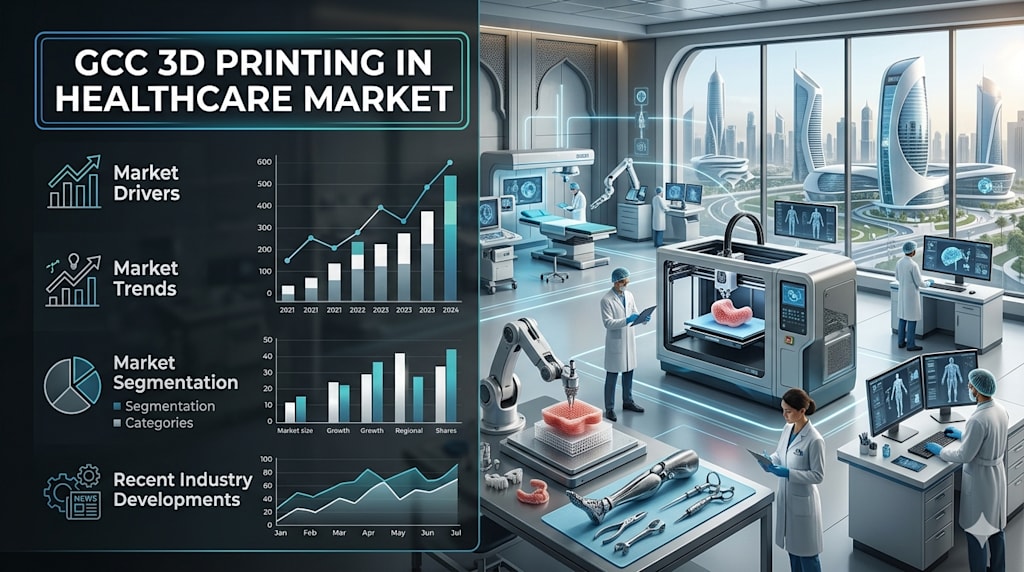
Market Overview
The 3D printing in healthcare market in the GCC region is experiencing rapid growth, driven by advancements in medical technology, increasing demand for personalized treatments, and strong government support for healthcare innovation. 3D printing is transforming healthcare by enabling the production of customized implants, prosthetics, and surgical models with high precision.
According to analysis by IMARC Group, the GCC 3D printing in healthcare market was valued at USD 1.05 billion in 2024 and is projected to reach approximately USD 6.44 billion by 2033. This reflects a strong compound annual growth rate (CAGR) of 20.70% during 2025–2033.
This growth is primarily driven by increasing investments in healthcare infrastructure, rising demand for patient-specific medical solutions, and cost-efficient production capabilities.
As healthcare systems modernize, the market is evolving into a highly innovative, precision-driven, and patient-centric ecosystem.
Analyze Market Potential with Expert Insights — Download the Sample
Key Drivers Fueling Market Growth
- Rising Demand for Personalized Medical Devices
Healthcare providers are increasingly using 3D printing to create customized implants, prosthetics, and surgical tools tailored to individual patients, improving treatment outcomes.
- Advancements in Healthcare Infrastructure
Countries like Saudi Arabia and the UAE are heavily investing in modern healthcare systems, supporting the adoption of advanced technologies such as 3D printing.
- Cost Efficiency and Faster Production
3D printing enables rapid prototyping and reduces manufacturing time and costs, making medical solutions more accessible and scalable.
Role of Technology and Innovation
- Bioprinting and Tissue Engineering
3D printing is enabling breakthroughs in regenerative medicine, including the development of tissues and organ models for research and treatment.
- Advanced Materials (Polymers and Metals)
Biocompatible materials such as polymers and alloys are improving the quality, durability, and safety of medical devices.
- Precision Surgical Planning
3D-printed anatomical models allow surgeons to plan complex procedures with higher accuracy, reducing risks and improving outcomes.
GCC 3D Printing in Healthcare Industry Trends & Drivers
The market is being reshaped by the increasing integration of 3D printing into mainstream healthcare practices. Hospitals and clinics are adopting this technology for applications such as dental implants, orthopedic solutions, and surgical simulations.
Government initiatives, such as Saudi Arabia’s healthcare innovation programs and the UAE’s digital health strategies, are further accelerating adoption across the region.
Additionally, the growing prevalence of chronic diseases and an aging population are increasing the need for customized and efficient healthcare solutions.
GCC 3D Printing in Healthcare Market Segmentation
Analysis by Technology:
- Stereo Lithography
- Deposition Modeling
- Electron Beam Melting
- Laser Sintering
- Jetting Technology
- Laminated Object Manufacturing
- Others
Analysis by Application:
- Medical Implants
- Prosthetics
- Wearable Devices
- Tissue Engineering
- Others
Analysis by Material:
- Metal and Alloy
- Polymer
- Others
Country Analysis:
- Saudi Arabia
- UAE
- Qatar
- Kuwait
- Oman
- Bahrain
Competitive Landscape
The GCC 3D printing in healthcare market is highly competitive, with key players such as 3D Systems Inc., Stratasys Ltd., Materialise NV, Renishaw PLC, and General Electric focusing on innovation and product development.
Competition is driven by advancements in materials, precision capabilities, and the ability to deliver customized healthcare solutions. Companies are investing heavily in R&D and partnerships with healthcare institutions to expand their market presence.
Market Outlook
The GCC 3D printing in healthcare market is expected to witness strong growth through 2033, supported by technological advancements, increasing healthcare demand, and government-backed innovation initiatives.
As the region continues to prioritize advanced healthcare solutions, 3D printing will play a critical role in enabling personalized medicine, improving surgical outcomes, and reducing costs.
In the coming years, the market will continue to evolve—becoming more advanced, accessible, and integral to the future of healthcare in the GCC region.
About the Creator
Jackleen Jackleen
Hi, I’m Jackleen Jackleen, a passionate content writer who loves creating clear, engaging, and value-driven content. I enjoy turning ideas into impactful stories that connect with readers.
Enjoyed the story? Support the Creator.
Subscribe for free to receive all their stories in your feed.
Comments
There are no comments for this story
Be the first to respond and start the conversation.