
Gas Analyzer Market Outlook: Emission Monitoring and Growth Opportunities
The Gas Analyzer Market is experiencing strong growth driven by increasing demand for accurate gas detection and emission monitoring across industries such as oil & gas, chemicals, healthcare, and environmental monitoring.

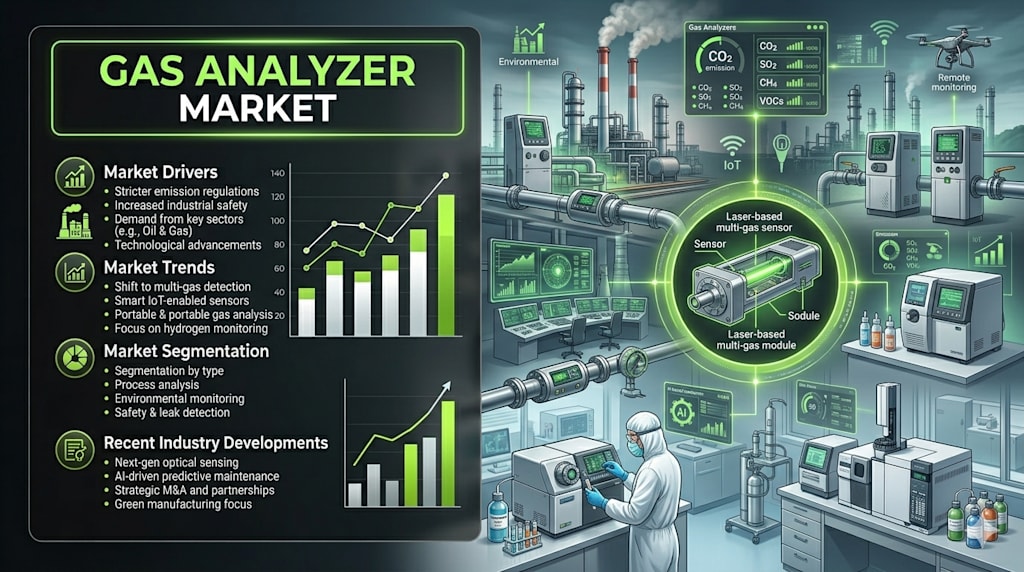
According to IMARC Group's latest research publication, The global gas analyzer market size reached USD 708.0 Million in 2025. Looking forward, IMARC Group expects the market to reach USD 1,134.5 Million by 2034, exhibiting a growth rate (CAGR) of 5.22% during 2026-2034.
How AI is Reshaping the Future of the Gas Analyzer Market
- Real-Time Emission Monitoring and Regulatory Compliance Automation: AI-powered gas analyzers continuously track emission levels across industrial facilities, automatically flagging deviations from permissible limits without requiring manual intervention. In the United States alone, approximately 66 million tons of pollutants were released into the atmosphere in a single year, creating immense regulatory pressure on manufacturers, energy producers, and automotive firms.
- Predictive Maintenance and Equipment Health Monitoring: Machine learning algorithms embedded within modern gas analyzers analyze sensor data patterns to predict equipment failures before they cause costly operational downtime. By identifying anomalies in temperature fluctuations, pressure readings, and gas concentration drift, AI enables maintenance teams to schedule interventions proactively rather than reactively.
- IoT Integration and Remote Gas Monitoring: AI-enhanced gas analyzers connected to Internet of Things networks allow operators to monitor gas levels, calibration status, and alert conditions remotely across distributed industrial sites. This capability eliminates the need for manual on-site inspections in hazardous environments such as underground mining, offshore drilling platforms, and chemical storage facilities.
Gas Analyzer Industry Overview
The gas analyzer market is experiencing sustained expansion driven by tightening environmental regulations, rapid industrialization across emerging economies, and growing adoption in healthcare settings. Asia Pacific leads global demand, with economies such as China and India witnessing substantial growth across petrochemicals, automotive, and manufacturing sectors that require robust gas analysis infrastructure. North America maintains a significant share owing to stringent air quality standards enforced by federal and state-level agencies, combined with a mature industrial base consistently upgrading legacy monitoring equipment. The oil and gas application segment commands the largest share within the market, as gas analyzers are integral to detecting hazardous gases like methane and hydrogen sulfide, optimizing combustion efficiency, and ensuring regulatory compliance at every production stage from exploration to refining.
Gas Analyzer Market Trends and Drivers
Stringent environmental policies and industrial emission regulations are among the most powerful catalysts accelerating gas analyzer adoption globally. Governments and international bodies are enforcing increasingly rigorous air quality and emission standards across manufacturing, energy, and transportation sectors, making continuous gas monitoring a legal obligation rather than an operational preference. This regulatory environment directly stimulates demand for fixed and portable analyzers capable of real-time multi-gas detection, with industries prioritizing investment in solutions that ensure seamless compliance reporting and audit readiness.
The expanding footprint of industrial sectors including petrochemicals, power generation, mining, and specialty chemicals is simultaneously broadening the addressable market for gas analyzers. Occupational health and safety awareness is rising sharply within these sectors, as enterprises recognize that exposure to toxic or combustible gases poses severe risks to workers and assets. Gas analyzers configured to continuously monitor dangerous gas concentrations and trigger alerts when thresholds are breached have become standard components of industrial safety frameworks, creating consistent replacement and upgrade cycles that support sustained market demand.
Technological innovation is reshaping product capabilities and expanding the application base of gas analyzers well beyond traditional industrial settings. Miniaturization advances have produced compact, portable devices capable of multi-gas detection with wireless connectivity, enabling field deployment in remote or hazardous locations. Integration with smartphone platforms and wireless networks allows operators to access real-time monitoring data, manage calibration schedules, and receive alerts from virtually any location. The shift toward IoT-connected analyzers is further supporting predictive maintenance applications, where continuous data streams allow AI systems to forecast sensor degradation and schedule servicing before accuracy is compromised, extending product lifespans and reducing total cost of ownership for operators across industries.
Leading Companies Operating in the Global Gas Analyzer Industry
- ABB Group
- Emerson Electric
- General Electric
- Figaro Engineering Inc.
- Thermo Fisher Scientific
Gas Analyzer Market Report Segmentation
By Application:
- Oil and Gas
- Power
- Chemicals
- Food and Beverages
- Pharmaceuticals
- Others
Oil and gas accounts for the majority of the market share, as gas analyzers perform essential functions in monitoring hazardous gas presence, optimizing combustion efficiency, and ensuring regulatory compliance across exploration, refining, and distribution operations.
Regional Insights:
- North America
- Europe
- Asia Pacific
- Latin America
- Middle East and Africa
Asia Pacific leads all regions in gas analyzer market share, driven by rapid industrialization in China and India, increasingly stringent emission regulations, and high capital investment in petrochemical and manufacturing infrastructure. North America follows closely, supported by advanced environmental compliance frameworks and a well-established industrial base actively adopting next-generation monitoring solutions.
Recent News and Developments in the Gas Analyzer Market
- February 2025: Thermo Fisher Scientific launched the MAX-iR FTIR Gas Analyzer, engineered for inline process monitoring, batch sampling, and gas purity certification applications. The system incorporates Thermo Scientific StarBoost Enhanced Optical Technology, enabling single-digit parts-per-billion detection limits across a broad range of industrial and laboratory applications.
- August 2024: ABB and Samsung Engineering announced a strategic collaboration focused on gas analyzers serving Saudi Arabia's energy sector. Under this agreement, ABB was designated as a single-source vendor for gas analyzer system integration for Samsung's operations in Saudi Arabia, consolidating procurement and ensuring standardized technical specifications across energy infrastructure projects in the region.
Note: If you require specific details, data, or insights that are not currently included in the scope of this report, we are happy to accommodate your request. As part of our customization service, we will gather and provide the additional information you need, tailored to your specific requirements. Please let us know your exact needs, and we will ensure the report is updated accordingly to meet your expectations.
About the Creator
Olivia Smith
Olivia Smits is a Research and Marketing Analyst who specializes in market research, trend analysis, and consumer insights. I help businesses make smarter marketing and strategy decisions by turning data into clear, actionable insights.
Enjoyed the story? Support the Creator.
Subscribe for free to receive all their stories in your feed.
Comments
There are no comments for this story
Be the first to respond and start the conversation.