
Gaming Peripherals Market Trends: RGB Accessories, Esports Growth & Forecast to 2034
How rising esports participation, demand for immersive gameplay, and high-performance accessories are driving innovation and consumer spending in the gaming peripherals market

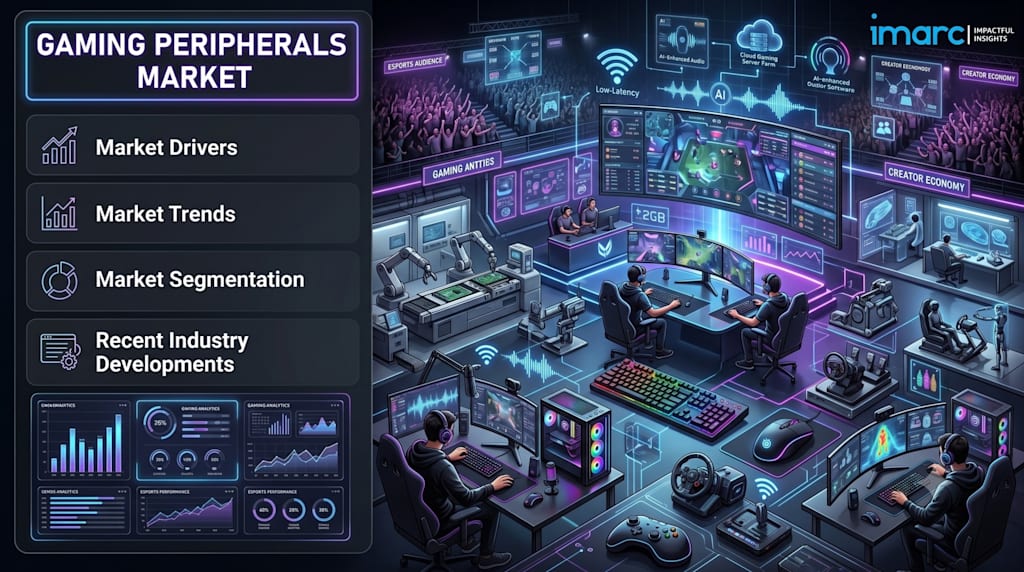
According to IMARC Group's latest research publication, The global gaming peripherals market size reached USD 5.5 Billion in 2025. Looking forward, IMARC Group expects the market to reach USD 9.7 Billion by 2034, exhibiting a growth rate (CAGR) of 6.61% during 2026-2034, driven by the increasing advent of over-the-ear headphones, the easy availability of products, the rising number of casual and professional gamers, and sustained growth across the global gaming industry.
How Technology Is Redefining the Gaming Peripherals Market
- Wireless Connectivity and Latency Elimination: Advances in wireless transmission protocols have effectively closed the performance gap between wired and wireless peripherals, making wireless the dominant technology segment in the market. Gaming mice, keyboards, and headsets now operate with response times comparable to their wired counterparts, removing the last remaining barrier to widespread wireless adoption. Competitive players who once insisted on cables are shifting their preference as brands release ultralight wireless mice and keyboards with multi-day battery life, reinforcing wireless as the new standard for both casual and tournament-level gaming.
- AI-Integrated Peripheral Ecosystems: Artificial intelligence is no longer confined to game engines. Peripheral manufacturers are embedding AI capabilities directly into hardware and companion software to offer real-time performance insights, adaptive sensitivity calibration, and personalized button mapping. Razer's Project Ava, unveiled in January 2026, introduced a holographic AI desktop companion capable of delivering real-time in-game coaching, voice-based command execution, and intelligent decision support, signaling that the next competitive frontier is AI-assisted play powered by the peripheral itself.
- Hall Effect Switch Technology: Hall Effect switches, which use magnetic fields instead of physical contact to register keystrokes and actuation, are gaining traction as the next evolution in mechanical keyboard and controller design. These switches offer theoretically unlimited lifespan, zero debounce delay, and adjustable actuation points, making them highly attractive to esports professionals who demand consistency across thousands of competitive matches. Corsair's MAKR PRO 75 Hall Effect DIY Keyboard, showcased at CES 2026 in January 2026, brought this technology to a wider professional audience.
- Haptic Feedback and Immersive Sensory Design: Gaming peripherals are increasingly incorporating haptic feedback mechanisms that simulate in-game physical sensations through controlled vibration and resistance. Controllers equipped with adaptive triggers and force feedback motors allow players to physically feel differences between terrains, weapon recoil, and environmental conditions, deepening immersion. This technology, initially popularized by console controllers, is now migrating into PC peripherals, creating premium product tiers that command significantly higher price points and margins for manufacturers.
- Sustainable Material Innovation: Environmental responsibility is entering the gaming peripherals design process as manufacturers respond to growing consumer awareness. Brands are experimenting with recycled plastics, bio-based resins, and reduced-packaging formats to lower their carbon footprint without compromising structural integrity or performance benchmarks. This shift is also a commercial strategy, as environmentally conscious younger consumers increasingly factor sustainability credentials into purchasing decisions alongside raw performance specifications.
Gaming Peripherals Industry Overview
The global gaming peripherals industry is operating at the intersection of entertainment, competitive sport, and consumer technology, with each of these forces amplifying the others in a self-reinforcing growth cycle. Headsets, gaming mice, mechanical keyboards, joysticks, gamepads, and controllers are no longer simple input devices but precision instruments engineered to deliver measurable performance advantages. The industry has expanded its consumer base well beyond the traditional gamer archetype. Today, gaming spans age groups, geographies, and income brackets, creating a diverse and growing addressable market that peripheral brands are actively targeting with tiered product portfolios ranging from entry-level to professional-grade hardware.
Government involvement has become a material driver of market expansion. Saudi Arabia's national Vision 2030 strategy has positioned the Kingdom as a global gaming and esports hub, backed by the Esports World Cup Foundation, a government-funded nonprofit that has committed over USD 20 million directly to 40 top esports clubs through its Club Partner Program. The 2025 Esports World Cup, held in Riyadh, featured a prize pool exceeding USD 70 million across 25 tournaments, attracting more than 2,000 players from over 100 countries. Events at this scale drive direct hardware investment, as professional teams and individual competitors invest in certified peripheral setups that meet tournament performance standards. The Esports Nations Cup, announced in August 2025 as the first global recurring national team competition in esports, is scheduled to launch in Riyadh in November 2026 in partnership with publishers including Electronic Arts, Krafton, Tencent, and Ubisoft, further cementing the region's institutional commitment to the competitive gaming ecosystem.
North America reinforces its market leadership through a combination of strong consumer spending power and a deeply embedded gaming culture. Total consumer spending on video games in the United States reached USD 60.7 billion in 2025, up from USD 59.3 billion the prior year, reflecting the enormous financial ecosystem underpinning peripheral demand. Commercial gaming zones, esports arenas, and entertainment centers located in shopping malls continue to proliferate, generating sustained B2B demand for durable, high-performance peripherals that can withstand intensive daily usage while meeting competitive player expectations. Asia Pacific contributes the largest volume of new entrants into the gaming market, driven by a vast youth population, rapidly expanding broadband infrastructure, and growing disposable incomes that are enabling first-time purchases of premium gaming accessories at scale.
Gaming Peripherals Market Trends and Drivers
The exponential rise of esports and competitive gaming remains the single most powerful structural driver of the Gaming Peripherals Market. Professional and amateur gamers alike are investing in equipment that delivers measurable precision, responsiveness, and customization, treating peripherals as performance tools rather than consumer electronics. This mindset shift has elevated average selling prices across categories, as consumers demonstrate willingness to pay premiums for verified competitive advantages. The esports industry's formalization through government-backed tournaments, professional team structures, and mainstream media distribution has brought mass awareness to peripheral brands that were previously niche, introducing millions of aspirational casual gamers to professional-grade hardware for the first time.
The increasing reliance on smartphones as primary gaming platforms has opened an entirely new peripheral sub-segment with high growth potential. Mobile gaming peripherals including Bluetooth controllers, portable cooling fans, clip-on joysticks, and dedicated gaming triggers have gained mainstream traction as smartphone hardware has become powerful enough to deliver console-quality gaming experiences. The proliferation of cloud gaming services that stream high-end titles directly to mobile devices has further accelerated this trend, as players seek responsive physical accessories that recreate the tactile precision of dedicated gaming setups on a portable device. This mobile-first segment is particularly significant in Asia Pacific and the Middle East, where smartphone penetration rates exceed PC ownership and mobile gaming represents the primary access point to interactive entertainment for hundreds of millions of users.
Rapid digitization across entertainment and communication has permanently expanded the gaming population. Gaming has transitioned from a niche subculture to a mainstream leisure activity that crosses demographic boundaries, incorporating children, working adults, retirees, and professional athletes into a single, interconnected community. This demographic broadening has created strong demand for peripherals designed for specific user needs, including ergonomic designs for extended sessions, accessibility-oriented controllers for users with physical limitations, and family-friendly bundles targeting households new to gaming. The integration of virtual reality and augmented reality into gaming platforms has added entirely new peripheral categories, with VR headsets, motion controllers, and haptic feedback gloves creating premium product segments that did not exist a decade ago. As games continue to evolve in graphical complexity and immersive depth, peripheral manufacturers are positioned to benefit from a continuous upgrade cycle driven by players seeking hardware that keeps pace with the demands of next-generation titles.
The rising number of gaming zones in commercial areas has created a high-volume institutional demand channel that complements the retail consumer segment. These venues invest consistently in premium peripherals to meet competitive player expectations, replacing hardware on accelerated cycles due to intensive usage. Tournament hosting at commercial gaming venues further drives demand for top-tier equipment, as organizers must provide gear that meets professional standards across dozens of simultaneous stations. This institutional demand creates a reliable, recurring revenue stream for manufacturers that extend beyond the volatility of consumer purchasing cycles.
Leading Companies Operating in the Global Gaming Peripherals Industry
- Anker
- Cooler Master
- Corsair
- Das Keyboard (Metadot Corporation)
- Dell Inc.
- Gamdias
- HP Inc.
- Logitech
- Mad Catz
- Razer Inc.
- Redragon
- Roccat
- Sades
- Sennheiser (Sonova)
- SteelSeries (GN Store Nord A/S)
- Turtle Beach
Gaming Peripherals Market Report Segmentation
By Product Type:
- Headsets
- Keyboards
- Joysticks
- Mice
- Gamepads
- Others
Headsets represent the largest product segment, driven by the critical role of spatial audio and clear team communication in competitive online multiplayer gaming and esports performance.
By Gaming Device Type:
- PC (Desktop/Laptop)
- Gaming Consoles
Gaming consoles account for the largest device segment, supported by the massive installed base of platforms such as PlayStation, Xbox, and Nintendo Switch and the growing ecosystem of compatible accessories designed to enhance console-specific gaming experiences.
By Technology:
- Wired
- Wireless
Wireless technology holds the largest share, reflecting consumer preference for freedom of movement, reduced cable clutter, and the closing of the latency gap between wired and wireless performance through advances in radio frequency transmission.
By Distribution Channel:
- Online
- Offline
Offline retail channels represent the dominant distribution segment, as consumers continue to value the hands-on ability to assess peripheral build quality, ergonomics, and comfort before making purchase decisions, particularly for higher-priced premium products.
Regional Insights
- North America (United States, Canada)
- Asia Pacific (China, Japan, India, South Korea, Australia, Indonesia, Others)
- Europe (Germany, France, United Kingdom, Italy, Spain, Russia, Others)
- Latin America (Brazil, Mexico, Others)
- Middle East and Africa (Saudi Arabia, UAE, Others)
North America exhibits clear dominance in the Gaming Peripherals Market, supported by the highest concentration of esports infrastructure, leading peripheral manufacturers, strong consumer purchasing power, and a mature omnichannel retail ecosystem that ensures wide product accessibility.
Recent News and Developments in the Gaming Peripherals Market
- January 2026: Corsair showcased the SABRE v2 PRO Ultralight Wireless Gaming Mouse in carbon-fiber and magnesium alloy versions alongside the MAKR PRO 75 Hall Effect DIY Keyboard at CES 2026, targeting the professional and aspiring esports gamer segment with a focus on precision, reduced weight, and customizable actuation.
- January 2026: Razer introduced Project Ava at CES 2026, a holographic AI desktop companion designed to provide gamers with real-time coaching, voice-activated commands, and in-game decision support, marking a significant expansion of the brand's vision beyond traditional hardware peripherals into AI-powered gaming assistance.
- July 2025: Corsair Gaming secured USD 225 million in post-IPO debt funding, reflecting strong institutional investor confidence in the long-term commercial trajectory of the gaming peripherals sector and providing Corsair with capital to accelerate product development and market expansion.
- June 2025: Razer announced a strategic partnership with Microsoft to co-develop gaming accessories optimized specifically for Xbox Cloud Gaming, targeting seamless hardware-software integration, cross-device compatibility, and reduced input latency for cloud-streamed titles on multiple platforms.
- January 2025: SteelSeries officially launched operations in India with a dedicated office in New Delhi and distribution agreements across major e-commerce platforms, expanding its presence in one of the world's fastest-growing gaming communities and signaling broader brand investment in the Asia Pacific region.
- November 2024: Market demand for AI-enabled peripherals, Hall Effect switches, and wireless ultralight gaming mice registered a notable surge globally, reflecting an accelerating consumer shift toward premium, high-performance gear as the performance ceiling of entry-level products becomes increasingly visible to experienced players.
Note: If you require specific details, data, or insights that are not currently included in the scope of this report, we are happy to accommodate your request. As part of our customization service, we will gather and provide the additional information you need, tailored to your specific requirements. Please let us know your exact needs, and we will ensure the report is updated accordingly to meet your expectations.
About the Creator
Abhay Rajput
I am working in market research company that provides market and business research intelligence across the globe.
Enjoyed the story? Support the Creator.
Subscribe for free to receive all their stories in your feed.
Comments
There are no comments for this story
Be the first to respond and start the conversation.