
Game-Based Learning Market Trends: Gamification Strategies, Digital Classrooms & Forecast to 2034
How gamification strategies, interactive content, and immersive digital platforms are transforming student engagement and learning experiences in the game-based learning market

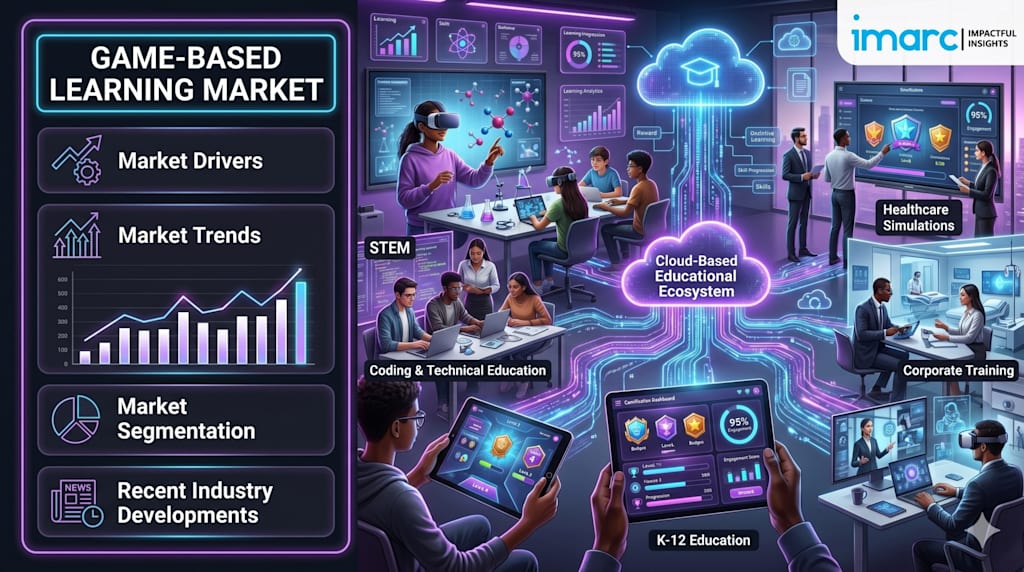
According to IMARC Group's latest research publication, The global game-based learning market size reached USD 24.5 Billion in 2025. Looking forward, IMARC Group expects the market to reach USD 88.6 Billion by 2034, exhibiting a growth rate (CAGR) of 14.59% during 2026-2034.
How Technology is Reshaping the Future of the Game Based Learning Market
- AI-Powered Personalization and Adaptive Learning Pathways: Artificial intelligence is enabling game-based learning platforms to dynamically adjust content difficulty, pacing, and learning style in real time based on individual learner performance. Platforms using AI-driven adaptive engines have demonstrated measurable improvements in knowledge retention and course completion rates compared to static digital content. These systems analyze behavioral data, identify learning gaps, and serve targeted game modules that reinforce weak areas, making the learning experience deeply personalized. For corporate training programs, this capability translates into faster onboarding timelines and more consistent skill acquisition across large, distributed workforces.
- Augmented Reality and Virtual Reality Integration: The incorporation of AR and VR technologies into game-based learning platforms is creating deeply immersive educational environments that were previously impossible to replicate in traditional or even standard digital formats. Medical students can now practice surgical procedures in risk-free virtual operating theaters, while engineering trainees simulate equipment operations before ever touching physical machinery. These technologies reduce the cost of high-stakes training scenarios and simultaneously increase learner engagement and confidence. The ability to repeat simulations indefinitely without consequence makes AR and VR-powered game-based learning especially valuable in safety-critical industries such as aviation, defense, healthcare, and manufacturing.
- Gamification of Corporate Compliance and Workforce Development: Enterprises across financial services, retail, and logistics are replacing conventional compliance training with interactive simulation games that record learner progress and generate auditable performance trails. Companies deploying gamified compliance modules report significantly higher completion rates and improved post-training assessment scores compared to video-based or text-based alternatives. Rewards systems incorporating badges, leaderboards, and point structures create intrinsic motivation loops that sustain engagement across multi-module training journeys. This application is particularly valuable for global organizations managing regulatory compliance requirements across multiple jurisdictions, where consistent knowledge standards are non-negotiable.
- Cloud-Based Platform Deployment and Scalability: The shift toward cloud-native game-based learning infrastructure is enabling institutions and enterprises to deploy, update, and scale educational content at a fraction of the cost associated with on-premises systems. Cloud platforms support device-agnostic access, allowing learners to engage through smartphones, tablets, and desktops regardless of geography or time zone. Real-time analytics dashboards embedded in cloud platforms give administrators granular visibility into learner progress, engagement patterns, and skill gaps across entire organizations. This scalability is particularly compelling for K-12 school districts, universities, and multinational corporations that require consistent learning delivery across thousands of concurrent users.
- Generative AI and Rapid Content Development: Generative AI tools are dramatically compressing the time and cost required to develop high-quality game-based learning modules, reducing development cycles from months to weeks. Publishers and enterprise learning and development teams can now iterate curricula in near-real time to reflect policy changes, regulatory updates, or evolving skill requirements. Smaller educational institutions that previously lacked resources to develop bespoke content are now able to produce tailored game modules without expanding headcount. This democratization of content production is broadening the addressable market and accelerating adoption across geographies that were previously underserved by traditional edtech providers.
Game Based Learning Industry Overview
North America dominates the global game based learning market, driven by a technologically advanced education infrastructure, high institutional spending on edtech, and a mature corporate training ecosystem that has embraced gamification as a standard practice. The United States alone accounts for a substantial portion of regional revenue, supported by government funding initiatives, a concentrated base of leading platform providers, and widespread digital connectivity. In April 2024, the U.S. Department of Education selected Legends of Learning for an USD 8 million grant under the Education Innovation and Research program to conduct a five-year study on game-based learning effectiveness in Florida's fifth-grade science classrooms within the Miami-Dade County Public Schools district. This government-backed study reflects a growing institutional confidence in gamified pedagogy as a legitimate, evidence-supported educational strategy.
Asia-Pacific is the fastest-growing regional market, propelled by smartphone ubiquity, government-sponsored digital education programs, and a massive base of young learners across China, India, Japan, South Korea, and Southeast Asia. In June 2025, Arizona State University partnered with Games for Change to advance educational innovation through game-based learning, research, and microcredential programs, exemplifying how leading academic institutions are anchoring their digital strategy around gamified content. In May 2025, the Congolese government launched an online learning platform to train young people in IT and communication skills, illustrating how game-based digital learning strategies are expanding into emerging markets that had previously been outside the mainstream edtech orbit.
Europe is registering steady adoption as schools and enterprises modernize learning delivery and invest in multilingual digital platforms aligned with regional skill development mandates.
Game Based Learning Market Trends and Drivers
The K-12 education segment continues to represent the largest end-user category within the game based learning market, as schools and school districts increasingly embed gamified learning tools into core curricula to improve student engagement and standardized assessment outcomes. In January 2024, Minecraft Education by Mojang Studios launched Level Up Learning, a digital event series developed in collaboration with ISTE, specifically aimed at tackling evolving educational challenges and promoting game-based learning approaches in formal classroom settings. In February 2024, Kahoot expanded its mobile and online platform to Indonesian-language users, reaching over 15 million participants and deepening its presence in one of Southeast Asia's largest and most rapidly digitalizing education markets.
Corporate and enterprise adoption is the fastest-growing application segment within the game based learning market, with compliance training, leadership development, and onboarding programs driving demand. In January 2025, Microsoft and Pearson announced a strategic partnership to develop AI-powered products and services designed to prepare the current and future workforce for an AI-driven economy, with game-based skill development modules forming a core component of the collaboration. In December 2024, Duolingo partnered with Netflix's Squid Game franchise to promote Korean language learning through an immersive campaign titled Learn Korean or Else, combining gamified lesson mechanics with high-stakes pop culture engagement to motivate language acquisition among millions of global users.
Consumer-facing game-based learning applications, including language learning platforms, coding games, and financial literacy tools, are experiencing robust momentum as lifelong learning trends gain traction among working professionals. Duolingo's revenue reached USD 230.7 million in the first quarter of 2025, directly reflecting how AI-powered content automation and gamified engagement mechanics are translating into significant operating scale for leading consumer platforms. In May 2025, IXL Learning acquired UK-based MyTutor, expanding its reach to over 200,000 families and 40 percent of UK secondary schools, highlighting how platform consolidation is reshaping the competitive landscape of the broader game based learning market.
The online platform segment commands the largest share of the market by delivery mode, as remote schooling trends normalized browser-based and app-based learning access globally. Gamification techniques including reward systems, progress badges, and competitive leaderboards are sustaining learner engagement in ways that passive digital content cannot replicate. The enterprise segment is accelerating at a particularly notable pace as regulatory environments in financial services, healthcare, and logistics increasingly require documented, evidence-based competency verification that gamified training platforms are uniquely equipped to deliver.
Leading Companies Operating in the Global Game Based Learning Industry
- Classcraft Studios Inc.
- Duolingo Inc.
- GradeCraft (The Regents of the University of Michigan)
- Kahoot ASA
- LearningWare Inc.
- Mojang Studios (Microsoft Corporation)
- Pearson plc
- Recurrence Inc.
- Six Waves Inc.
- Gametize Pte. Ltd.
- BreakAway Ltd. Inc.
- ELM Learning
- Filament Games
- Gamelearn
- Centrical
Game Based Learning Market Report Segmentation
By Platform:
- Online
- Offline
The online segment represents the largest share of the market, driven by the increasing accessibility of digital technologies and internet connectivity that allows learners to access educational games anytime and anywhere across devices.
By Revenue Type:
- Game Purchase
- Advertising
- Others
Game purchase leads the revenue type segmentation as institutions and consumers increasingly prefer one-time or subscription-based ownership models that provide uninterrupted, ad-free learning experiences.
By End User:
- K-12 Game-Based Learning
- Higher Education Game-Based Learning
- Enterprise and Corporate Training
- Government
- Consumers
K-12 education leads the end-user segment owing to widespread institutional adoption of gamified learning tools as part of core curriculum delivery and student engagement strategies.
Regional Insights
- North America (United States, Canada)
- Asia Pacific (China, Japan, India, South Korea, Australia, Indonesia, Others)
- Europe (Germany, France, United Kingdom, Italy, Spain, Russia, Others)
- Latin America (Brazil, Mexico, Others)
- Middle East and Africa
North America exhibits clear dominance in the game based learning market due to its advanced digital education infrastructure, high levels of government and institutional investment in edtech, and a well-established corporate training ecosystem that has adopted gamification at scale.
Recent News and Developments in the Game Based Learning Market
- June 2025: Arizona State University partnered with Games for Change to advance educational innovation through game-based learning, collaborative research programs, and the development of microcredentials, reinforcing the United States' position as a global leader in gamified higher education.
- May 2025: IXL Learning completed its acquisition of UK-based MyTutor, bringing its reach to more than 200,000 families and establishing a presence in 40 percent of UK secondary schools, marking a significant consolidation milestone in the game based learning market.
- January 2025: Microsoft and Pearson announced a strategic partnership focused on delivering AI-powered skilling products and services designed to prepare global workforces for an AI-driven economy, with game-based learning tools forming a central pillar of the collaboration.
- December 2024: Duolingo launched a high-profile partnership with Netflix's Squid Game franchise under the campaign titled Learn Korean or Else, integrating gamified Korean language lessons with the pop culture energy of the series to drive mass-market language learning engagement.
- April 2024: The U.S. Department of Education awarded an USD 8 million grant to Legends of Learning under the Education Innovation and Research program to conduct a five-year study on the effectiveness of game-based learning in fifth-grade science classrooms across Miami-Dade County Public Schools in Florida.
Note: If you require specific details, data, or insights that are not currently included in the scope of this report, we are happy to accommodate your request. As part of our customization service, we will gather and provide the additional information you need, tailored to your specific requirements. Please let us know your exact needs, and we will ensure the report is updated accordingly to meet your expectations.
About the Creator
Abhay Rajput
I am working in market research company that provides market and business research intelligence across the globe.
Enjoyed the story? Support the Creator.
Subscribe for free to receive all their stories in your feed.
Comments
There are no comments for this story
Be the first to respond and start the conversation.