
Fuel Oil Market Witnesses Strong Growth Amid Energy Demand Growth
The Fuel Oil Market is experiencing steady growth driven by increasing demand for energy across industrial, marine, power generation, and commercial sectors.

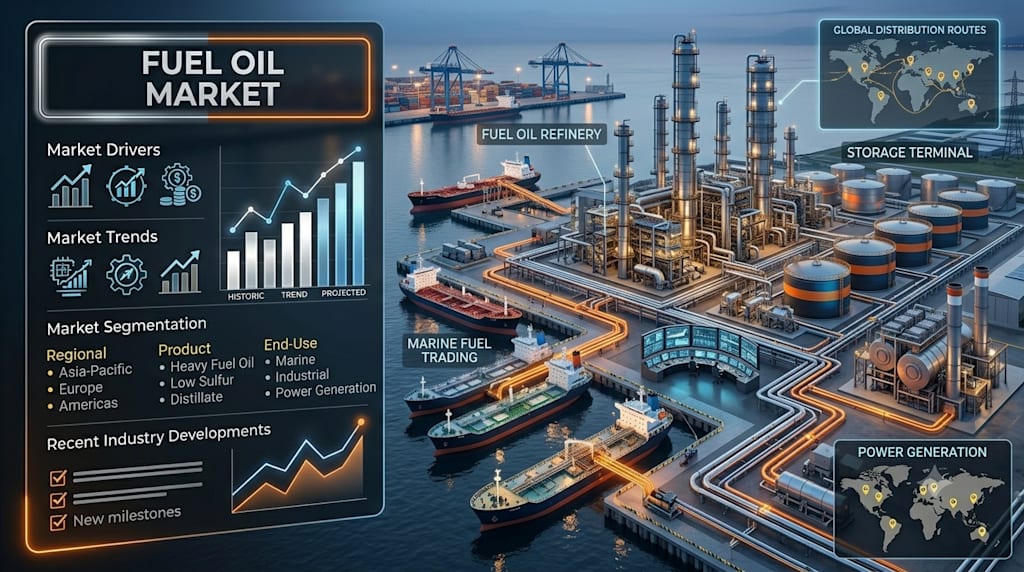
According to IMARC Group's latest research, The global fuel oil market size reached USD 195.8 Billion in 2024. Looking forward, IMARC Group expects the market to reach USD 273.8 Billion by 2033, exhibiting a growth rate (CAGR) of 3.9% during 2025-2033.
How AI is Reshaping the Future of Fuel Oil Market
- Predictive Price and Demand Analytics: AI-driven algorithms analyze geopolitical events, weather patterns, and supply chain disruptions to forecast fuel oil demand and price movements with high accuracy. Machine learning models have improved forecasting precision by approximately 25 percent, enabling producers to optimize production scheduling and inventory management effectively.
- Quality Control and Sulfur Content Monitoring: Computer vision systems equipped with AI automatically detect sulfur content levels and quality parameters in real-time during refining processes. Automated monitoring ensures compliance with IMO 2020 regulations and VLSFO standards, reducing non-compliant product shipments by up to 18 percent while maintaining production efficiency.
- Supply Chain Route Optimization and Risk Management: AI platforms analyze geopolitical risks, maritime chokepoints, and shipping corridors to recommend optimal delivery routes and mitigate disruption exposure. Real-time threat detection identifies potential supply chain vulnerabilities, enabling faster response times and reducing shipping delays by approximately 20 percent.
Fuel Oil Industry Overview
Asia-Pacific dominates the fuel oil market through rapid industrialization, particularly in China and India, where manufacturing intensity and population growth drive sustained energy demand. The region consumed approximately 40 percent of global fuel oil supplies last year, supported by expanding petrochemical sectors and power generation facilities. Heavy dependence on maritime trade for regional commerce creates consistent bunker fuel demand, with Shanghai, Singapore, and Indian ports serving as critical distribution hubs. Government energy policies prioritizing economic growth over immediate transition support continued fuel oil infrastructure development across emerging economies.
Fuel Oil Market Trends & Drivers
Geopolitical Disruptions and Strategic Energy Stockpiling: Geopolitical tensions in key oil-producing regions, particularly the Middle East, create supply chain vulnerabilities and price volatility. Strategic chokepoints like the Strait of Hormuz directly impact global fuel oil availability, with recent disruptions restricting shipment flows significantly. Countries are increasingly implementing strategic petroleum reserves and fuel stockpiling policies to protect against unexpected supply interruptions, driving incremental demand as nations secure long-term fuel contracts and build inventory buffers against regional instability.
Maritime Shipping Expansion and Regulatory Compliance: Global maritime trade continues expanding alongside e-commerce growth, increasing bunker fuel consumption across container ships and bulk carriers substantially. IMO 2020 sulfur cap regulations mandate transition from high-sulfur fuel oil to very low-sulfur fuel oil, requiring significant refinery investments and process upgrades worldwide. Shipping operators selecting scrubber technology versus compliant fuels create dual demand streams, supporting both traditional fuel oil and specialty products. Enhanced environmental standards drive innovation in fuel formulations and refining techniques to meet stricter specifications.
Industrial Power Generation and Residential Heating Demand: Fuel oil remains critical for backup power generation in regions with unstable electrical grids, particularly across Asia, Africa, and Latin America. Industrial facilities including steel mills, cement production, and petrochemical plants depend on fuel oil for consistent, affordable energy inputs supporting manufacturing operations. Residential and commercial heating demand seasonal variations, especially in colder climates, create predictable consumption patterns. Emerging economies with limited natural gas infrastructure continue relying on fuel oil for heating and power generation despite renewable energy expansion initiatives.
Fuel Oil Market Segmentation
By Type
- Heavy Fuel Oil: Primary use in industrial applications, power generation, and large marine vessels; driven by cost efficiency in bulk operations
- Light Fuel Oil: Includes diesel and kerosene for transportation, residential heating, and aviation fuel applications; favored for efficiency and lower sulfur content
By Application
- Road and Domestic Waterway: Largest segment; driven by transportation sector growth, logistics expansion, and inland waterway trade
- Marine Bunkers: Critical for global shipping and maritime commerce; growing with increased international trade
- Petrochemicals: Feedstock for refining processes producing lighter refined products
- Residential/Commercial/Agricultural: Heating applications in cold climates and agricultural operations
- Electricity Generation: Backup and primary power source in regions with unstable grid infrastructure
- Others: Industrial heating, specialty applications, and niche markets
By Region
- Asia Pacific: Dominant market with largest consumption share driven by industrialization and shipping activity
- Middle East and Africa: Significant producer influence and major supply control
- Europe: Declining consumption due to renewable energy shift and stringent environmental regulations
- North America: Stable market with focus on marine bunkers and petrochemical applications
- Latin America: Growing demand supported by industrial expansion and infrastructure development
Leading Companies Operating in the Global Fuel Oil Industry
- BP p.l.c.
- Exxon Mobil Corporation
- Gazprom Neft PJSC (Gazprom PAO)
- Petróleo Brasileiro S.A.
- PJSC Lukoil Oil Company
- PJSC Rosneft Oil Company
- PT Pertamina (Persero)
- Shell plc
- TotalEnergies SE
Recent News and Developments in Fuel Oil Market
Q1 2026: Geopolitical tensions in the Middle East and disruptions at the Strait of Hormuz caused significant oil price volatility, with Brent crude reaching USD 118 per barrel. The closure of critical shipping corridors restricted fuel oil flows globally, prompting countries to implement strategic energy reserves and alternative routing strategies. Refined product markets experienced exceptional tightness, with middle distillate prices reaching all-time highs above USD 290 per barrel in Singapore, directly impacting fuel oil availability and pricing.
2024: Algeria announced major agreements with Chevron and ExxonMobil to significantly boost oil and gas production and exploration efforts. These strategic partnerships focus on developing substantial oil and gas fields across the country, part of Algeria's comprehensive energy sector reforms aimed at increasing output stability. Enhanced European supply security through increased African production supports global fuel oil market stability and reduces regional supply concentration risks.
2025-2026: The maritime industry accelerated adoption of very low-sulfur fuel oil and scrubber technologies to meet IMO 2020 sulfur cap regulations mandating maximum 0.5 percent sulfur content. Refineries worldwide invested heavily in desulfurization technology upgrades and process modifications. Fuel oil producers developed specialized blends combining low-sulfur compliance with performance optimization, creating market segmentation between VLSFO compliant products and traditional high-sulfur fuel oil variants.
2021: Lukoil successfully acquired a 50 percent operating interest in the Gulf of Mexico Area 4 project for USD 435 million. The transaction provided access to substantial crude oil reserves across two offshore blocks covering 58 square kilometers, located 42 kilometers off the Mexican coast. This strategic expansion strengthened Lukoil's upstream production capabilities and international presence while supporting long-term fuel oil supply security through enhanced crude oil access.
Note: If you require specific details, data, or insights not currently included in the scope of this report, we are happy to accommodate your request. As part of our customization service, we will gather and provide the additional information you need, tailored to your specific requirements. Please let us know your exact needs, and we will ensure the report is updated accordingly to meet your expectations.
About the Creator
Michael Richard
Michael Richard is a Market Research Expert specializing in market intelligence, competitive analysis, and data-driven insights. He helps organizations understand trends and emerging opportunities through in-depth research.
Enjoyed the story? Support the Creator.
Subscribe for free to receive all their stories in your feed.
Comments
There are no comments for this story
Be the first to respond and start the conversation.