
Francis Halzen: The Man Who Turned Ice into a Telescope
Building on Pauli’s prediction and Cowan and Reines’s discovery, he helped transform elusive neutrinos into messengers from the universe
Introduction
Some scientific discoveries begin with a particle that nobody can see, while others begin with an instrument that nobody has yet built. Francis Halzen’s achievement connects those two challenges, turning an extraordinary idea about Antarctic ice into a new way of exploring the universe.
The particle was the neutrino, proposed by Wolfgang Pauli in 1930 and experimentally detected by Clyde Cowan, Frederick Reines and their colleagues in 1956. Halzen did not discover it again, but helped develop a means of using high-energy neutrinos to investigate violent events far beyond Earth.
On 6 October 2026, that achievement brought him the Nobel Prize in Physics. Behind the award lies a long story of theoretical insight, experimental ingenuity and the determination of an international team working in one of the world’s most demanding environments.
Pauli’s Solution to Missing Energy
The story began with a puzzle in radioactive beta decay. Measurements appeared to show that the emitted electron did not account for all the energy expected from the process, leaving physicists to question what had happened to the remainder.
Pauli proposed an electrically neutral particle that escaped detection while carrying away the missing energy. It was a bold suggestion because the particle had not been observed, but it preserved the principle that energy was conserved.
The particle became known as the neutrino, and Enrico Fermi incorporated it into a theory of beta decay. What initially looked like an accounting problem in nuclear physics had introduced an entirely new component of nature.
Neutrinos proved exceptionally elusive because they interact so rarely with matter. Their lack of electric charge also means that they do not leave the familiar direct electrical traces produced by many other particles.
Cowan and Reines Catch the Elusive Particle
Cowan and Reines realised that a nuclear reactor offered an intense supply of particles for an experiment. More precisely, they sought electron antineutrinos, the corresponding antiparticles, which could interact with protons and produce a positron and a neutron.
Their apparatus looked for the distinctive signals produced by those secondary particles. The crucial principle was indirect detection: they could identify an otherwise invisible visitor through the measurable consequences of its interaction.
Definitive results came from their work at the Savannah River reactor site in South Carolina. In June 1956, they informed Pauli by telegram that they had detected neutrinos, and their confirmation paper appeared in Science the following month.
Reines received a share of the 1995 Nobel Prize in Physics for the discovery. Cowan had died in 1974, making him ineligible for the award, although his contribution remained central to the achievement.
Halzen Asks a Larger Question
Francis Halzen was born in Tienen, Belgium, on 23rd March 1944. His career at the University of Wisconsin–Madison brought together particle physics, astrophysics and cosmology, fields connected by questions about how matter behaves under extreme conditions.
For Halzen, neutrinos offered more than a laboratory curiosity. They could carry information from cosmic environments where energetic particles collide and where ordinary observations might reveal only part of what is happening.
Charged cosmic rays are diverted by magnetic fields, making their origins difficult to trace. Neutrinos, being electrically neutral, offer a more direct indication of the direction from which they arrived, although reconstructing that direction still involves experimental uncertainty.
The challenge was to detect enough of them. A particle that usually passes through matter unnoticed requires a very large target if scientists hope to record its occasional interactions.
An Observatory Beneath Antarctica
Halzen became a driving force behind the development of neutrino detection in polar ice, working from 1987 on the programme that began with AMANDA. That earlier detector helped establish the feasibility of the much larger IceCube Neutrino Observatory.
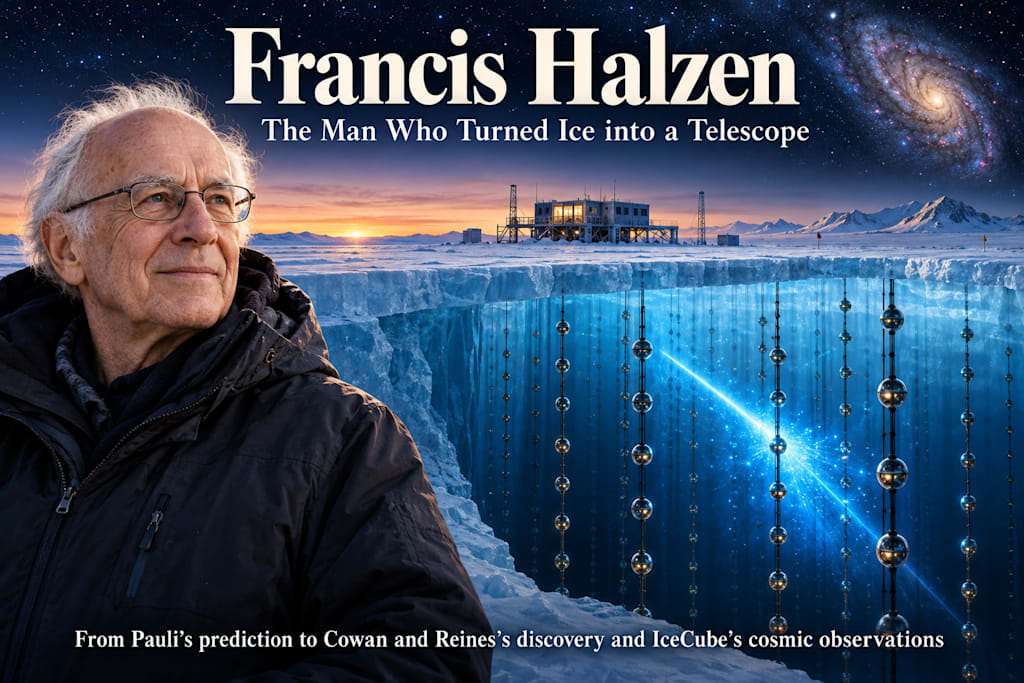
The concept was remarkable: use natural Antarctic ice as the detecting medium instead of building an enormous artificial tank. Sensitive instruments embedded deep beneath the South Pole would watch for faint light from particle interactions.
The original IceCube array contained 5,160 optical sensors distributed along 86 strings, instrumenting approximately a cubic kilometre of ice. Most sensors were installed between about 1,450 and 2,450 metres below the surface, creating a telescope whose principal structure was hidden underground.
The final string was deployed in December 2010, and full operation of the completed array began in 2011. Its construction required hot-water drilling, specialised equipment and the practical skills of people capable of working through Antarctic conditions.
How Ice Becomes a Telescope
IceCube does not photograph neutrinos as they pass through the ice. Instead, a neutrino occasionally interacts with matter and produces charged particles, which can generate a faint optical signal.
When such a particle travels faster than light travels through the ice, it produces Cherenkov radiation. This does not violate relativity because the particle remains slower than light in a vacuum, the relevant universal speed limit.
The sensors record the timing and brightness of the light. Scientists then use those measurements to reconstruct the event and estimate properties such as energy and arrival direction.
Different interactions produce different patterns, including elongated tracks and more compact showers of particles. The analysis must also distinguish potential cosmic neutrinos from signals associated with particles produced in Earth’s atmosphere.
Discovering a New Cosmic Messenger
In 2013, IceCube reported strong evidence for a population of high-energy neutrinos of astrophysical origin. The finding showed that the detector could investigate natural cosmic accelerators, although the individual sources were initially uncertain.
An important further advance followed an alert on 22nd September 2017. Observations by other telescopes helped associate the neutrino with a flaring blazar called TXS 0506+056, and the results were published in 2018.
A blazar is an active galaxy with a powerful jet directed towards our line of sight. Combining its electromagnetic activity with neutrino observations gave scientists evidence connecting an identifiable cosmic object with high-energy particle production.
IceCube later reported evidence of neutrino emission from the active galaxy NGC 1068 and, in 2023, neutrinos associated with the Milky Way. The observatory was developing from a successful detector into a tool for studying astronomical sources.
A Legacy Built by Many People
Halzen’s importance lies in scientific vision and leadership, rather than personally carrying out every stage of a vast experiment. IceCube required contributions from physicists, engineers, technicians, drilling crews, computer specialists and institutions across many countries.
Its heritage also extends beyond the three names at the beginning of this story. Earlier neutrino observatories, underwater detector projects and researchers who developed the principles of neutrino astronomy all helped establish the field.
The 2026 Nobel award recognises Halzen’s decisive contributions to IceCube and the discovery of high-energy cosmic neutrinos. It also draws attention to an achievement that could only have emerged through sustained collaboration.
Conclusion
Pauli proposed an unseen particle to explain missing energy, and Cowan and Reines demonstrated that it could be detected. Halzen and his collaborators helped take the next major step, using such particles to investigate the universe itself.
The connection between their achievements is scientific continuity rather than a single experiment passed unchanged from one generation to another. Each stage transformed what researchers could ask, moving from whether neutrinos existed to what they could reveal about distant cosmic processes.
A particle once considered almost impossible to observe became a messenger from extreme environments in space. Halzen’s extraordinary contribution was helping scientists listen for those messages inside a vast expanse of Antarctic ice.
About the Creator
Alan Spencer
Have been an author and writer for over 20 years. Have been a journalist, editor, proofreader, and a designer and presenter of training courses. Have written over 100 articles, two books, and around 20 training courses.
Enjoyed the story? Support the Creator.
Subscribe for free to receive all their stories in your feed. You could also become a paid subscriber, letting them know you appreciate their work.
Comments
There are no comments for this story
Be the first to respond and start the conversation.