
France Car Rental Market Set for Strong Growth as Flexible Mobility and Tourism Drive Demand Through 2033
From Paris to Provence, France’s Expanding Rental Ecosystem Is Transforming the Way Residents and Tourists Travel

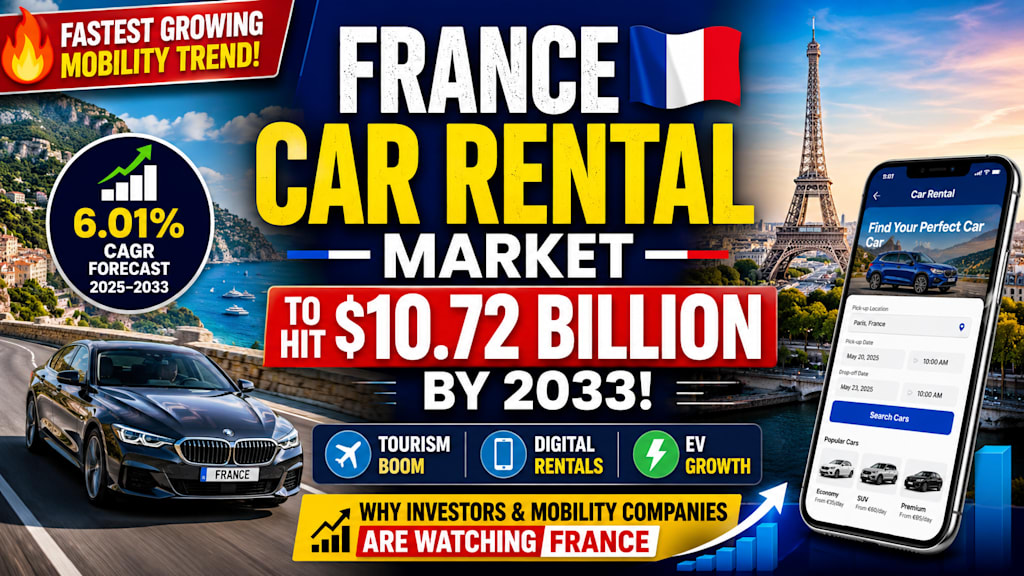
France’s car rental industry is entering a new phase of expansion as changing consumer preferences, rising tourism activity, and digital mobility solutions reshape transportation across the country. Once viewed primarily as a service for tourists and business travelers, car rentals have evolved into a flexible mobility solution for residents, occasional drivers, and environmentally conscious consumers.
According to Renub Research, the France Car Rental Market is projected to grow from US$ 6.34 billion in 2024 to US$ 10.72 billion by 2033, registering a CAGR of 6.01% during 2025–2033. The growth reflects broader shifts in travel behavior, urban mobility trends, and increasing demand for convenient transportation alternatives.
As France continues to welcome record numbers of visitors and embrace digital transformation, the car rental industry is positioned to benefit from both domestic and international demand.
Tourism Remains the Foundation of Market Growth
France consistently ranks among the world’s most visited countries, attracting millions of tourists every year. The country's cultural heritage, gastronomy, historical landmarks, picturesque villages, and scenic coastlines create continuous demand for transportation services.
Tourists increasingly prefer rental cars because they provide flexibility that public transportation cannot always offer. While France boasts one of Europe’s most advanced rail networks, travelers often seek greater freedom when exploring destinations beyond major urban centers.
Regions such as Provence, Normandy, Brittany, the Loire Valley, Bordeaux, and the French Riviera remain popular among travelers who prefer self-guided experiences. Rental vehicles allow visitors to move at their own pace, discover hidden attractions, and access rural locations that may not be easily reachable by train or bus.
The French government reported that tourism activity reached unprecedented levels in 2024, with more than 100 million foreign visitors expected. This surge in international arrivals has created substantial opportunities for rental operators throughout airports, railway stations, and city centers.
As tourism continues to recover and expand, rental companies are expected to benefit from sustained demand across both leisure and business travel segments.
Digital Platforms Are Revolutionizing the Customer Experience
One of the most significant developments shaping the France car rental market is the rapid adoption of digital technologies.
Consumers today expect seamless booking experiences, transparent pricing, instant confirmations, and mobile accessibility. Rental providers have responded by investing heavily in online reservation systems, mobile applications, and automated fleet management solutions.
Modern customers can now search, compare, reserve, modify, and even unlock vehicles directly through smartphone applications. These innovations have simplified the rental process and significantly improved customer satisfaction.
The emergence of integrated mobility platforms is further accelerating market growth. In October 2024, Free2move expanded its mobility ecosystem by introducing an advanced application that combines traditional car rental services with car-sharing capabilities, providing access to hundreds of thousands of vehicles globally.
Such developments are changing consumer expectations and encouraging wider adoption of rental services among both residents and tourists.
Flexible Mobility Is Becoming More Attractive Than Ownership
Urban lifestyles are changing rapidly across France. Rising vehicle ownership costs, parking challenges, fuel expenses, and environmental regulations have prompted many consumers to reconsider the need for permanent vehicle ownership.
Instead of purchasing a car, many individuals now prefer mobility solutions that provide access only when needed.
Car rental services perfectly align with this trend. Consumers can rent vehicles for a few hours, several days, or extended periods without the financial responsibilities associated with ownership.
This shift is particularly visible among younger generations living in major cities such as Paris, Lyon, Marseille, and Toulouse. Many urban residents rely on public transportation for daily commuting and choose rental vehicles only for special occasions, weekend trips, or family vacations.
The growing popularity of flexible transportation models is expected to remain one of the industry's strongest growth drivers throughout the forecast period.
Sustainability Is Influencing Rental Preferences
Environmental awareness is becoming a major factor influencing vehicle rental decisions across France.
The country has implemented various policies aimed at reducing emissions and promoting cleaner transportation solutions. As a result, consumers increasingly seek environmentally friendly vehicles when renting cars.
Hybrid and electric vehicles are gaining popularity among both domestic and international travelers. Many rental providers are actively expanding their low-emission fleets to meet changing customer expectations and regulatory requirements.
Interest in sustainable mobility became particularly evident in early 2024 when France's social leasing initiative for electric vehicles received overwhelming public interest. Applications far exceeded government expectations, demonstrating growing consumer enthusiasm for cleaner transportation alternatives.
Rental companies that successfully integrate hybrid and electric vehicles into their fleets are expected to gain a competitive advantage in the coming years.
Intense Competition Creates Market Challenges
Despite strong growth prospects, the French car rental market remains highly competitive.
International giants compete aggressively alongside domestic providers, creating significant pricing pressure across the industry. Customers often compare multiple providers before making reservations, making price one of the most important purchasing factors.
This environment forces operators to offer frequent discounts, promotional packages, loyalty programs, and value-added services to attract and retain customers.
While competitive pricing helps consumers, it can create challenges for profitability. Rental companies must continuously balance customer expectations with operational sustainability.
As digital platforms increase transparency and comparison shopping becomes easier, maintaining healthy profit margins will remain an ongoing challenge for industry participants.
Rising Operational Costs Continue to Impact Providers
Fleet management remains one of the largest expenses within the car rental industry.
Companies must invest heavily in vehicle acquisition, maintenance, insurance coverage, repairs, fleet upgrades, and technology infrastructure. In addition, environmental regulations are encouraging operators to replace traditional vehicles with hybrid and electric alternatives, requiring substantial capital investment.
France’s increasingly strict emission standards are accelerating this transition.
While sustainability initiatives create long-term opportunities, they also increase short-term financial pressures on rental companies. Businesses that effectively manage fleet efficiency and operational costs will be better positioned to succeed in the evolving marketplace.
Short-Term Rentals Continue to Dominate
Short-term rentals remain the largest segment within the French car rental industry.
Tourists, business travelers, and occasional users frequently rent vehicles for periods ranging from a few hours to several weeks. Airport locations, railway stations, and city centers serve as major demand hubs for these rentals.
Seasonal tourism further strengthens this segment, particularly during summer vacations, holidays, and major cultural events.
The convenience of app-based reservations and contactless rental processes has also encouraged more consumers to choose short-term rental solutions instead of relying solely on public transportation.
As travel activity continues to increase, short-term rentals are expected to remain the market’s primary revenue contributor.
Online Booking Channels Lead Market Expansion
Digital booking channels have become the preferred method for vehicle reservations throughout France.
Consumers appreciate the ability to compare prices, view vehicle availability, read reviews, and secure reservations within minutes. Online platforms also provide greater transparency regarding rental conditions, insurance options, and additional fees.
International tourists especially benefit from online booking systems, allowing them to arrange transportation before arriving in France.
The integration of loyalty programs, personalized offers, and real-time customer support has further strengthened online adoption.
As smartphone penetration continues to increase, online bookings are expected to account for an even larger share of future market revenues.
Tourism Rentals Generate Significant Revenue
Leisure and tourism applications represent one of the most important sources of rental demand in France.
Visitors frequently rent vehicles to explore regions beyond major metropolitan areas. Scenic routes, wine tourism destinations, coastal resorts, and rural attractions continue to attract travelers seeking independent experiences.
Popular destinations such as Provence, the French Riviera, Normandy, and Bordeaux generate particularly strong rental demand during peak tourism seasons.
The growing popularity of experiential travel is expected to further strengthen this segment over the coming decade.
Budget Vehicles Continue to Attract Price-Conscious Customers
Budget and economy vehicles remain highly popular among travelers seeking affordable transportation solutions.
Compact vehicles are especially attractive in urban environments due to lower fuel consumption and easier parking. Students, young professionals, domestic travelers, and budget-conscious tourists frequently select economy models when renting vehicles.
As inflation and economic uncertainty influence spending behavior, demand for affordable rental options is expected to remain strong.
Rental companies are therefore maintaining significant investments in economy-class fleets to meet evolving consumer preferences.
Airport Rentals Remain Critical Distribution Channels
Airport rental locations continue to play a central role in the French market.
Major transportation hubs such as Charles de Gaulle Airport, Orly Airport, Nice Côte d’Azur Airport, Lyon-Saint Exupéry Airport, and Marseille Provence Airport generate substantial rental activity throughout the year.
Travelers often reserve vehicles before arrival, ensuring immediate transportation upon landing.
Both leisure and business travelers contribute to demand, making airport locations among the most profitable distribution channels for rental providers.
As international air travel continues to expand, airport-based rental operations are expected to remain key revenue generators.
Regional Spotlight: Paris Leads the Market
Paris remains the largest and most influential car rental market in France.
The city attracts millions of tourists, corporate travelers, conference attendees, and international visitors annually. Multiple airports, extensive business activity, and global events contribute to strong rental demand.
Environmental regulations encouraging low-emission transportation are also accelerating adoption of hybrid and electric rental vehicles within the capital.
Beyond Paris, regions such as Occitanie and Nouvelle-Aquitaine continue to demonstrate significant growth potential due to expanding tourism industries, cultural attractions, and increasing visitor numbers.
These regions benefit from strong connections to airports, rail networks, and major tourist destinations, creating favorable conditions for rental market expansion.
10 Recent Developments Among Leading France Car Rental Companies
1. Europcar Mobility Group
Expanded electric and hybrid vehicle offerings across multiple French cities to support sustainability initiatives and low-emission zones.
2. Free2move
Launched an integrated mobility platform in 2024 that combines rental and car-sharing services within a single application.
3. Sixt SE
Enhanced premium fleet offerings and digital customer experiences across key French airports and metropolitan locations.
4. The Hertz Corporation
Accelerated investments in electric vehicle rentals and charging infrastructure partnerships across Europe.
5. Avis Budget Group Inc.
Expanded digital self-service technologies and contactless rental processes to improve customer convenience.
6. Enterprise Holdings Inc.
Strengthened airport rental operations and expanded fleet availability in major European travel destinations.
7. Getaround France
Continued expanding peer-to-peer vehicle sharing capabilities to complement traditional rental services.
8. Ada SA
Increased focus on neighborhood-based rental locations, improving accessibility for local consumers.
9. Ubeeqo
Enhanced corporate mobility solutions and fleet-sharing services for business clients throughout France.
10. Keddy by Europcar
Expanded budget-focused rental offerings to attract value-conscious domestic and international travelers.
Competitive Landscape
The French car rental market includes a mix of global industry leaders and domestic operators competing across various customer segments.
Major companies continue investing in digital transformation, electric vehicle fleets, operational efficiency, and customer experience enhancements to strengthen their market positions.
Key market participants include:
Avis Budget Group Inc.
Enterprise Holdings Inc.
Europcar Mobility Group
The Hertz Corporation
Sixt SE
Ada SA
Rent A Car (France)
Ubeeqo
Keddy by Europcar
Getaround France
Competition is expected to intensify as emerging mobility technologies and evolving consumer expectations reshape the industry.
Final Thoughts
The France car rental market is undergoing a remarkable transformation driven by tourism growth, digital innovation, sustainability initiatives, and changing mobility preferences. As consumers increasingly prioritize convenience, flexibility, and environmentally responsible transportation, rental providers are adapting their business models to meet new expectations.
With the market forecast to grow from US$ 6.34 billion in 2024 to US$ 10.72 billion by 2033, the sector presents substantial opportunities for established operators and emerging mobility providers alike. Companies that embrace digital platforms, expand eco-friendly fleets, and deliver seamless customer experiences will be best positioned to capitalize on France’s evolving transportation landscape.
About the Creator
Enjoyed the story? Support the Creator.
Subscribe for free to receive all their stories in your feed.
Comments
There are no comments for this story
Be the first to respond and start the conversation.